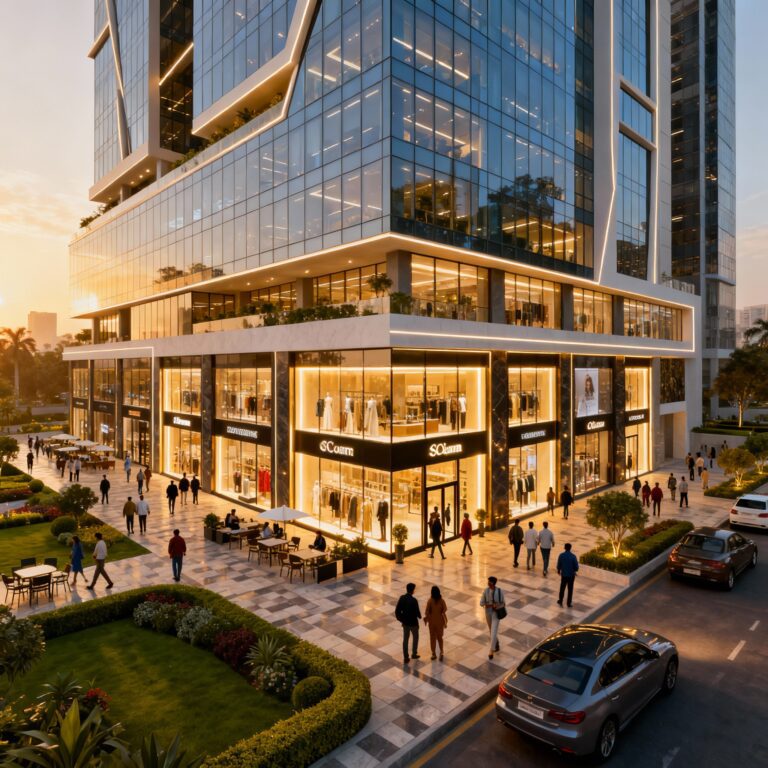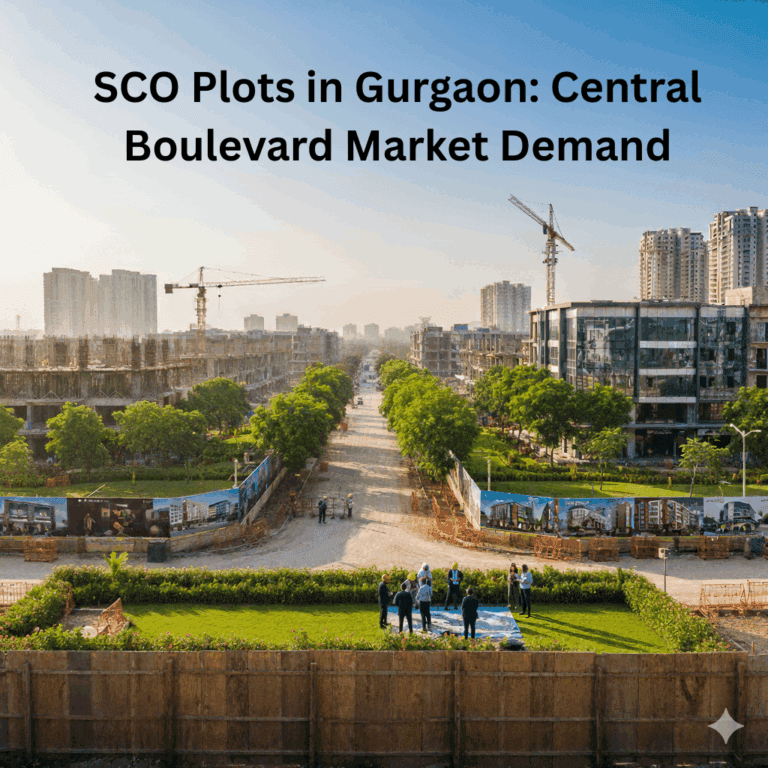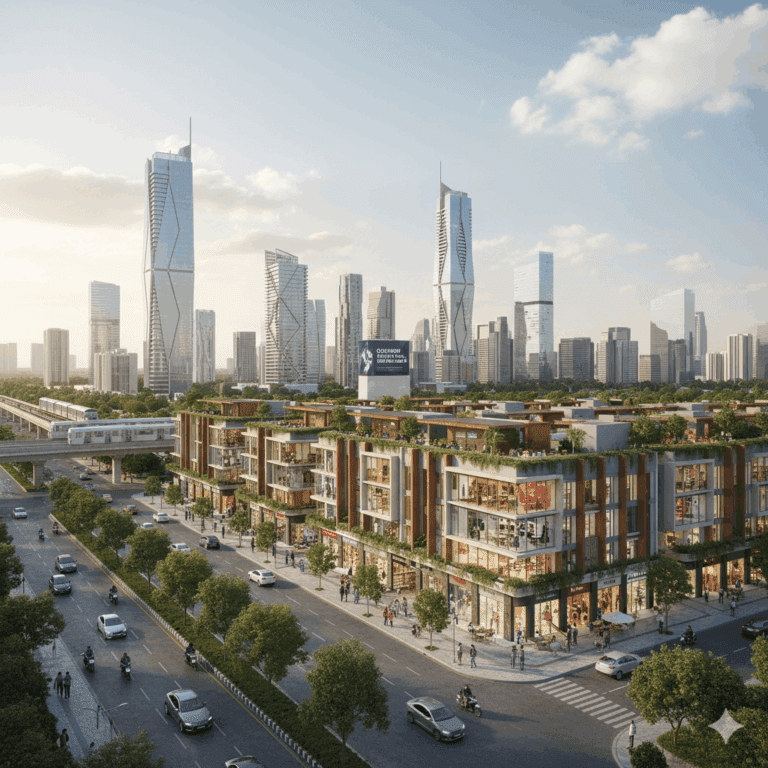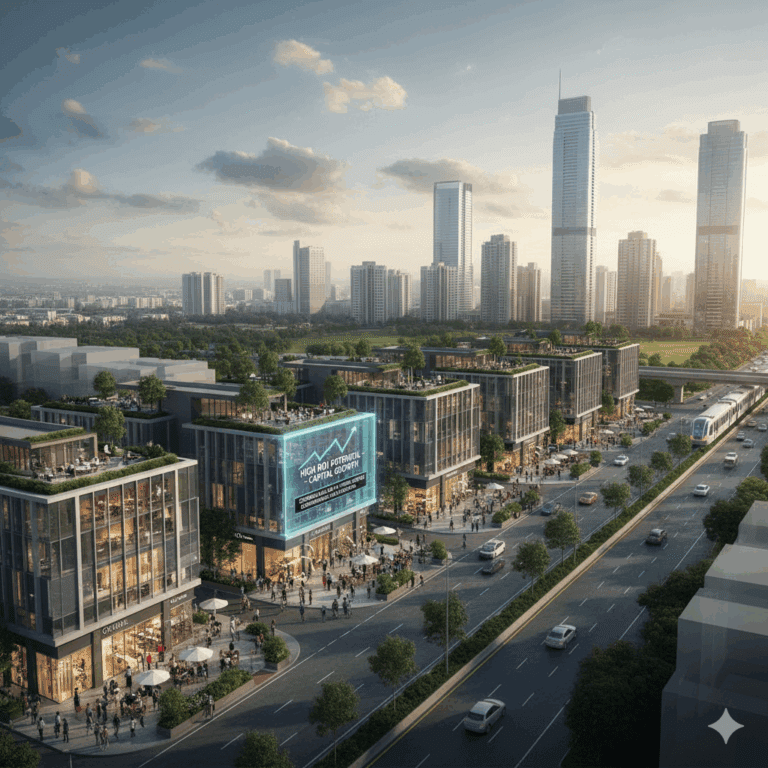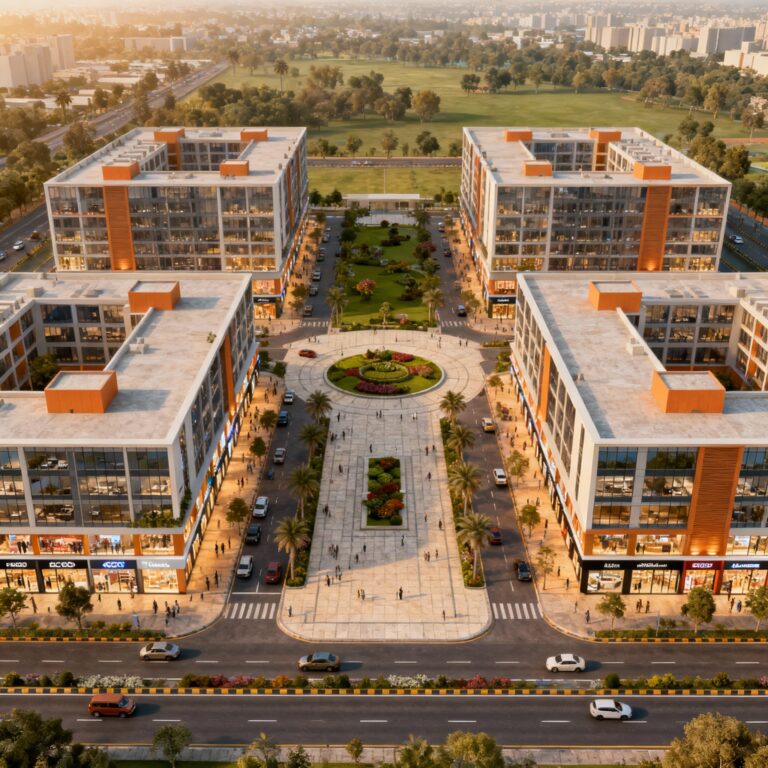
Capital One Global Sector 73 Gurgaon is emerging as a notable commercial property destination for buyers looking at SCO plots, shop-cum-office opportunities and commercial investment in the southern Gurgaon growth belt. Positioned on the Southern Peripheral Road (SPR), the project is planned as a large-format commercial development with 84 SCO plots spread across approximately 7.4 acres, along with water bodies, sit-out areas, retail spaces and supporting infrastructure. The project is registered under Haryana RERA with registration number GGM/686/418/2023/30.

For a buyer, however, the attraction is not simply the project name or its Sector 73 address. The real question is how the Capital One Global location, plot configuration, development potential, access roads, surrounding catchment and overall commercial environment work together. With plot sizes ranging from approximately 101 to 255 square yards and published prices starting from around ₹6 crore, this is a premium-ticket commercial property and therefore deserves a closer look before making a booking decision.

Capital One Global Sector 73 Gurgaon at a Glance

Capital One Global is positioned as a commercial development based around the SCO, or Shop-Cum-Office, concept. The project information describes it as a Sociozone, combining retail and office activity with open spaces, water bodies and lifestyle-oriented areas. The development covers approximately 7.4 acres and includes 84 exclusive SCO plots. The project page also highlights around 1.145 acres of water bodies and sit-out areas, giving the development a different character from a conventional row of commercial plots.

The available configurations are designed for different types of commercial users. Published project information lists five broad plot categories: 101 square yards, 126 square yards, 208 square yards, 225 square yards and 255 square yards. A separate property listing also confirms the same five size categories and identifies the development as an SCO plot project in Sector 73, Gurgaon.

Particular Capital One Global Details
Project Name Capital One Global
Location Sector 73, Gurgaon
Main Corridor Southern Peripheral Road (SPR)
Property Type Commercial SCO Plots
Development Area Approximately 7.4 Acres
Number of Plots 84
Plot Sizes 101, 126, 208, 225 & 255 Sq. Yd.
Starting Price Around ₹6 Crore*
RERA Registration GGM/686/418/2023/30
Water Bodies & Sit-outs Approximately 1.145 Acres
Development Format SCO / Shop-Cum-Office
Road Access 90 m, 60 m and 24 m roads
Development Potential Project information states Ground + 4 upper floors; buyers should verify the sanctioned plan
Ownership Project information describes the plots as freehold

Prices, availability, charges and development conditions should be verified against the latest official documents before booking.

Capital One Global Location: Why Sector 73 Matters

The Capital One Global location is one of the strongest parts of the project proposition. Sector 73 is situated along the Southern Peripheral Road, an important east-west road corridor through Gurgaon. The project page highlights access from 90-metre, 60-metre and 24-metre roads, along with six entry and exit points. For commercial property, multiple approaches can be particularly useful because customers, employees, delivery vehicles and service providers do not have to rely on a single access route.

The wider Sector 73 market also benefits from its position within the southern Gurgaon urban expansion zone. Nearby residential sectors and established commercial developments create the potential for a mixed customer base rather than dependence on one type of user. Project information specifically mentions residential catchments around sectors 71, 72, 74, 75 and 76, along with commercial developments in the surrounding area.

The project’s location information also lists connections and distances to several important destinations. The project page cites approximately 23.8 km to IGI Airport, 16.2 km to Rapid Metro, 22.4 km to Venkateshwar Hospital and 27.5 km to NH-8, although actual travel distance and time can vary depending on the route and current road conditions.

For buyers researching Capital One Global Sector 73 Gurgaon location, the important takeaway is that this is not an isolated commercial pocket. Its value proposition is tied to the larger SPR corridor, surrounding residential development and the continuing expansion of commercial activity in southern Gurgaon.

Capital One Global Price: What Buyers Need to Know

Capital One Global price is one of the most searched aspects of the project, particularly because the development falls into the premium SCO category.

The project information currently available on SCO Space lists the starting price at approximately ₹6 crore onwards. It also gives indicative configuration-level prices of approximately ₹6 crore for a 101-square-yard plot, ₹7.50 crore for 126 square yards, ₹12 crore for 208 square yards, ₹13 crore for 225 square yards and ₹15 crore for 255 square yards. At the same time, the same project page references a saleable-area price range of approximately ₹6 crore to ₹13.07 crore, while other property portals list the project in a ₹6 crore to ₹13.07 crore range.

Because these figures are not completely identical across published sources, buyers should not treat every online price as a final transaction price. Plot location, frontage, floor potential, applicable charges, taxes, PLC or other premiums, payment schedule and current inventory can influence the actual acquisition cost.

A practical buyer should request a current price sheet showing:

This is particularly important for a commercial property where the initial purchase price represents only one part of the total capital requirement.

Capital One Global Plot Sizes and Configurations

The project offers five principal plot configurations. This is useful because the right plot size depends heavily on whether the buyer wants to operate a business personally, construct an office, develop retail space, lease the property or build a combination of uses subject to approvals.

101 Square Yard SCO Plots

The 101-square-yard configuration is the smallest published option and is therefore the entry point into the project’s plot range. The project page lists 20 plots in this category. This size may be considered by buyers looking for a relatively compact commercial footprint, subject to the permitted use and sanctioned building plan.

126 Square Yard SCO Plots

The 126-square-yard category represents another practical size for businesses that need more space than the entry-level configuration. The project information lists 38 plots in this category, making it the largest configuration by number of plots.

208 Square Yard SCO Plots

The 208-square-yard option provides a considerably larger footprint and may suit buyers considering larger retail, office or mixed commercial operations. The published project information lists 13 plots in this category.

225 Square Yard SCO Plots

The 225-square-yard configuration is another larger-format option, with seven plots listed in the project information. Larger plots can provide greater planning flexibility, but the final usable built-up configuration should always be assessed against the sanctioned building plan and applicable development regulations.

255 Square Yard SCO Plots

The 255-square-yard configuration is the largest of the five published plot sizes. Six plots are listed in this category. Such larger plots may appeal to businesses requiring a broader frontage or greater internal floor area, but they also involve a substantially higher initial investment.

Capital One Global Floor Plan

The Capital One Global floor plan is particularly important because an SCO plot is different from a conventional ready-to-use commercial unit. The buyer is acquiring a plot with development potential rather than simply purchasing a finished shop with a fixed internal layout.

The project page states a development format of Ground + 4 upper floors. Its amenities section separately refers to a B + G + 4 + terrace format. Because these descriptions differ slightly, prospective buyers should obtain the latest sanctioned building plan and confirm whether basement construction, floor count, terrace rights and other development parameters apply to the specific plot being considered.

The broader idea behind the floor plan is flexibility. Ground-level space can be planned for customer-facing activity, while upper floors can potentially be used for offices or other permissible commercial functions. The exact permitted use, floor area, setbacks, parking requirements and construction specifications should be confirmed through the approved project documentation rather than assumed from marketing material.

For a business owner, this can make the Capital One Global floor plan more interesting than a fixed-format commercial unit. A company could potentially create a showroom below and offices above, while a professional service business could use multiple floors as an integrated workplace. Retail, food and beverage, healthcare, education and service-oriented businesses may also evaluate the format depending on approvals and project rules.

Capital One Global Master Plan

The Capital One Global master plan is built around more than just a collection of commercial plots. The project information highlights a planned combination of SCO plots, roads, open areas, water bodies and sit-out spaces.

Approximately 1.145 acres of the development is identified for water bodies and sit-out areas. The master-plan concept therefore attempts to create an environment where visitors can spend time rather than simply arrive, transact and leave. This distinction can matter for restaurants, cafés, lifestyle businesses and other customer-experience-led commercial formats.

Road access is another important part of the master plan. The project page identifies access from three road widths—90 metres, 60 metres and 24 metres—and highlights six entry and exit points. The combination is intended to distribute movement around the development and improve accessibility.

The master plan also incorporates landscaped areas, promenades, parking and common facilities. These elements are relevant to the commercial performance of a development because the surrounding environment can influence customer movement, visibility and the overall perception of a business address.

A buyer should nevertheless inspect the actual approved master plan before choosing a plot. Marketing images can provide an overview, but the sanctioned plan is the document that matters when assessing plot position, road frontage, neighbouring plots, common areas, access, parking and development boundaries.

Capital One Global Amenities

Commercial buyers increasingly look beyond the plot itself. A development has to provide an environment where customers are comfortable and businesses can operate efficiently.

The project information lists several amenities and infrastructure features, including landscaped open-air boulevards and promenades, parking, security arrangements, common-area power backup, water bodies and sit-out spaces. It also highlights high-speed connectivity infrastructure and common-area facilities.

The waterfront component is particularly prominent in the project’s positioning. The approximately 1.145-acre water-body and sit-out area is intended to contribute to the overall retail environment. Such spaces can be especially relevant to cafés, restaurants, food outlets and lifestyle-oriented businesses where the surrounding setting can become part of the customer experience.

Other listed features include:

The availability and operational status of individual facilities should be checked during the site visit rather than assumed solely from promotional material.

Capital One Global RERA Details

The project carries Haryana RERA registration number GGM/686/418/2023/30. This registration number is also independently reflected in property databases for the project.

RERA registration is an important starting point for due diligence, but it should not be the only check a buyer performs. Before signing an agreement, a buyer should review the RERA registration details, approved plans, developer documentation, title-related information, payment terms, construction obligations and applicable possession provisions.

For a commercial property purchase running into several crores, legal due diligence is not an optional step. Buyers should have the documentation reviewed by a qualified property lawyer and should compare the documents received from the seller with the relevant regulatory records.

Capital One Global Booking Amount and Payment Plan

The project information lists a ₹10 lakh booking amount and describes payment structures including a 10% booking/agreement arrangement and a 30:40:30 distributed payment plan. Another published listing also identifies ₹10 lakh as the booking amount for the different plot categories.

Because payment plans can change according to inventory and commercial negotiations, buyers should obtain the current payment schedule in writing.

A buyer should specifically ask whether the quoted booking amount is:

  1. Fully adjustable against the purchase price.
  2. Refundable under specified circumstances.
  3. Subject to a separate application form.
  4. Followed by an agreement deadline.
  5. Linked to a particular plot number.
  6. Inclusive or exclusive of applicable charges.

The Capital One Global payment plan should also be evaluated against the buyer’s cash-flow position. A construction-linked schedule may look manageable initially but can require significant capital at different stages. For an investor using financing, interest costs must be included in the overall investment calculation.

How to Book Capital One Global

Anyone planning to book Capital One Global should avoid making the decision solely from an advertisement or phone conversation.

A sensible booking process begins with selecting the required plot size and identifying the exact plot number. The buyer should then request the latest price sheet, payment plan, project brochure, sanctioned plan, master plan, RERA documentation and terms and conditions.

Before paying a booking amount, confirm:

A physical Capital One Global site visit is equally important. Online floor plans and master-plan images cannot replace seeing the site, access roads, surrounding development and actual approach routes.

Why the SPR Location Is Important for Commercial Property

The Southern Peripheral Road is one of the key reasons buyers consider commercial property in this part of Gurgaon. For businesses, road connectivity can directly influence visibility, employee convenience, logistics and customer access.

Capital One Global is described as having access from three road sides, including 90-metre, 60-metre and 24-metre roads. The project also identifies six entry and exit points.

This road network is particularly relevant for a commercial project with multiple businesses operating simultaneously. A restaurant, showroom, office or clinic does not function in isolation. Customers need straightforward access, parking needs to be practical, and deliveries need to move efficiently.

The surrounding catchment is another consideration. Project information references nearby residential communities and commercial developments, including areas around Sectors 71, 72, 74, 75 and 76. It also mentions commercial developments such as Tata Intellion, DLF Corporate Greens, American Express Complex and Plazo Tower.

For a business looking at commercial property in Gurgaon, this combination of residential and employment catchments is worth studying carefully.

Who Should Consider Capital One Global SCO Plots?

Capital One Global may appeal to several types of commercial buyers, but the suitability depends on the buyer’s business model and budget.

A retail entrepreneur may look at the project for a showroom or branded outlet. A restaurant operator may focus on plots with stronger visibility and proximity to landscaped or waterfront areas. A professional-services firm may value the ability to create office space across multiple floors.

Potential commercial categories can include:

The important point is that the buyer should confirm the permitted use before committing to a particular business concept.

Capital One Global for Investment

The investment case for an SCO plot should be assessed differently from that of a residential apartment.

An investor should consider four broad factors: acquisition cost, development cost, rental potential and exit liquidity.

The first is straightforward. A plot priced from around ₹6 crore represents a substantial capital commitment. The second can be just as important because the buyer may need additional funds to construct and fit out the property.

Rental potential depends on the completed building, floor configuration, location within the development, frontage, tenant profile and prevailing market conditions. It should not be assumed that a published rental estimate will automatically materialise.

Exit value is similarly dependent on market conditions. Commercial property can offer significant upside in a strong market, but it can also take longer to sell than a smaller residential asset because the buyer pool is narrower and transaction values are higher.

For this reason, Capital One Global investment should be viewed as a medium- to long-term commercial strategy rather than a guaranteed short-term return.

Capital One Global Rental Potential

A number of online sources publish projected rental yields and rental rates for the project, but these should be treated as estimates rather than assured returns.

The actual rent achievable after construction will depend on:

A buyer considering the property for rental income should conduct a comparable-rent survey in Sector 73 and nearby commercial corridors before calculating expected yield.

The correct calculation should use net rental income, not headline rent. Maintenance, property management, vacancy periods, taxes, financing costs and other expenses can materially affect the final yield.

Capital One Global Investment Risks

No commercial property should be presented as a guaranteed investment.

The major risks to consider include the high entry price, construction and fit-out costs, market cycles, tenant demand, competition from other commercial developments, financing costs and the time required to establish a mature retail environment.

There is also a difference between a project being attractive on paper and the completed development achieving sustained footfall. A commercial destination needs businesses, customers, parking, accessibility and a functioning tenant ecosystem to create long-term commercial momentum.

Therefore, the question is not simply whether Capital One Global Sector 73 Gurgaon is a good project. The more useful question is whether the particular plot, purchase price and intended business model make sense for the individual buyer.

Capital One Global vs Conventional Commercial Units

An SCO plot provides a different ownership proposition from a conventional retail unit or office space.

With a ready commercial unit, the buyer usually receives a defined floor area and predetermined layout. With an SCO plot, the development potential can offer greater control over how the building is configured, subject to sanctioned plans and applicable regulations.

That flexibility can be useful for entrepreneurs who want their property to reflect a specific business model.

For example, a brand could potentially plan a customer-facing retail floor at the ground level and use upper floors for offices or related operations. A restaurant operator could design the property around dining and service requirements. A professional company could create a multi-floor workplace.

The trade-off is that the buyer takes on greater responsibility for development, construction, financing and execution.

Capital One Global Master Plan and Floor Plan: What Buyers Should Inspect

When visiting the project, buyers should not only look at the model or marketing images. They should inspect the actual location of the selected plot within the Capital One Global master plan.

Pay attention to:

Road frontage: A plot facing a wider road may have different visibility characteristics from an internal plot.

Corner position: Corner plots can offer multiple visible elevations but may also carry a premium.

Waterfront proximity: A plot close to the water-body area may have a different commercial appeal, depending on the business.

Parking: The practical relationship between the plot and parking areas matters for retail and food businesses.

Entry and exit: The location of the nearest access point can influence convenience.

Neighbouring plots: The nature of adjacent businesses can affect the overall commercial ecosystem.

Floor potential: Confirm the exact sanctioned development rights for the selected plot.

Frontage: Plot width can be as important as total area for a showroom or customer-facing business.

These details can make one plot materially more attractive than another even when the nominal plot size is identical.

Capital One Global Sector 73 Gurgaon: Is It Worth Considering?

Capital One Global has several characteristics that make it relevant to the Gurgaon commercial-property market: a Sector 73 address, SPR positioning, multiple SCO plot sizes, a planned waterfront component, multiple road accesses and a commercial development format designed around retail and office use.

Its starting price, however, means this is not a low-budget commercial investment. Buyers need substantial capital and should calculate the full cost of acquisition and development rather than focusing only on the advertised entry price.

The project’s strongest potential lies in its combination of location and development format. The SCO model gives business owners an opportunity to create a commercial property around their specific requirements, while the planned common environment aims to create a destination rather than a simple roadside strip.

For an investor, the calculation is more demanding. Appreciation cannot be guaranteed, rental income depends on future market conditions, and development costs need to be accounted for. The right plot at the right price can have a very different investment profile from a less suitable plot purchased at a premium.

Capital One Global Sector 73 Gurgaon: A New Commercial Destination on SPR is a strong search topic because the project brings together several factors that commercial-property buyers actively look for: SCO plots, a prominent Gurgaon corridor, flexible plot sizes, retail and office potential, planned common amenities and a distinctive waterfront component.

The project spans approximately 7.4 acres and includes 84 SCO plots across five published size categories from 101 to 255 square yards. The advertised entry point is around ₹6 crore, while project information provides different indicative figures depending on configuration and source.

Its Capital One Global location in Sector 73 along SPR is central to the proposition, while the Capital One Global floor plan and development format provide the potential for multi-level commercial use, subject to sanctioned plans and approvals. The Capital One Global master plan further differentiates the project through water bodies, sit-outs, landscaped spaces, road access and a broader commercial environment.

For someone searching for Capital One Global price, Capital One Global location, Capital One Global floor plan, Capital One Global master plan, Capital One Global SCO plots, Capital One Global booking, Capital One Global amenities, Capital One Global payment plan, Capital One Global RERA, Capital One Global Sector 73 Gurgaon and related commercial-property terms, the project offers plenty to evaluate.

The sensible next step is not to book immediately. First, shortlist the required plot size, inspect the master plan, compare the exact plot location, obtain the latest price sheet, understand every additional charge and verify the sanctioned development rights. Then compare the total investment with realistic business or rental objectives.

For a buyer who wants a premium commercial plot in a strategically positioned Gurgaon corridor and has the capital required for both acquisition and development, Capital One Global deserves a detailed evaluation. For everyone else, the project should be compared carefully against other SCO plots and commercial developments in Gurgaon before making a final decision.

Book only after verifying the latest inventory, price, payment plan, RERA documents, sanctioned plans and legal paperwork.

Microtek Grandfront is a licensed Shop-cum-Office street on 2.1 acres in planned Sector 81, Gurgaon. Thirty plots. Three blocks. That is the entire inventory. Microtek Infrastructures markets the scheme; the licence sits with Action Constructwell Pvt. Ltd. (CIN U45400DL2008PTC183591). Corporate desk: Unit 110-112, Tower-C, Yatra First India Place, MG Road, Gurugram.

An investor who types SCO plots in Gurgaon is usually trying to escape two traps. The first is a mall shop — high CAM, no land, a fascia that the landlord can re-trade. The second is a bare commercial land in Gurgaon parcel with no control sheet and a two-year wait for drawings. Microtek Grandfront Gurgaon sits between those poles. It is commercial land for sale Gurgaon with a DTCP architectural control sheet already in place, so the buyer knows the height before the cheque is written.

The product is shop cum office Gurgaon in the Haryana sense: basement, ground retail, four office floors, terrace rights. That is why the same 99-square-yard module can hold a boutique, a clinic, and a terrace café without a second purchase. Investors who want shop cum office plots Gurgaon are buying that stack, not a single lockable cabin.

Scarcity is structural — thirty plots will not be recut

Most commercial property Gurgaon launches sell density. This one sells the opposite. Thirty SCO plots Sector 81 on 2.10 acres (about 8,509 sq. m) means the street cannot be diluted by a phase two of eighty more units. When a later buyer wants the same address, they buy from you, not from a fresh inventory dump. That is the first reason hold-period investors are here.

The second is title. These are freehold commercial plots Gurgaon. The buyer is not a lessee of HUDA or HSVP land writing an annual ground rent. Transfer to an heir or a later purchaser does not wait on a lessor’s NOC. That is why freehold SCO plots Gurgaon clear at a premium on resale and why banks prefer them when a commercial loan is even discussed. A leased shop can be a good trade. It is a weaker estate.

HARERA lists the scheme as a RERA approved commercial property under registration GGM/683/415/2023/27 dated 30 January 2023 (unique ID RERA-GRG-PROJ-1280-2023; also cited as RC/REP/HARERA/GGM/683/415/2023/27). DTCP Licence 156 of 2022 was issued on 29 September 2022 and runs till 28 September 2027. Scheduled completion on the registration is November 2025. Read the live form on the Haryana RERA portal before you treat any brochure date as gospel. The point for an investor is simpler: the paper exists, the licence is live, and the promoter is on the public register.

The ticket still opens where a first commercial cheque can reach

Current asking for these SCO plots for sale Gurgaon starts at ₹2.70 Crore. The published yardage rate is ₹3.89 Lakh per square yard. Mid and large formats are quoted on request. In a year when many premium SCO plots Gurgaon on Golf Course Extension open well above ₹8–10 Crore, a 99-yard module at this rate is why the phrase affordable SCO plots Gurgaon still attaches to this street without being a leftover odd plot.

A live possession-linked offer quotes 20% now, 80% in 2027, with a complimentary car park on allotment. That cash cycle is doing as much work as the rate. An investor can warehouse the land with a first cheque near ₹54 Lakh on the opening ticket and keep powder for construction or for another deal. Other listed paths — construction-linked, 10:90, 40:60, 30:40:30, 50:50, and a heavier down payment — exist so a retailer, an NRI, and a domestic fund do not have to wear the same tenure.

Type Plot / carpet Indicative price Investor use
Type A 99 sq. yd · 882 sq. ft (86.95 sq. m)
Carpet 864–882 · built-up ~888
From ₹2.70 Crore Boutique, café, clinic, chamber
Type B 111 sq. yd · 999–1,006 sq. ft On request Brand retail, restaurant, gym
Type C 129 sq. yd · 1,161–1,163 sq. ft (108 sq. m) On request Showroom, flagship, larger plate

Range across the pocket: 99–129 square yards, carpet 864–1,161 sq. ft, 30 units. Confirm plot number, facing and PLC on the allotment letter. GST, EDC/IDC and construction sit on top of the land ticket.

For anyone comparing commercial property New Gurgaon against older Golf Course stock, the underwriting is this: you are not buying the cheapest land in the district. You are buying a titled, three-side-open module in a planned sector at a rate that still leaves room for construction and a first tenant. That is a different sentence from “cheap.”

Six levels on one title is the yield argument

Plot sizes on this SCO property Gurgaon street run 99, 111 and 129 square yards. The control sheet on these SCO plots Gurgaon allows Basement + Ground + 4 floors + terrace. Project FAR is 12,747.578 sq. m across the 2.1 acres. Structure is RCC frame. Plans are pre-sanctioned, which cuts the year some owners lose waiting for a fresh drawing set.

Investors do not buy height for the elevation. They buy the right to split rent. Ground takes the retail rate. Mid-floors take clinic, CA, coaching or a small office. Terrace takes evening F&B. Basement takes store and staff parking. A vacant mid-floor does not zero the month the way a single mall shop does. Prime SCO commercial plots in Gurugram have been leasing in the 8–10% annual band when that stack is let separately — well above the 2–4% most residential books still print.

Corners are three-side open. Two edges take 60-metre roads. Combined street face is about 810 feet. A ground fascia here reads from a moving car on a sector road, not from a mall corridor that shuts at 11 p.m. That visibility is why a brand will pay a ground-floor premium on a 99-yard plot they would not pay on a buried shop.

The map: NH-8 in minutes, Dwarka Expressway in five

Microtek Grandfront Sector 81 Gurgaon – Premium SCO Plots Near NH-8 is not a slogan invented for a hoarding. The site sits on a planned 75-metre sector road, a few minutes off NH-8 / NH-48 (about 3 km), roughly five minutes from the Dwarka Expressway (about 4.8 km), fifteen minutes from Hero Honda Chowk, and about thirty minutes from IGI Airport (about 29 km). Pataudi Road is ~4.5 km. Gurgaon railway station is ~15 km. Gurugram, Delhi NCR, Faridabad and Manesar are all on arterial routes, not on a single dead-end lane.

Corridor searches — commercial land Dwarka Expressway, NH-8 commercial, new launch SCO plots Gurgaon — usually dump the buyer on Sectors 113–114 or 84. Sector 81 is the quieter seam between those two noises. It is close enough to both spines to catch commuter and airport traffic, and close enough to occupied housing to catch the evening walk-in that a pure highway plot never sees. That dual catch is the location thesis. It is also why this pocket is discussed next to upcoming SCO plots Gurgaon lists even though the registration already points at a 2025 completion.

Node Approx. time / distance What the investor buys
NH-8 / NH-48 A few minutes · ~3 km Delhi–Jaipur spine, pass-by trade
Dwarka Expressway ~5 min · ~4.8 km 8-lane city-to-airport corridor
Hero Honda Chowk ~15 minutes Junction onto the highway system
Pataudi Road ~4.5 km West Gurgaon and Manesar link
IGI Airport ~30 min · ~29 km Fly-in clients, hotel overflow
Railway station ~15 km Regional rail catch

Forty-five thousand families are the demand, not the highway

Highway frontage without households is a fuel station. About 45,000 families live inside a 5 km ring. The wider Sector 81–86 belt is often counted near 50,000 households. Housing next door includes DLF Ultima, Bestech Ananda, Bestech Park View Spa, Signature Global and Godrej Frontier. That is a daily-need market for a chemist, a salon, a tuition floor and a family restaurant — the tenants who actually pay SCO rent on time.

Social kit around the plot is already built, which is why end-users are as active as pure investors. St. Xavier’s School is two minutes. DPS Sector 84 is eight. RPS International (89) and Amity University (87) are about five. Aarvy / Aarya Healthcare in Sector 90 is three minutes; Medanta is thirty. Vatika Town Square and Sapphire 83 handle the larger retail. PVR and INOX screens sit inside 5 km. Eros Corporate Park is about 3 km. A declared institutional belt of roughly 50 acres and a sports / park / lake reservation face the site. The Aravalli edge keeps the pocket on a green fringe rather than a factory yard.

Investors who buy SCO plots Gurgaon for yield should underwrite this catchment before they underwrite the highway. Pass-by traffic fills Saturday. The 45,000 families fill Tuesday afternoon. Both matter. Only one of them pays the clinic on the second floor.

Common areas that protect rent, not a clubhouse calendar

commercial property for sale Gurgaon pitch often lists amenities as if the buyer were taking a flat. The list at SCO plots Gurgaon streets that actually lease is shorter and more boring — and more valuable. Grandfront’s commons are built for trading hours.

Taken together, the pocket reads as managed commercial space in Gurgaon rather than raw commercial plots in Gurgaon behind a boundary wall. Tenants will pay for that. Owners will notice it in vacancy, not in a club-house brochure.

Three kinds of capital are walking the same 30 plots

Handover is listed around November 2025, which is why brokers already tag parts of the street ready to move commercial property Gurgaon. The SCO property Gurgaon envelope is format-agnostic, so three very different cheques land on the same allotment desk.

The end-user brand. A retailer or a restaurant that is tired of mall CAM and wants a fascia on a 75-metre road. Ground for the shop, first floor for storage or a private dining room, terrace if the format is F&B. This buyer cares about the 810-foot frontage and the three-side-open corners more than about the 20:80 plan.

The yield book. A domestic HNI or a family office that wants land-backed commercial with more than one tenant. They will let ground to retail, mid-floors to a clinic and a CA, and hold the terrace for a later café. They care about freehold, HARERA paper, and the 45,000-family ring. They are the reason shop cum office Gurgaon has become a search phrase and not only a planning term.

The overseas cheque. An NRI who cannot underwrite a four-year construction risk on a tower and does not want a leased shop they cannot easily gift. Freehold SCO, a 20:80 tail into 2027, and a promoter with a delivered residential flagship (Microtek Greenburg, Sector 86) is a cleaner story to send home than a pre-launch atrium.

Trades that fit the envelope without stretching the control sheet: apparel, jewellery, footwear, cosmetics; mobiles and appliances; convenience and specialty retail; family dining, QSR, bakery, coffee, terrace lounge; branch office, studio, co-working, CA / legal / design; clinic, dental, diagnostics, physio; gym, yoga, salon, spa, coaching; bank and insurance desks. Match the module to the trade — 99 yards for a chamber or boutique, 111 for a restaurant or gym, 129 for a showroom — and do not force a flagship onto a Type A just because the rate looks gentle.

Who is on the other side of the allotment letter

Microtek Infrastructures Pvt. Ltd. was formed in 2010 as a joint platform of the Action Group (footwear, steel, power) and the Okaya Power Group. Group literature cites five decades of consumer brands and more than 55 delivered residential and commercial works across Gurugram, Chandigarh, Sonipat and Bahadurgarh. The residential flagship is Microtek Greenburg, Sector 86 — 14.64 acres, 738 apartments, 75% green, occupancy from 2017–18, L&T Myone construction. The next SCO street from the same stable is Microtek Success Hub, Sector 95A.

That record does not make a plot cheap. It makes the completion story easier to underwrite than a first-time licence on a nameless letterhead. Investors who have already lost a year on an unregistered “assured-rent” shop are the ones who now ask for CIN, licence scan and HARERA ID before they ask for the view. Microtek Grandfront Sector 81 Gurgaon has those three documents. That is a low bar. It is also a bar a surprising number of commercial property Gurgaon conversations still fail.

A short filter — walk away if this is not your brief

This street is the wrong buy if you need a 200-yard flagship, a pre-leased national credit tenant on day one, or a Golf Course Road pin code for a visiting board. It is the right buy if the brief is titled SCO plots Gurgaon on a planned sector road, a first cheque that can still start near ₹2.70 Crore, and a hold that can take both highway pass-by and neighbourhood trade.

Ask for the live map — Type A, B or C, facing, PLC — and lock Microtek Grandfront Gurgaon on the plan that matches the cash cycle. Thirty freehold SCO plots Gurgaon will not be recut. The full SCO desk sits at SCO plots for sale Gurgaon; the corridor list is under upcoming SCO plots Gurgaon. Treat the next visit as a reading of the allotment letter and the HARERA form, not as another walk past a sample fascia.

Disclaimer: Rates, possession (November 2025), the 20:80 schedule into 2027, and unit counts are as circulated for marketing. Plot PLC, GST, EDC/IDC, construction cost and the final HARERA timeline must be read on the latest allotment letter and on haryanarera.gov.in before any payment. This brief is for information; it is not an offer to sell.

Buying a commercial plot is a decision that deserves more preparation than simply choosing a preferred size and paying a booking amount. A commercial property has to work from several perspectives at once. It should fit the intended business, offer practical customer access, have an appropriate configuration, remain financially manageable and satisfy the buyer’s legal and technical due-diligence requirements.

For buyers researching Capital One Global Property, the booking process should therefore begin with plot selection rather than payment. The development is presented on the Southern Peripheral Road in Sector 73 Gurgaon and is designed around a Sociozone concept that combines commercial, retail, office and lifestyle components. The project page describes approximately 7.4 acres, a detailed overview of 84 SCO plots, approximately 1.145 acres of water bodies and sit-out areas, and development comprising ground plus four upper floors.

The project source also identifies RERA registration number GGM/686/418/2023/30. Buyers should verify the current registration and project status against the latest official records before committing funds.

A good booking decision begins with a simple principle:

Do not reserve a plot until you understand exactly what you are buying, what it will cost and how you intend to use it.

Step One: Decide Why You Are Buying

The first question for a buyer considering Capital One Global Gurgaon Property should be the purpose of the purchase.

There are three common objectives.

Self-Use

You may intend to operate your own retail outlet, office, restaurant, clinic, consultancy or service business.

In this situation, business suitability should be the priority.

Investment

You may intend to construct and lease the property or hold it for future appreciation.

In this case, tenant demand, location, rental feasibility and exit liquidity become particularly important.

Hybrid Use

You may want to operate your business from part of the property while using other floors for supporting functions or future leasing, subject to permitted usage.

This approach can make an SCO format attractive because the project is designed around multi-level commercial use.

The purpose should be established before comparing plot sizes.

Step Two: Understand the Available Plot Configurations

The detailed project information lists five plot configurations:

Plot Type Approx. Area Number Listed
Type A 101 sq. yd. 20
Type B 126 sq. yd. 38
Type C 208 sq. yd. 13
Type D 225 sq. yd. 7
Type E 255 sq. yd. 6

These figures come from the detailed project section of the reference page.

The source also contains different inventory references elsewhere on the same page, including references to 99 and 108 plots. This inconsistency means buyers should not rely on an old online figure when making a booking decision. The latest approved layout and current inventory statement should take priority.

The plot size should be matched to the intended commercial use.

A 101-square-yard plot may be suitable for a compact business.

A 126-square-yard plot can provide more flexibility.

A 208-square-yard plot may suit a larger retail or office concept.

A 225- or 255-square-yard plot may be more appropriate for businesses requiring a larger footprint.

But size should never be considered independently of location.

Step Three: Compare Plot Position, Not Just Area

When buyers see two plots at different prices, their first instinct is often to compare price per square yard.

That is only the beginning.

The actual comparison should include:

The project source describes access from 90-metre, 60-metre and 24-metre roads and highlights multiple entry and exit points. It also describes open-frontage and two-side-open characteristics.

A buyer should determine how those features apply to the exact plot being offered.

Step Four: Visit the Site Before Booking

A site visit should be treated as part of due diligence, not as a formality.

The buyer should physically inspect the development and selected plot before reserving it.

During the visit, examine the approach from the main road.

Check whether the project is easy to identify.

Look at traffic movement.

Inspect parking.

Walk through the internal areas.

Study the frontage.

Check nearby plots.

Understand where the waterbody and common areas are located.

Look at the likely customer movement.

A site visit can also reveal whether the actual environment matches the project presentation.

Step Five: Analyse the Road Connectivity

The location of Capital One Global Sector 73 SCO is one of the major considerations for buyers.

The project is positioned on Southern Peripheral Road and the reference page highlights access toward Golf Course Extension Road, Dwarka Expressway, Cyber City, NH-8 and other major destinations. It also lists connectivity information to locations such as IGI Airport and Rapid Metro.

For a business owner, the key question is not how many roads are nearby.

It is:

How easily can my customers and employees reach this property?

For an investor, another question matters:

Will this accessibility remain commercially relevant as the surrounding area develops?

These questions encourage a more realistic evaluation.

Step Six: Examine the Customer Catchment

A commercial plot needs customers.

The project page states that more than 55,000 families are located within a five-kilometre radius and identifies premium residential sectors and communities around the development. It also refers to nearby commercial occupiers and business hubs.

This can provide a useful starting point for market research.

However, a buyer should go further.

Determine the actual occupancy of surrounding residential communities.

Identify the age and income profile of residents.

Study existing retail demand.

Find out which businesses are already operating nearby.

Identify gaps in the local market.

This is particularly important when choosing a plot for self-use.

Step Seven: Decide What Type of Business Fits the Location

The project page describes potential uses across retail, food and beverage, professional services, healthcare, wellness, education, hospitality and mixed-use operations, subject to applicable permissions.

A buyer should narrow this down to a specific business concept.

For example:

Retail: frontage and visibility may dominate.

Restaurant: access, parking, visibility, service access and technical permissions may be critical.

Clinic: accessibility, privacy and customer convenience may be more important.

Office: employee access, parking and floor configuration may matter most.

Showroom: frontage, signage and road visibility may carry greater weight.

Once the business category is established, plot selection becomes easier.

Step Eight: Understand the Multi-Level Configuration

The detailed source describes ground plus four upper floors and presents the property as a shop-cum-office format.

This can create several planning possibilities.

A business may use the ground floor for customer interaction.

Upper floors can potentially be used for offices, additional retail, consultation rooms, storage or other approved commercial functions.

An investor can potentially construct a building designed for a particular tenant category.

However, buyers should verify the sanctioned plans, FAR, setbacks, height restrictions, basement provisions and permitted uses before incorporating these assumptions into a financial model.

Marketing descriptions should never replace approved technical documentation.

Step Nine: Review the Current Price Carefully

The reference page lists indicative pricing from approximately ₹6 crore onwards and provides different starting figures for the five detailed plot types. It also mentions an indicative per-square-yard rate of ₹6.50 lakh onwards plus applicable costs.

Because commercial prices can change and different plots can carry different premiums, buyers should request a current, dated quotation.

The buyer should not assume that the headline rate represents the final amount payable.

Ask whether the quotation includes:

A complete cost sheet is essential before booking.

Step Ten: Calculate the Total Investment

A commercial plot is only the first component of the investment.

The complete calculation should be:

Plot Acquisition + Statutory Charges + Construction + Financing + Interior/Fit-Out + Operating Setup = Total Capital Requirement

For an investor, this calculation should then be compared with expected rental income and potential resale value.

For an end-user, it should be compared with the cost of operating from rented premises.

This comparison can reveal whether buying is financially preferable to leasing.

Step Eleven: Examine the Payment Plan

The project reference describes several payment structures, including:

The detailed page also states a ₹10 lakh booking amount for the listed plans. These figures are project-source claims and should be confirmed against the current commercial offer before making payment.

A payment plan should be evaluated according to cash flow rather than convenience.

A low initial payment does not necessarily mean a cheaper purchase.

A deferred payment structure may create a large future obligation.

A construction-linked plan can align payments with milestones, but buyers should understand exactly what constitutes each milestone.

Always obtain the payment schedule in writing.

Step Twelve: Check Financing Requirements

The reference page states that financing support may be available through financial institutions and mentions commercial property loans of up to 70% of property value. Buyers should independently confirm current lender eligibility, loan-to-value ratios, interest rates, processing fees and applicable conditions because these vary by borrower and lender.

Before booking, calculate:

A commercial property should not place excessive pressure on the operating business.

Step Thirteen: Evaluate the Plot as an Investment

For investors examining Capital One Global SCO Plots Sector 73, the key question is whether the property can produce an acceptable risk-adjusted return.

The investor should estimate:

Rental Yield

Expected annual rent divided by total investment.

Capital Appreciation

Potential increase in property value over the holding period.

Vacancy

Expected periods without a tenant.

Maintenance

Recurring property and common-area costs.

Financing

Interest and related borrowing expenses.

Exit Liquidity

How easily the property could be sold if circumstances change.

The project source promotes rental and appreciation potential, but projected market returns should not be treated as guaranteed.

A conservative scenario should always be tested.

Step Fourteen: Compare the Plot Against Alternative Commercial Properties

Before reserving Capital One Global Commercial Property, compare it with competing commercial developments in the surrounding area.

The comparison should include:

This does not mean choosing the cheapest option.

A premium plot can be better value if its commercial characteristics justify the premium.

Conversely, an expensive location can be a poor investment if the price exceeds realistic business or rental potential.

Step Fifteen: Examine the Waterfront and Common Areas

The project reference highlights approximately 1.145 acres of water bodies and sit-out areas and presents the development as a waterfront retail experience.

This can add destination appeal.

But buyers should determine whether the chosen plot actually benefits from these features.

Ask:

Is the plot near the waterbody?

Is there direct visual exposure?

Can customers access the sit-out areas?

Are there restrictions around common areas?

What maintenance costs apply?

Are the facilities operational?

These details can materially affect the practical value of the property.

Step Sixteen: Understand the Sociozone Concept

The project is presented as a Sociozone rather than a conventional isolated commercial complex.

The concept is designed to combine commerce, culture and community within one environment. The project page describes food courts, dining spaces, recreational facilities, a clubhouse, entertainment areas, multi-brand retail, party/event spaces and café zones.

From a business perspective, this integrated environment can potentially encourage customers to spend more time within the destination.

From an investor’s perspective, the tenant mix matters.

A strong combination of complementary businesses can create a better overall commercial ecosystem.

However, this depends on actual tenant occupancy and project execution.

Step Seventeen: Verify Infrastructure and Services

The project page identifies several infrastructure features, including power backup, water supply, fibre connectivity, CCTV surveillance, security personnel and fire-safety systems.

Before booking, ask which facilities are included in common infrastructure and which services may involve additional charges.

Also confirm:

Commercial operations depend heavily on reliable infrastructure.

Step Eighteen: Conduct Legal Due Diligence

Before paying the booking amount, review the relevant documents.

The buyer should verify:

The project source identifies RERA registration GGM/686/418/2023/30. This should be checked through the current official RERA records before purchase.

Legal verification should be performed by a qualified property lawyer where appropriate.

Step Nineteen: Verify the Exact Plot Number

Never book based only on a verbal description such as “corner plot” or “main-road-facing plot.”

Ask for the exact plot number.

Then locate it on the approved layout.

Check:

This is particularly important because plot-level characteristics can influence commercial value significantly.

Step Twenty: Understand the Booking Amount

A booking amount should only be paid after the buyer understands the terms attached to it.

Ask:

Is it refundable?

Under what circumstances?

What documentation accompanies the booking?

When is the agreement signed?

When does the booking become binding?

What happens if financing is not approved?

What happens if the buyer cancels?

What happens if the seller cannot deliver according to the agreement?

The project source refers to a ₹10 lakh refundable booking fee within its payment-plan descriptions, but the exact current booking terms should be confirmed in the latest written offer.

Step Twenty-One: Do Not Choose a Plot Only Because It Is Available

Availability does not automatically mean suitability.

Suppose three plots are available:

The right choice depends on the buyer’s objective.

An investor may favour the plot with stronger leasing characteristics.

A retailer may favour frontage.

An office user may favour access and parking.

A budget-conscious buyer may prefer a smaller configuration.

The booking decision should therefore follow the business strategy, not the other way around.

Step Twenty-Two: Create a Plot Comparison Sheet

Before reserving a Capital One Global 73 SCO Plots option, prepare a simple comparison.

Criteria Plot 1 Plot 2 Plot 3
Area Verify Verify Verify
Price Verify Verify Verify
Frontage Verify Verify Verify
Corner Yes/No Yes/No Yes/No
Open sides Verify Verify Verify
Road access Verify Verify Verify
Visibility High/Medium/Low High/Medium/Low High/Medium/Low
Parking Verify Verify Verify
Waterbody proximity Verify Verify Verify
Business suitability Assess Assess Assess
Total investment Calculate Calculate Calculate
Expected rent Estimate Estimate Estimate

This makes the decision more objective.

Step Twenty-Three: Think About Future Exit

Even if the intention is to hold the property indefinitely, an exit strategy should exist.

Circumstances can change.

The business may relocate.

Capital may be needed elsewhere.

The investor may want to diversify.

A future buyer will examine the same characteristics that you should examine today:

Therefore, buying a commercially usable plot can potentially improve future marketability.

Step Twenty-Four: Understand the Difference Between Project and Plot Value

A strong development does not mean every plot has identical value.

The project creates the overall environment.

The individual plot determines the exact commercial position.

This distinction is critical for Capital One Global SCO Property buyers.

The project may have strong road connectivity, but a particular plot may have weaker visibility.

The project may have a waterfront, but a particular plot may be farther from it.

The project may offer parking, but a particular location may be less convenient for customer access.

Therefore, project-level research should always be followed by plot-level research.

Step Twenty-Five: Complete the Site Visit Before Final Confirmation

The site visit should be the final reality check before booking.

During the visit, verify that the information supplied to you corresponds with what you see.

Check the approach road.

Check the development entrance.

Check the proposed plot.

Check frontage.

Check nearby construction.

Check parking.

Check surrounding residential and commercial development.

Observe traffic.

If possible, visit more than once.

A weekday visit can reveal business traffic.

An evening visit can reveal retail and restaurant movement.

A weekend visit can show residential customer activity.

A Simple Booking Decision Framework

A buyer can use five stages.

Stage 1 — Business Fit

Does the property suit the intended business?

Stage 2 — Location Fit

Can customers and employees reach it conveniently?

Stage 3 — Plot Fit

Does the exact plot provide the necessary frontage, access and size?

Stage 4 — Financial Fit

Can the buyer comfortably manage the total acquisition and construction cost?

Stage 5 — Legal Fit

Have all documents and permissions been verified?

Only when all five stages are satisfactory should the booking proceed.

Who May Benefit From This Commercial Format?

The project’s shop-cum-office configuration may be relevant to a range of users, subject to permitted uses.

Retailers may use the property for customer-facing outlets.

Professional firms may use it for offices and consultations.

Restaurants and cafés may seek destination-oriented locations.

Healthcare operators may require accessible commercial premises.

Education and training businesses may need multi-level space.

Investors may consider leasing opportunities.

The suitability depends on the exact business model and approvals.

Common Booking Mistakes to Avoid

Choosing on Price Alone

The cheapest plot is not necessarily the best commercial investment.

Ignoring Frontage

A poor frontage can affect customer visibility.

Assuming Every Plot Is Identical

Location within the development matters.

Relying on Old Inventory

Availability changes.

Ignoring Total Cost

The plot price is only one component of the investment.

Skipping Legal Verification

Commercial property requires documentation review.

Assuming Returns Are Guaranteed

Rental and appreciation projections are not guarantees.

Booking Before a Site Visit

Online information cannot replace physical inspection.

Final Booking Checklist

Before reserving your Capital One Global Sector 73 Gurgaon plot, confirm:

Keep copies of all documents and written communications.

Capital One Global 73 Gurgaon is positioned as a commercial development designed around SCO plots, a multi-level shop-cum-office format and a Sociozone environment along Southern Peripheral Road in Sector 73. The project reference highlights multiple road accesses, a waterfront-oriented commercial setting, varied plot sizes, parking, infrastructure and lifestyle-oriented common facilities.

For buyers, however, the most important part of the booking process is not the project name.

It is selecting the right plot.

A 101-square-yard plot may be ideal for one business and inadequate for another. A corner plot may justify a premium for a retailer but not necessarily for an office user. A larger plot may create greater development potential while also requiring substantially more capital.

The most effective strategy is therefore to work backwards from the intended business or investment objective.

First determine what the property needs to achieve.

Then identify the required size and configuration.

After that, compare available plots according to frontage, access, visibility, parking and location.

Next, calculate the complete acquisition and construction cost.

Finally, verify legal and technical documentation before paying the booking amount.

The supplied source contains conflicting inventory references, with the detailed project overview describing 84 plots while other sections mention 99 and 108 plots. Buyers should therefore obtain the latest official inventory and approved layout rather than relying on any single online figure.

A well-considered booking decision is not about moving fastest. It is about having enough information to know exactly why a particular plot deserves to be reserved.

Once the plot, documentation, financial structure and intended business use all align, the buyer can move forward with a much stronger foundation.

Choosing a commercial plot is fundamentally different from buying a property only for personal use. A residential buyer may focus on construction quality, neighbourhood, amenities and daily convenience, but a commercial property buyer must think about customers, visibility, access, frontage, business compatibility, surrounding development and long-term demand. These factors become particularly important when evaluating a shop-cum-office plot, where the value of the property can be influenced significantly by its exact position within a larger commercial development.

Capital One Global Sector 73 Gurgaon is positioned along the Southern Peripheral Road in Sector 73 and is presented as a commercial development based around an integrated “Sociozone” concept. The project page describes approximately 7.4 acres of development, 84 SCO plots in its detailed project overview, ground-plus-four-upper-floor development potential, and approximately 1.145 acres of water bodies and sit-out areas. The same source describes the development as a RERA-approved commercial project with registration number GGM/686/418/2023/30.

For someone considering Capital One Global SCO Plots, however, the bigger question is not simply whether the project is located in Sector 73. The real question is whether a particular plot has the characteristics that can support the intended business or investment strategy.

A good commercial location is created by a combination of factors. Road connectivity alone is not enough. A plot may be on a major road but have poor internal visibility. Another may be slightly away from the main frontage but benefit from a stronger corner position, better pedestrian movement or proximity to a central activity zone. The right choice therefore requires a more detailed evaluation.

Location Should Be Judged From a Business Perspective

The first principle for evaluating Capital One Global Sector 73 is to stop looking at the location only on a map.

A commercial location should be assessed according to the customer journey.

Where will customers come from?

How will they reach the property?

Where will they park?

Can they easily identify the development?

Can they see the individual plot?

Is the entrance convenient?

Will the surrounding businesses create complementary footfall?

Will the area continue to develop after the property is purchased?

These questions are more useful than simply saying that a project has a “prime location.”

Capital One Global is described as being strategically positioned on the Southern Peripheral Road, or SPR. The source identifies access through 90-metre, 60-metre and 24-metre roads and states that the development has multiple entry and exit points. These characteristics can be particularly relevant to businesses that depend on convenient vehicle access and visibility.

However, the buyer should examine the actual plot rather than applying these advantages uniformly to every available unit.

Why Southern Peripheral Road Matters

Road connectivity is one of the fundamental elements of commercial real estate.

A business requires customers, employees, suppliers and service providers to reach its premises without unnecessary friction. A strategically positioned road corridor can therefore improve the practical usability of commercial property.

The project reference positions Capital One Global Gurgaon on SPR and describes the corridor as an emerging commercial destination. It also highlights connectivity toward Golf Course Extension Road, Dwarka Expressway, Cyber City, NH-8 and other major parts of the wider Gurugram region.

For a retailer, connectivity can increase the potential customer catchment.

For an office user, it can improve employee and client accessibility.

For a restaurant, it can support both local and destination-driven visits.

For an investor, connectivity can influence the attractiveness of the property to future tenants.

Nevertheless, good connectivity does not automatically mean high returns. The surrounding commercial ecosystem, actual traffic patterns, competition and customer demographics must also be considered.

The Importance of Frontage

Frontage is one of the most overlooked characteristics when buyers compare commercial plots.

A plot’s frontage determines how much of the property is exposed to passing customers and how effectively the business can present its brand.

Imagine two commercial plots with similar areas. One has a broad frontage facing a prominent road, while the other has a deeper configuration with limited visual exposure. Their physical areas may be comparable, but their commercial utility may be very different.

The project page highlights three-side accessibility through 90-metre, 60-metre and 24-metre roads and describes open-facade planning intended to support visibility. It also describes all plots in certain sections as two-side-open and highlights large frontages. These details should be confirmed for the exact plot being offered.

A buyer should therefore ask for the exact plot dimensions rather than looking only at square-yard area.

Corner Plots Can Have Different Commercial Characteristics

Corner positioning is another factor worth investigating.

A corner plot may have exposure to more than one direction, potentially improving signage opportunities, customer recognition and access. This can be particularly valuable for retail, food and beverage, healthcare, lifestyle and other customer-facing businesses.

But corner status alone should not determine the purchase.

A corner plot may cost more. The additional price should therefore be compared with the incremental commercial value it could create.

For an investor, the question should be:

Does the premium paid for the location have a reasonable relationship with future leasing or resale potential?

For an end-user, the question is slightly different:

Will the additional visibility materially improve business performance?

These are more practical ways to evaluate Capital One Global SCO Plots Sector 73.

Size Is Important, But Bigger Is Not Always Better

The project reference identifies five detailed plot configurations:

The detailed source lists 20 plots of 101 square yards, 38 of 126 square yards, 13 of 208 square yards, 7 of 225 square yards and 6 of 255 square yards.

These different sizes create different commercial possibilities.

A smaller plot may be appropriate for a boutique retailer, professional office or compact service business.

A mid-sized plot may provide more room for a café, showroom or multi-level office.

A larger plot could support a flagship retail concept, larger corporate operation or business requiring substantial floor space.

But purchasing the largest available plot simply because it appears more premium can be a mistake.

A larger property means a larger capital requirement and potentially higher construction and maintenance expenses. The business must be capable of using the additional space productively.

The right plot is therefore not necessarily the biggest one. It is the one whose size matches the intended use.

The Shop-Cum-Office Advantage

The Capital One Global SCO Plots Gurgaon format is designed around the combination of commercial retail and office functions.

The project reference describes development up to ground plus four upper floors. This creates opportunities for businesses to separate customer-facing and operational functions within one property, subject to approved plans and applicable regulations.

For example, a retailer could potentially use the lower level for customer interaction and upper floors for inventory, administration or additional display.

A professional practice could create reception and consultation areas alongside private offices.

A service company could combine a public-facing facility with back-office operations.

The actual permissible usage must be verified through the sanctioned plans and relevant authorities. Buyers should not assume that every commercial activity is automatically permitted simply because a property is described as an SCO plot.

Customer Catchment Is More Important Than Distance Alone

One of the strongest indicators of commercial viability is the quality of the surrounding customer catchment.

The project page states that more than 55,000 families are located within a five-kilometre radius and identifies premium residential sectors including Sectors 71, 72, 74, 75 and 76. It also refers to nearby residential developments and commercial occupiers.

This information is relevant because many commercial businesses depend heavily on local customers.

A salon needs nearby residents.

A café needs regular consumers.

A convenience retailer depends on repeat visits.

A clinic benefits from local accessibility.

A restaurant may draw both residents and office workers.

An investor should therefore evaluate the demographic profile of the catchment rather than relying only on the number of households.

Affluence, household composition, employment profile, lifestyle preferences and existing spending patterns can all influence commercial demand.

Residential Development Can Support Commercial Activity

Commercial and residential real estate often develop together.

As residential communities become occupied, demand for everyday services increases. Retailers, restaurants, salons, healthcare providers, educational businesses and professional services can benefit from this expanding customer base.

The project reference specifically identifies nearby premium residential communities and describes the surrounding market as an expanding ecosystem.

For Capital One Global Gurgaon Property, this surrounding ecosystem can therefore be an important consideration.

But buyers should distinguish between completed occupancy and announced development.

A planned residential project does not necessarily create immediate customer demand.

During due diligence, buyers should determine:

This research can reveal whether the intended business has a genuine market gap.

Commercial Competition Should Be Studied Carefully

Competition is not automatically negative.

In fact, a cluster of similar businesses can sometimes strengthen a commercial destination.

A restaurant cluster may attract customers specifically because they have multiple dining options.

A furniture cluster can become a destination for home buyers.

A healthcare cluster can increase awareness of the location.

However, excessive competition can reduce the customer share available to individual operators.

Before purchasing a plot, examine the existing and planned commercial inventory around the development.

If you are planning a café, identify nearby cafés.

If you are planning a clinic, study healthcare competitors.

If you are opening a fashion outlet, analyse competing brands.

The objective is not necessarily to avoid competition. It is to understand whether sufficient demand exists.

Waterfront Positioning and Customer Experience

One of the distinctive elements highlighted by the project reference is the presence of approximately 1.145 acres of water bodies and sit-out areas. The source describes the development as a waterfront retail experience and identifies landscaped areas, premium sit-outs and recreational spaces.

For lifestyle-oriented businesses, this can have practical significance.

Restaurants and cafés can benefit from attractive surroundings.

Premium retail brands can use the environment to strengthen customer experience.

Event-oriented businesses may value destination appeal.

An aesthetically strong commercial environment can also support the overall positioning of a business.

However, buyers should not assign a monetary premium to waterfront positioning without assessing the exact plot’s relationship to the water feature.

A plot that is adjacent to a visible waterbody may have a different commercial profile from one located farther away.

Access Points and Customer Convenience

The project source describes six entry and exit points across three road sides.

From a commercial planning perspective, multiple access points can help distribute traffic and reduce dependence on a single entrance.

This can be beneficial for:

But again, the buyer should inspect the actual internal road layout.

A development can have multiple entrances while a particular plot remains less convenient because of its position.

During the site visit, physically walk from the entrance to the proposed plot.

That simple exercise can reveal details that a master plan may not communicate clearly.

Parking Is a Commercial Requirement

Parking is not merely an amenity.

For many commercial businesses, it directly affects customer conversion.

A customer who cannot find convenient parking may choose another restaurant, clinic, showroom or service provider.

The source identifies ample parking and visitor parking as project features.

Prospective buyers should nevertheless verify:

If the intended business expects high customer volumes, parking should be analysed as part of the business model.

Infrastructure Can Affect Long-Term Business Operations

Modern commercial businesses depend heavily on infrastructure.

Reliable electricity is essential.

Internet connectivity is essential for digital payments, cloud systems and communication.

Water supply matters for restaurants, healthcare businesses and other service categories.

Fire safety is critical.

The project page describes 24×7 power backup, water supply, fibre connectivity, fire safety systems, CCTV surveillance and professional security staff among its stated infrastructure features.

The buyer should ask whether these facilities apply to the individual plot, common areas or the development as a whole and what costs are associated with their operation.

Construction Flexibility

A commercial plot’s potential depends partly on what can legally and technically be built on it.

The project source states a ground-plus-four-upper-floor configuration and also references a B+G+4+terrace development allowance in its highlights. Because the page contains multiple descriptions, buyers should verify the sanctioned building plan applicable to the exact property before relying on any floor-count statement.

This is particularly important for investors.

More permissible floor area can potentially increase usable commercial space, but it also increases construction costs.

The correct approach is to calculate:

Land Cost + Construction Cost + Statutory Charges + Financing Cost + Fit-Out Cost = Total Project Cost

Only then should expected rental or business income be considered.

How a Business Owner Should Select a Plot

An end-user should begin with the business rather than the property.

Define:

  1. Target customer
  2. Required floor area
  3. Required frontage
  4. Parking needs
  5. Storage requirements
  6. Employee count
  7. Delivery requirements
  8. Expected operating hours
  9. Brand positioning
  10. Expansion requirements

Then compare available plots against these requirements.

For example, a compact consulting practice may not need a 255-square-yard plot.

A flagship retail brand may find a 101-square-yard plot restrictive.

A restaurant may prioritise visibility and parking over total plot area.

A clinic may require better privacy and access.

A business-focused approach produces a more rational purchase.

How an Investor Should Select a Plot

An investor should approach the property differently.

The key variables include:

The project source promotes rental and appreciation potential, but it also provides projected return claims that should not be treated as guaranteed outcomes. Actual investment performance depends on market conditions, tenant demand, costs and timing.

A conservative financial model is therefore preferable.

The Importance of Exact Plot-Level Due Diligence

A common mistake is evaluating the project but not the plot.

Commercial property is highly location-sensitive.

Two units within the same development can have different values because of:

That is why Capital One Global Commercial Plots should always be evaluated individually.

Request the exact plot plan.

Mark the plot on the master layout.

Check its dimensions.

Walk its surrounding roads.

Understand what will be built next to it.

Then make the investment decision.

What Makes a Good Commercial Plot Location?

A strong commercial plot generally combines several characteristics rather than relying on one.

A useful evaluation framework is:

Accessibility + Visibility + Catchment + Frontage + Parking + Business Compatibility + Infrastructure + Future Development

If most of these factors are strong, the plot may have a solid commercial foundation.

If only one or two are strong, the buyer should investigate further.

For Capital One Global 73, the project’s SPR positioning, multiple road access, surrounding residential catchment, commercial ecosystem, waterbody features and planned SCO configuration provide several factors worth examining.

The final decision, however, should depend on the exact plot and the buyer’s objective.

A Practical Site-Visit Checklist

During the site visit, inspect the property from the perspective of an actual customer.

Drive to the development.

Observe the road.

Enter through different access points.

Walk toward the plot.

Stand at the proposed storefront.

Look at the surrounding properties.

Check parking.

Observe pedestrian movement.

Return during another time of day if possible.

Then ask yourself:

Would my customer find this location convenient?

That question is often more useful than a long list of brochure features.

Capital One Global 73 Gurgaon is positioned as a commercial SCO development on Southern Peripheral Road in Sector 73, with a Sociozone concept combining retail, office and lifestyle elements. The project reference highlights approximately 7.4 acres of development, a range of plot sizes, multiple road access points, water bodies and sit-out areas, parking and infrastructure facilities.

But the quality of a commercial investment ultimately depends on more than the project’s headline features.

A good commercial plot is one that matches its location with a viable business model.

For an entrepreneur, this means choosing a plot that customers can reach, identify and use comfortably.

For an investor, it means choosing a property whose acquisition cost, development potential and future tenant demand create a sensible risk-return proposition.

The best decision is therefore not simply to choose the largest plot, the corner plot or the plot with the highest advertised premium. It is to identify the property whose location, size, frontage, accessibility and financial structure align with the intended commercial objective.

Before purchasing, obtain the latest availability, plot-specific cost sheet, sanctioned plans and applicable approvals. The source page also contains inconsistent inventory references, including 84 plots in the detailed overview and different figures in the highlights, so this information should be verified from current authorised documentation before publication or booking.

When those checks are complete, a site visit can turn a general commercial-property enquiry into an informed plot-selection decision.

Finding the right commercial property is rarely about selecting the first available unit. For an entrepreneur, the decision involves location, customer access, visibility, business suitability and long-term ownership. For an investor, the evaluation extends further into pricing, construction requirements, leasing potential, resale prospects and total acquisition cost. Buyers currently researching WAL Street 73 SCO Plots should therefore begin with a simple but important step: verify the latest inventory and inspect the selected plot personally.

WAL Street 73 Gurgaon is positioned in Sector 73 along the Southern Peripheral Road and is planned as a luxury high-street commercial destination. According to the supplied project reference, the development covers approximately 2.825 acres and includes 33 SCO plots, with plot sizes ranging from approximately 115 to 298 square yards. The commercial format is shop-cum-office, giving the development relevance for retailers, office users, service businesses, restaurants, showrooms and investors.

Because commercial inventory can change, the availability of a particular plot should not be assumed from an old advertisement or online listing. Buyers searching for WAL Street 73 SCO Plots for Sale should obtain a current availability chart, confirm the plot number and dimensions, request the latest commercial terms and then arrange a site visit before making a final decision.

Start With Current WAL Street 73 Availability

The first step for any buyer is to establish which plots are actually available.

The project information states that the development contains 33 SCO plots. However, the number of plots available for fresh booking at any particular time can be lower because inventory may already have been booked, allocated or otherwise unavailable.

A buyer should therefore request an updated inventory sheet rather than relying on a general statement such as “plots are available.”

Ask for the following:

This is especially important because two plots of similar size can have very different commercial characteristics depending on their position.

Why Plot Position Matters

Within a commercial development, visibility is an asset.

A plot near a prominent entrance, corner, boulevard, courtyard or high-traffic pedestrian area may have different business potential from an internal plot. The exact value depends on the permitted access, frontage, visibility, surrounding businesses and customer movement.

The reference information specifically identifies two-sided open plots as one of the project characteristics. Buyers should nevertheless verify whether the individual plot being offered has that configuration.

Understanding WAL Street 73 Sector 73 Gurgaon

The location is one of the central reasons buyers consider this commercial development.

WAL Street 73 Sector 73 Gurgaon is located along the Southern Peripheral Road, a major Gurugram corridor connecting residential and commercial areas. The project information also identifies DLF Alameda in Sector 73 at approximately 450 metres from the development. Other listed surrounding destinations include educational institutions, healthcare facilities, metro connectivity, railway access and the airport.

The practical significance of this location depends on the business.

A restaurant may value residential density and evening movement.

A salon may depend on nearby households.

A clinic may benefit from easy local access.

A professional office may prioritise road connectivity and employee convenience.

A retail brand may be more concerned with visibility, parking and pedestrian movement.

Therefore, buyers should evaluate location according to the intended business rather than treating connectivity as a generic advantage.

What Are WAL Street 73 Shop Cum Office Plots?

The WAL Street 73 Shop Cum Office Plots format is designed around the idea that one commercial property can accommodate more than one business function.

A typical business model could potentially use a customer-facing lower level for retail or reception while using upper levels for office, consultation, administration, studio or other approved purposes.

This can be valuable for entrepreneurs who want to establish a permanent commercial identity.

For example, a boutique retailer could operate its main showroom on the customer-facing floor and use another level for inventory management and administration.

A professional firm could create reception and client areas alongside dedicated offices.

A service business could combine a customer-facing facility with operational space.

The final permissible use, however, must be confirmed through approved project documentation and applicable authority regulations.

Why Buyers Should Book a Site Visit

A site visit is one of the most valuable steps in the commercial-property buying process.

A project page can provide plot sizes, amenities, location descriptions and photographs, but it cannot fully communicate the actual experience of arriving at a property.

During the visit, pay attention to:

Approach Road

Observe how easily a vehicle can reach the development.

Road Visibility

Check whether the project and individual plot are visible from the main road.

Internal Circulation

Walk through the development and understand how pedestrians and vehicles move.

Parking

Check where customers, employees and visitors are expected to park.

Plot Frontage

Stand directly in front of the proposed plot and evaluate its visibility.

Neighbouring Development

Look at existing and upcoming residential and commercial projects nearby.

Commercial Activity

Assess whether surrounding businesses are operational, occupied and generating customer movement.

Evening Environment

If the proposed business is food, entertainment, lifestyle or retail-oriented, an evening visit can be particularly useful.

The High-Street Concept

The project is presented as a luxury high-street commercial destination rather than a basic collection of independent commercial plots.

The architectural concept is inspired by Federal Hall on Wall Street, New York, with a majestic façade and Romanesque pillars. The project also includes a central courtyard, boulevard-style circulation and several destination-oriented features.

This approach can be relevant for businesses that depend on presentation.

A premium restaurant, for instance, needs an environment that supports its brand identity. Similarly, a jewellery store, fashion outlet, salon or boutique may want customers to associate the location with a particular level of quality.

The surrounding architecture does not replace business fundamentals, but it can contribute to the overall customer experience.

Features of WAL Street 73 Commercial Property

The project information identifies several features that prospective buyers can examine during a site visit.

These include:

These features are intended to create a more complete commercial environment rather than a simple row of shops.

During a site visit, prospective buyers should determine which facilities are operational, which are planned and what maintenance arrangements apply.

WAL Street 73 Commercial Project for Retail Businesses

Retail businesses are among the natural users of an SCO environment.

A retailer evaluating WAL Street 73 Commercial Project should examine the relationship between plot position and customer movement.

The following categories may be relevant:

The best plot for a retailer is not necessarily the largest plot.

A smaller, highly visible plot with good frontage may suit a compact premium brand better than a larger internal property.

Conversely, a business requiring extensive back-end operations may prefer a larger plot even if it has a different frontage profile.

Food and Beverage Businesses

Restaurants and cafés need a more detailed feasibility analysis.

Before purchasing a plot for food and beverage operations, verify:

A visually attractive commercial plot does not automatically mean that every business model can operate there.

The buyer must match the business plan with the technical and regulatory conditions of the property.

Offices and Professional Businesses

For office-oriented users, WAL Street 73 Gurgaon SCO can be evaluated as a way to combine business visibility with dedicated workspace.

Potential users could include:

A shop-cum-office arrangement can help businesses maintain a client-facing presence while retaining separate operational areas.

For a growing company, ownership may also provide greater control over future modifications than a conventional rental arrangement, subject to applicable rules.

Amenities That Add to the Destination Experience

The reference page lists a variety of lifestyle and community-oriented facilities.

Among them are an experience area, meeting rooms, outdoor pool deck, art wall, children’s play area, multipurpose hall, reading area, squash court, lounge, music room and indoor games zones. It also identifies 24-hour security.

These facilities can be relevant to businesses because modern commercial destinations increasingly compete on experience.

A customer visiting a development for lunch may stay longer because of the surrounding environment.

A family visiting a lifestyle outlet may appreciate child-friendly facilities.

A corporate user may value meeting spaces.

A mixed commercial environment can potentially encourage customers to combine several activities during one visit.

However, the buyer should confirm the actual operating status and maintenance arrangements for each facility.

WAL Street 73 Commercial Property Price: What Should Buyers Check?

One of the most common questions from prospective purchasers is the current price.

The reference project page does not publish a fixed public rate card. Instead, it recommends obtaining a dated quotation from the authorised sales team.

This is the correct approach because commercial inventory and pricing can change.

When requesting the latest WAL Street 73 Commercial Property price, ask for a complete cost sheet rather than only the headline plot price.

The quotation should clearly identify:

A buyer should know the complete financial commitment before deciding whether the plot fits the budget.

How to Compare Different Available Plots

Suppose several plots are available.

Do not compare them only by price per square yard.

Create a comparison based on:

Factor Plot A Plot B Plot C
Plot size Verify Verify Verify
Frontage Verify Verify Verify
Corner position Verify Verify Verify
Two-sided opening Verify Verify Verify
Visibility Assess Assess Assess
Access Assess Assess Assess
Parking convenience Assess Assess Assess
Business suitability Assess Assess Assess
Total acquisition cost Calculate Calculate Calculate
Expected construction cost Calculate Calculate Calculate
Exit potential Assess Assess Assess

This method forces the buyer to evaluate the property as an operating asset rather than simply comparing advertised prices.

WAL Street 73 SCO Property for Investors

For investors, WAL Street 73 SCO Property should be considered within a complete financial model.

The basic calculation should include:

Total Investment = Plot Cost + Statutory Charges + Construction + Financing + Fit-Out + Other Costs

Then estimate potential income based on realistic market assumptions.

An investor should not calculate returns using an assumed rent without checking comparable properties in the surrounding market.

The following factors influence leasing potential:

Potential appreciation should also be treated as an assumption, not a guarantee.

The reference project page explicitly advises buyers to consider construction expenses, financing charges, maintenance, taxes, vacancy risk, tenant demand and resale prospects.

RERA and Documentation Check

The project reference identifies RERA registration under Certificate No. 102 of 2022 and notes that an extension application has been filed. Buyers should independently verify the latest registration and extension status through official records.

Before booking, request copies or access to relevant documentation covering:

A property purchase should never be based exclusively on marketing material.

Booking Process for WAL Street 73 SCO Plots

A structured booking process can reduce avoidable mistakes.

Step 1: Define Your Objective

Decide whether the property is intended for:

The intended purpose should influence plot selection.

Step 2: Request Current Inventory

Ask for the latest available plot list.

Do not select a plot before knowing which units are genuinely available.

Step 3: Request the Complete Cost Sheet

Ask for all charges in writing.

Step 4: Arrange the Site Visit

Inspect the project and selected plot personally.

Step 5: Compare Available Options

If several plots remain available, compare them objectively.

Step 6: Conduct Legal Verification

Have the relevant documents reviewed by an appropriate property lawyer or qualified professional.

Step 7: Review Payment Terms

Understand every instalment, due date, cancellation provision and default consequence.

Step 8: Proceed With Booking

Only proceed after the plot, price, documents and terms have been satisfactorily verified.

What to Carry or Prepare for a Site Visit

A serious commercial buyer should arrive prepared.

Take a simple checklist containing:

If possible, visit with your architect, business partner or financial adviser.

An architect can identify technical constraints that a normal buyer may overlook.

A business adviser can help assess operating suitability.

A financial professional can examine the investment structure.

Questions to Ask During the Site Visit

Do not leave the visit without asking specific questions.

Plot-related questions

What is the exact plot area?

What is the frontage?

Is it a corner plot?

Is it two-sided open?

Where are the entrances?

What is the neighbouring plot?

Financial questions

What is the current basic price?

What additional charges apply?

What is the payment schedule?

Are there any location premiums?

What are the maintenance obligations?

Construction questions

What construction is permitted?

What are the FAR and setback requirements?

What are the height limitations?

What approvals are required?

Operational questions

What businesses are permitted?

What are the parking provisions?

How is loading and unloading handled?

What are the security arrangements?

What facilities are operational?

Getting written answers to these questions is preferable to relying on verbal explanations.

Why Buyers Should Avoid Relying on Old Availability Information

Commercial inventory can change quickly.

A plot advertised online may already have been booked. A quoted price may no longer be valid. Payment plans may be revised. Charges may change.

This is why WAL Street 73 SCO Plots for Sale should always be treated as a live-inventory enquiry.

The project reference itself advises buyers to confirm current availability through an authorised representative and specifically recommends requesting an updated availability chart.

The same principle applies to pricing.

Always ask for a dated quotation.

Who Should Consider WAL Street 73?

The project may be worth evaluating by:

Entrepreneurs

Business owners seeking a permanent commercial address.

Retail Brands

Companies requiring visibility and a high-street environment.

Restaurant Operators

Businesses looking for a destination-oriented commercial setting, subject to usage and technical approvals.

Professional Firms

Consultants and service providers requiring a customer-facing office.

Franchise Operators

Brands looking for an established commercial format.

Long-Term Investors

Buyers prepared to evaluate development costs, leasing and holding-period considerations.

Family Businesses

Entrepreneurs seeking a long-term property for business continuity.

The right buyer is not simply someone who can afford the plot. It is someone whose business or investment strategy matches the property format.

Final Checklist Before Booking

Before making the final commitment, confirm all of the following:

Only after these items are satisfactorily addressed should a buyer proceed.

WAL Street 73 Gurgaon offers a shop-cum-office commercial format in Sector 73 along the Southern Peripheral Road, with approximately 33 plots across around 2.825 acres and plot sizes stated at approximately 115 to 298 square yards. The development combines a high-street concept with two-sided open plots, architectural character, central public areas, parking and lifestyle-oriented facilities.

For a business owner, the strongest proposition may be the possibility of establishing a permanent commercial address with flexible business usage.

For an investor, the opportunity needs to be assessed through a more rigorous lens involving acquisition cost, construction expenditure, tenant demand, rental feasibility, vacancy assumptions and exit strategy.

The next step should therefore not be an immediate booking based on an online advertisement. It should be a current availability check followed by a physical site visit and document review.

Prospective buyers should ask for the latest inventory chart, plot-specific details, current price, complete payment plan and applicable charges. A site visit can then help determine whether the actual location, frontage, access and surrounding environment match the intended business or investment strategy.

If the selected plot fits the buyer’s objective and passes financial, legal and technical due diligence, the buyer can then move forward with greater confidence.

Just message us to book your plot. Limited availability may apply. Call +91-9212306116 or email enquiry.realestates@gmail.com for the latest price, availability, brochure and payment plan.

Commercial real estate in Gurugram is increasingly moving beyond conventional office towers and enclosed shopping centres. Business owners and investors are looking for formats that provide stronger visibility, greater control over the premises and the possibility of combining retail, office and service-oriented activities within one property. This is where WAL Street 73 Commercial Plots attract attention, particularly among buyers evaluating established and emerging commercial corridors in Sector 73.

Located along the Southern Peripheral Road, WAL Street 73 is presented as a premium high-street commercial development designed around shop-cum-office plots. The project is planned across approximately 2.825 acres and comprises 33 SCO plots, with plot sizes stated to range from approximately 115 to 298 square yards. The development is positioned as a commercial destination where retail outlets, offices, restaurants, showrooms, professional establishments and lifestyle businesses can operate within a planned environment.

For an entrepreneur, the attraction of an SCO plot is not simply the location. It is the combination of land ownership, business flexibility and the ability to plan a commercial establishment according to a particular operating model. For an investor, the calculation is different. The focus may be on acquisition cost, construction expenditure, future leasing potential, tenant demand, resale prospects and the overall development trajectory of the surrounding micro-market.

This guide examines those considerations in detail so that prospective buyers can approach WAL Street 73 Commercial Property with a more practical understanding of the opportunity.

Understanding the WAL Street 73 SCO Format

The term SCO generally refers to a shop-cum-office configuration, a commercial format that can provide more flexibility than a conventional single-floor retail unit. The reference information for the project describes the plots as shop-cum-office properties, allowing the lower levels to be considered for retail, display or customer-facing functions while upper levels can potentially support office, consultation, studio or other permitted commercial activities.

For a business owner, this arrangement can change the economics of occupying commercial premises.

Instead of maintaining a separate retail outlet and office, an entrepreneur may be able to integrate both functions into the same property, subject to approved plans and applicable regulations. A fashion business, for example, could use its customer-facing area for product display while maintaining administrative operations on another floor. A professional practice could combine reception and consultation facilities with private offices. A restaurant or lifestyle brand could potentially create a customer-oriented ground-floor environment while using upper levels for administration or supporting operations, subject to the permitted use of the property.

The precise development potential should never be assumed solely from marketing terminology. Buyers need to verify sanctioned building plans, permissible commercial usage, FAR, setbacks, height restrictions, parking requirements and other applicable conditions before purchasing.

Project Snapshot

The available project information identifies the following broad characteristics:

These details should be checked against the latest authorised project documents before making a financial commitment.

Why Sector 73 Matters to Commercial Buyers

Location remains one of the strongest determinants of commercial property performance.

A commercial plot can have attractive specifications, but its long-term usefulness depends heavily on accessibility, surrounding development, customer catchment, competition and the type of businesses operating nearby. WAL Street 73 Sector 73 Gurgaon is positioned on the Southern Peripheral Road, an important Gurugram corridor connecting residential and commercial areas.

The reference project information also places DLF Alameda in Sector 73 approximately 450 metres from the development. Other nearby landmarks mentioned include CD International School, DPG Degree College, Park Hospital, Millennium City Centre Metro Station, Gurgaon Railway Station and Indira Gandhi International Airport, although the distances provided are approximate and can vary according to routes and measurement points.

For a business owner, nearby residential communities can matter because many commercial categories depend on repeat local customers. Restaurants, cafés, salons, clinics, convenience businesses, professional services and lifestyle retailers generally benefit from a catchment that can access them without travelling long distances.

For an investor, the surrounding development profile is equally important because future tenants will ultimately depend on customer and employee movement.

What Makes WAL Street 73 Different From a Conventional Commercial Unit?

A conventional commercial unit typically gives the buyer a defined space within a larger building. An SCO plot presents a different ownership and development proposition.

The WAL Street 73 Commercial Project is planned around individual SCO plots rather than a conventional enclosed shopping mall format. This distinction can be important for buyers who want greater control over the identity and configuration of their commercial property.

The project is described as a luxury high-street destination and features an architectural concept inspired by Federal Hall on Wall Street, New York. The design includes a majestic façade, Romanesque pillars and a central courtyard.

The intention appears to be to create more than a collection of disconnected shops. The development incorporates pedestrian-oriented internal movement, a boulevard around the corner, a central courtyard, a mini amphitheatre, an LED screen, a waterbody, a trellis pergola and a dedicated drop-off area.

From a business perspective, these details can influence the experience surrounding a store or office. A customer visiting a premium restaurant, boutique, clinic or showroom is likely to evaluate the complete destination, not merely the four walls of the individual premises.

Business Uses That May Suit the Project

The flexibility associated with WAL Street 73 Shop Cum Office Plots makes the format potentially relevant to several commercial categories.

Retail and Showrooms

Retailers requiring visibility and customer access can evaluate the development for businesses such as:

A high-street environment can be particularly useful for brands that depend on physical presentation and walk-in interaction.

Food and Beverage

Restaurants, cafés, bakeries, dessert outlets and other food businesses may also consider the format. However, restaurant operators should conduct a more detailed technical assessment because kitchen ventilation, fire safety, service access, waste management, power requirements and permitted usage can materially affect the feasibility of a particular plot.

Professional Services

The development may also be relevant to professional users such as:

For these users, the shop-cum-office configuration can potentially provide a combination of reception, customer interaction and back-office areas.

Wellness and Lifestyle

Salons, wellness centres, fitness-related businesses and lifestyle services may benefit from a destination-oriented commercial environment, provided the selected activity is permitted under the relevant approvals and building regulations.

Architectural Planning and Customer Experience

A major feature of the project is its emphasis on creating a recognisable commercial identity.

The reference information describes two-sided open plots, vehicle-free movement within the planned commercial environment, a boulevard around the corner and a central courtyard. It also identifies a mini amphitheatre, LED screen, waterbody, trellis pergola, luxury drop-off zone and parking facilities.

For retailers, such features can support brand visibility.

Imagine a business owner opening a premium fashion outlet. The customer experience begins before the visitor enters the store. The approach road, parking, drop-off point, surrounding façade, pedestrian circulation and adjacent businesses all contribute to the perception of the destination.

This is one reason high-street developments can appeal to brands seeking an environment that complements their positioning.

Sustainability-Oriented Development

Another stated feature of the project is its GRIHA certification positioning. The reference page describes the development as GRIHA-certified while also advising prospective buyers to verify the exact scope, level and validity of the certification through authorised documentation before booking.

For commercial buyers, sustainability can have practical relevance beyond branding.

Energy efficiency, water management, waste management, environmental performance and user comfort are increasingly considered in commercial property planning. Businesses with environmental objectives may also prefer locations where sustainability has been incorporated into the development approach.

However, buyers should distinguish between a broad sustainability positioning and the exact technical certification applicable to the property. Documentation should always take precedence over promotional descriptions.

Amenities and Supporting Infrastructure

The project information identifies several features intended to create a premium commercial environment.

These include an experience area, meeting rooms, outdoor pool deck, art wall, kids’ play area, multipurpose hall, reading area, squash court, lounge, music room and indoor games zones. The page also lists 24-hour security.

For investors, amenities are relevant when they contribute to the overall attractiveness of a destination.

A restaurant may value family-friendly features because they encourage longer visits. A professional office may benefit from meeting facilities. A lifestyle brand may appreciate a destination that attracts customers for multiple reasons.

The project also identifies Tata Power EV charging stations, wheelchair-friendly planning and 100% power backup among its stated features.

The exact operational arrangements, maintenance responsibilities and availability of individual facilities should be confirmed before purchase.

Evaluating WAL Street 73 Commercial Property as an Investment

Investment decisions require a different approach from end-use decisions.

An entrepreneur may ask, “Can this location work for my business?”

An investor should ask several additional questions:

What is the complete acquisition cost?

How much will construction cost?

What financing will be required?

How long is the intended holding period?

What type of tenant could occupy the property?

What rent could realistically be achieved?

How much vacancy should be assumed?

What will maintenance and statutory expenses be?

How liquid is the property if an exit becomes necessary?

These questions are more important than simply assuming that a commercial property will appreciate.

The reference source itself states that investment returns are not guaranteed and recommends examining construction costs, financing charges, maintenance obligations, taxes, vacancy risk, tenant demand and future resale prospects.

End-Use Versus Investment: Which Buyer Is Better Suited?

There is no universal answer.

Business Owner

A business owner may find an SCO plot attractive when:

Investor

An investor may consider the property when:

Family-Owned Business

For a family-owned enterprise, ownership can provide continuity. A property can become a long-term operating address rather than a recurring rental obligation.

However, the capital locked into the property must be compared with the returns that could be generated by deploying the same funds elsewhere.

How to Assess a Specific Plot

Not every plot within a commercial project has the same commercial value.

Before selecting from WAL Street 73 Commercial Plots, examine:

Plot Position

Determine whether the plot occupies a prominent position within the development.

Frontage

Frontage can be important for retail businesses because it affects visibility and display potential.

Corner Position

A corner plot may offer different visibility and access characteristics from an internal plot.

Two-Sided Opening

The project information identifies two-sided open plots as a feature. Buyers should confirm the exact configuration of their selected plot rather than assuming every available unit has identical exposure.

Access and Parking

Customers need to reach a business conveniently. Examine entry points, drop-off areas, pedestrian movement and parking.

Surrounding Businesses

The tenant mix can influence the overall destination. Complementary businesses may create cross-footfall, while excessive competition can create pressure on individual operators.

Price Should Be Evaluated as Total Acquisition Cost

One of the most important points for a buyer searching for WAL Street 73 Gurgaon SCO is that the quoted plot price should not automatically be treated as the complete investment requirement.

The reference project page does not publish a fixed public rate card and advises buyers to request a dated written quotation. It also recommends checking whether the quotation includes items such as external development charges, infrastructure charges, preferential location charges, parking, maintenance deposits, GST, stamp duty, registration and documentation charges.

This distinction is critical.

A buyer should prepare a complete project budget covering:

  1. Plot acquisition
  2. Applicable statutory charges
  3. Registration-related expenses
  4. Financing costs
  5. Architectural fees
  6. Construction
  7. Interior fit-out
  8. Equipment
  9. Branding and signage
  10. Initial operating capital

For an investor planning to lease the property, the calculation should additionally include expected vacancy and maintenance expenditure.

Legal and Technical Due Diligence

Before purchasing WAL Street 73 SCO Property, buyers should verify the legal and technical documentation.

A professional due-diligence exercise should cover:

The reference page states that the project is marketed as RERA approved with Registration Certificate No. 102 of 2022 and notes that an extension application has been filed. This information should be independently checked against the latest government records before a booking decision.

A Practical Investment Framework

Instead of asking whether a project is simply “good” or “bad,” investors should build a scenario-based model.

Conservative Scenario

Assume slower occupancy, higher construction expenses and a longer holding period.

Base Scenario

Use realistic construction costs, expected tenant demand and reasonable leasing assumptions.

Optimistic Scenario

Consider stronger demand and faster commercial absorption, but do not rely on optimistic assumptions for debt servicing.

The investment should remain financially manageable under the conservative case.

This approach is particularly useful for WAL Street 73 Commercial Property because an SCO plot requires a buyer to think beyond acquisition and consider the development stage as well.

Why a Site Visit Matters

Online brochures and project pages provide useful preliminary information, but commercial property is ultimately physical.

A site visit allows a buyer to observe:

A buyer should visit at different times if possible. Morning, afternoon and evening movement can reveal different patterns.

For restaurants and retail businesses, evening activity may be particularly relevant. For professional offices, weekday daytime movement may matter more.

Questions to Ask Before Booking

Before finalising a WAL Street 73 Commercial Project purchase, request written answers to the following:

Written documentation is preferable to relying solely on verbal assurances.

WAL Street 73 Gurgaon presents a commercial property proposition built around SCO plots rather than conventional shop units. Its Sector 73 location, Southern Peripheral Road frontage, planned high-street environment, two-sided open plot configuration, architectural identity and range of supporting amenities make it worthy of consideration by buyers seeking a more flexible commercial format.

For business owners, the principal attraction may be control: control over the commercial address, business configuration, branding and long-term occupation.

For investors, the attraction requires a more disciplined assessment. The project should be evaluated on acquisition cost, development expenses, tenant demand, surrounding infrastructure, rental feasibility, holding period and exit strategy.

The most important point is to treat the project as a real commercial investment rather than simply a property purchase. A good location does not automatically produce a successful business, and a premium-looking project does not guarantee appreciation. The selected plot, permitted use, final financial commitment and surrounding market conditions all need to work together.

Prospective buyers should therefore obtain the latest availability chart, dated price quotation, payment plan, project documents and plot-specific information before making a booking decision.

Just message us to book your plot. Limited availability may apply. Call +91-9212306116 or email enquiry.realestates@gmail.com for the latest price, availability, brochure and payment plan.

Buying an SCO plot is a major commercial decision. It involves more than selecting a location and paying a booking amount. The buyer may also need to plan construction, obtain approvals, arrange finance, design the business space, manage interiors and develop a long-term leasing or self-use strategy.

WAL Street 73 is planned as a premium commercial development on the Southern Peripheral Road. The project includes two-sided open SCO plots, a luxury architectural concept, common amenities and a combination of work and leisure spaces.

Before you book, use the following checklist.

1. Verify the exact plot position

The project includes approximately 33 SCO plots with sizes ranging from around 115 to 298 square yards. Buyers should not select a plot based only on its area.

Request a layout plan that clearly shows:

A plot with better frontage may work well for retail, while a deeper plot may be more suitable for office use or a larger showroom.

You should also check whether the selected plot is near a high-visibility zone, courtyard, entrance, drop-off area or other common feature. The final commercial terms may vary depending on the location.

2. Understand the SCO concept

WAL Street 73 SCO Plots are planned as shop-cum-office spaces. This may allow a buyer to combine retail and office functions, but the exact use will depend on approved plans and applicable rules.

Before booking, explain your proposed business to the sales team and request written confirmation about its suitability.

Check the requirements for:

Some businesses may require additional permissions, fire-safety measures, exhaust systems, power capacity or waste-management arrangements.

3. Ask for the latest price and complete cost sheet

Prices may vary according to plot size, frontage, position, orientation, applicable charges and current inventory.

Request the latest WAL Street 73 Price in writing. The quotation should clearly separate the basic price from other charges.

Check whether the total cost includes:

The advertised rate may not represent the complete amount payable. Ask for a final cost sheet before making the booking payment.

4. Review the payment schedule

The payment plan should match your financial capacity. Ask for a written schedule with dates, amounts and payment milestones.

The WAL Street 73 Payment Plan may include:

Also understand the consequences of delayed payment. Ask about interest, cancellation, refund and transfer conditions.

If you are arranging finance, check loan eligibility before booking. Commercial property loans may have different conditions from residential loans, including higher margins, shorter repayment periods or additional documentation.

5. Verify RERA information

The project is described as an RERA-approved commercial property with Registration Certificate No. 102 of 2022, with an extension application filed.

Before proceeding, verify the current status through the relevant official RERA records. Check whether the project details, promoter name, layout and registered area match the information provided to you.

Review:

RERA verification should be combined with independent legal review. Buyers should not treat registration as a replacement for title and document checks.

6. Examine title and ownership documents

Before paying a substantial amount, ask a property lawyer to examine the project documents.

The legal review may cover:

The lawyer can also review whether the seller has the right to sell the plot and whether any restrictions may affect construction or transfer.

7. Confirm the completion and development status

The project information states that a Completion Certificate has been received. Buyers should request the certificate and understand the area or development component covered by it.

Ask about the status of:

If your intention is to start a business quickly, confirm whether the plot is ready for construction and whether the required permissions are in place.

8. Visit the project before booking

A site visit is one of the most useful steps in the purchase process. Marketing images cannot show traffic, access, noise, nearby construction or the practical location of a plot.

During the visit, observe:

Try visiting at more than one time of day. A location may have different traffic and customer movement during mornings, afternoons, evenings and weekends.

To explore WAL Street 73 Gurgaon, contact the sales team and request a scheduled site visit.

9. Study the surrounding location

WAL Street 73 is located in Sector 73, Gurgaon, on SPR. DLF Alameda is approximately 450 metres away.

Other approximate distances include:

These nearby destinations can support different types of businesses. Schools and colleges may support cafés, stationery outlets and learning services. Hospitals may support pharmacies, clinics and convenience retail. Residential communities may support daily-use businesses and lifestyle services.

Still, every business has different requirements. A restaurant needs parking and evening activity. An office may prioritise employee access. A clinic may need easy drop-off and accessibility. Study the location according to your business model.

10. Understand the architectural and common-area features

The project has a Federal Hall-inspired design with Romanesque pillars, a royal façade, a central courtyard, mini amphitheatre, LED screen, waterbody and trellis pergola.

It also highlights vehicle-free movement and a boulevard running around the corner. These elements are intended to create a more comfortable and visually attractive commercial environment.

Before booking, ask:

A premium design can support the project’s identity, but regular maintenance and effective management are equally important.

11. Review the amenities and their operating terms

The project lists several amenities:

Tata Power EV charging stations are also highlighted.

Ask whether each amenity is completed, operational or proposed. Confirm whether it is available to all owners, whether separate charges apply and how maintenance will be handled.

12. Prepare a construction budget

An SCO plot may require the owner to manage construction and fit-out. Your budget should cover more than the land or plot price.

Possible expenses include:

Request an estimate from an experienced commercial architect or contractor. The proposed business may also require specialised interiors or equipment.

Keep adequate funds for working capital if you plan to operate the business yourself.

13. Decide whether the property is for self-use or investment

Before buying, decide how you will use the property.

Self-use

You may develop the property for your own office, store, restaurant, clinic, showroom or service business.

Leasing

You may construct the space and lease it to a suitable tenant. Rental demand will depend on location, customer movement, property quality and market conditions.

Business expansion

An existing business may use the property for a flagship outlet, corporate office or regional centre.

Long-term holding

An investor may hold the property for a longer period while the surrounding area develops.

There is no guaranteed appreciation or rental income. Prepare a realistic calculation that includes vacancy, financing, construction, maintenance, taxes and brokerage.

14. Check maintenance and management obligations

Common facilities require regular operation and maintenance. Ask for a written explanation of the owner’s responsibilities.

Confirm who will manage:

Also ask whether maintenance charges can increase and whether a sinking fund or replacement reserve applies.

15. Read the sale and allotment agreement

Read the agreement carefully before signing. Pay attention to:

If any clause is unclear, ask for professional advice. Do not sign documents under pressure.

Questions to ask before booking

Ask the sales team:

  1. What is the current price of the selected plot?
  2. What is the complete cost, including additional charges?
  3. Is the plot two-sided open or corner?
  4. What business activities are permitted?
  5. What is the latest RERA status?
  6. What documents are available for legal review?
  7. What is the payment plan?
  8. What are the construction conditions?
  9. What are the maintenance charges?
  10. What is the cancellation policy?
  11. Which amenities are currently operational?
  12. What is the expected development status?

Clear answers will help you compare the property with other commercial opportunities.

Book your WAL Street 73 SCO Property

If you are looking for WAL Street 73 SCO Property, contact the authorised sales team to request the latest price, availability, payment schedule, brochure and project documents.

Just message us to book your plot. Limited availability may apply. You can also request a site visit to understand the exact plot location, road approach, internal planning and surrounding development.

Enquiry details

Name:
Mobile number:
Email address:
Preferred plot size:
Purpose: Self-use / Investment / Leasing
Preferred site visit date:

A site visit and document review should be completed before making the final booking decision.

Introduction: The Commercial Real Estate Evolution

Gurgaon’s commercial real estate market is at a crossroads. Business owners, entrepreneurs, and investors face a critical decision: invest in traditional retail spaces within established malls or commercial complexes, or explore the emerging opportunity of SCO plots (Shop-Cum-Office plots). This comprehensive guide breaks down the fundamental differences between these two investment formats, providing the financial analysis, comparative data, and strategic insights you need to make an informed decision.

SCO plots represent a paradigm shift in commercial property investment, combining freehold ownership with dual-use flexibility. Retail spaces, whether in malls, office towers, or standalone locations, offer established infrastructure and guaranteed footfall. Both have distinct advantages—the key is understanding which aligns with your financial goals, business model, and investment timeline.

Explore premium SCO projects in Gurgaon to see real-world examples of this investment opportunity in action.

What Are SCO Plots? Understanding the Freehold Commercial Property

SCO (Shop-Cum-Office) is a commercial property format designed to accommodate both retail operations and office functions within a single freehold structure. Unlike leasehold commercial spaces, SCO plots grant 100% ownership of both land and building, with construction rights typically extending to Basement + Ground + 4 floors + Terrace.

Key Characteristics:

What Are Retail Spaces? Understanding Traditional Commercial Property

Retail spaces typically refer to commercial units in established malls, office complexes, or commercial towers. These are usually leasehold properties with fixed design, single-use restrictions (typically retail-only), and shared building management.

Key Characteristics:

Critical Differences: SCO Plots vs. Retail Spaces

1. Ownership Model: Freehold vs. Leasehold

Factor SCO Plots Retail Spaces
Ownership Type 100% Freehold Leasehold/Strata (Time-bound)
Duration Perpetual (Forever) 3-30 years (requires renewal)
Renewal Costs None 10-25% of property value
Hereditary Rights Complete (generations) Complex after expiration
Control Complete authority Managed by developer/association
Transfer Rights Free and unrestricted Subject to lease conditions

Financial Impact: A retail space purchased for ₹1 crore with 20-year lease becomes worth ₹40-50 lakh after 15 years as lease reduces. The same ₹1 crore SCO plot appreciates to ₹1.5-1.8 crore (50-80% appreciation).

2. Customization & Design Flexibility

SCO Plots:

Retail Spaces:

Example Scenario: A retail shop in mall is restricted to 2000 sq.ft. retail space. A SCO plot of same size can be configured as: 3000 sq.ft. retail + 5000 sq.ft. offices + 1500 sq.ft. basement + 2000 sq.ft. parking.

3. Revenue Generation Potential

SCO Plots: Multi-Stream Income

Monthly Income Breakdown (150 sq.yd plot example):

Retail Spaces: Single-Stream Income

Monthly Income Breakdown (2000 sq.ft. retail space):

Rental Yield Comparison:

Multiplier Effect: SCO plots generate 12-15x higher annual income than retail spaces of equivalent size.

4. Tenant Mix & Business Suitability

SCO Plots – Tenant Diversity:

Retail Spaces – Tenant Limitation:

Vacancy Risk: If single tenant in retail space defaults, 100% income loss. SCO plot with 4-5 tenants has only 20-25% income loss if one tenant defaults.

5. Maintenance & Management Burden

Aspect SCO Plots Retail Spaces
CAM Charges Zero or minimal 15-20% of rental income
Building Maintenance Owner responsibility Developer manages
Monthly CAM Cost ₹5-10 lakh (self-managed) ₹4-6 lakh (included in fees)
Net Income Impact Full control over costs Fixed percentage deduction
Flexibility Can optimize operations Charges non-negotiable

Financial Example:

6. Capital Investment & Financing

SCO Plots Investment:

Retail Spaces Investment:

Break-Even Analysis:

7. Location Advantages & Market Positioning

SCO Plots – Strategic Locations:

Retail Spaces – Mall Locations:

Location Value: SCO plots appreciate with area development; retail spaces appreciate with mall performance only.

8. Return on Investment (ROI) Comparison

5-Year ROI Analysis

SCO Plot (₹6 Cr, Sector 82A):

Retail Space (₹60 lakh, mall location):

ROI Comparison: SCO plots deliver 2.2x higher returns than retail spaces over 5 years.

9. Lease Terms & Flexibility

SCO Plots:

Retail Spaces:

Long-term Impact: After 15 years, SCO plot is worth 2-2.5x original cost. Retail space lease has only 5 years remaining, reducing value 30-40%.

10. Resale Value & Liquidity

SCO Plots – Strong Appreciation:

Retail Spaces – Moderate Appreciation:

Comprehensive Comparison Table: SCO vs. Retail Spaces

Parameter SCO Plots Retail Spaces Winner
Ownership Freehold (perpetual) Leasehold (time-bound) SCO
Initial Investment ₹2-6 Cr ₹40-80 lakh Retail
Monthly Income ₹25-30 lakh ₹1.6-2 lakh SCO
Annual Rental Yield 6-9% 3-4% SCO
CAM Charges Zero-minimal 15-20% of rent SCO
Design Flexibility Complete None SCO
Customization Full rights Developer-restricted SCO
Tenant Diversity 4-5 types Single-use SCO
Occupancy Rate 90-95% 70-85% SCO
Vacancy Risk Low (diversified) High (single-tenant) SCO
Annual Appreciation 10-15% 5-7% SCO
5-Year ROI 160-180% 70-80% SCO
10-Year Value Multiple 2.5-3x 1.5-1.8x SCO
Financing Available 60-70% LTV 70-80% LTV Retail
Break-even Period 2.2 years 3-4 years SCO
Long-term Wealth Perpetual Lease-limited SCO
Resale Liquidity High Moderate SCO
Professional Management Owner-managed Developer-managed Retail
Established Footfall Growing Pre-established Retail
Scalability Yes (expansion) Limited SCO
Inflation Hedge Excellent Good SCO

Practical Decision Framework: Which Should You Choose?

Choose SCO Plots If:

✓ You’re a long-term investor (10+ years holding period)
✓ You want maximum rental income (₹20-30 lakh monthly)
✓ You seek complete ownership and control
✓ You can manage ₹2-6 Cr investment
✓ You want to diversify tenant mix
✓ Future wealth creation is priority
✓ You value design flexibility
✓ You want to avoid CAM charges

Choose Retail Spaces If:

✓ You have limited capital (₹40-80 lakh budget)
✓ You want immediate established footfall
✓ You prefer hands-off, professionally managed property
✓ You need quick setup (ready-to-move)
✓ You have 5-7 year investment horizon
✓ You want lower maintenance burden
✓ You’re a retail business owner needing immediate location
✓ You prefer familiar, established malls/complexes

Wrapping Up

The difference between SCO plots and retail spaces isn’t merely structural—it’s fundamental. SCO plots represent modern commercial real estate evolution, offering perpetual ownership, multi-stream income, and significant appreciation potential. Retail spaces provide established infrastructure and immediate footfall but lack the long-term wealth creation potential.

For Gurgaon investors in 2025, SCO plots along Dwarka Expressway and New Gurgaon represent the superior investment opportunity, delivering 2-3x higher returns while building perpetual wealth. The choice is clear: invest in SCO plots on scospace.in for generational wealth creation, not retail spaces for marginal returns.

Explore our premium SCO projects today and secure your financial future in Gurgaon’s booming commercial real estate market.

FAQs:

Q 1: What is the fundamental difference between SCO plots and retail spaces?

Answer: The fundamental difference lies in ownership structure and usage flexibility:

SCO Plots:

Retail Spaces:

Practical Impact: With ₹6 crore investment, SCO plot generates ₹25-30 lakh monthly income. Same amount in retail spaces yields ₹1.6-2 lakh monthly—15x less income.

Q 2: Which investment offers better financial returns: SCO or retail spaces?

Answer: 5-Year Financial Comparison:

SCO Plot (₹6 Cr investment):

Retail Space (₹60 lakh investment):

Conclusion: SCO plots deliver 2.2x higher returns on investment over 5 years. Annual rental yield: SCO (6-9%) vs. Retail (3-4%).

Q 3: What are the financing differences between SCO and retail space purchases?

Answer: 

Financing Aspect SCO Plots Retail Spaces
LTV Offered 60-70% 70-80%
Interest Rate 9-11% 9-11%
Tenure 15-20 years 10-15 years
Down Payment 30-40% 20-30%
Rent Coverage 50-60% of rent needed 60-70% of rent needed
Bank Willingness Strong (appreciating asset) Good (established property)

Financing Example (₹6 Cr SCO vs. ₹60 lakh Retail):

SCO Plot:

Retail Space:

Q 4: How do maintenance and management burdens compare?

Answer: SCO Plots – Owner-Managed:

Retail Spaces – Developer-Managed:

Annual Maintenance Impact:

SCO Plot (₹30 lakh monthly income):

Retail Space (₹2 lakh monthly income):

Winner: SCO plots (lower proportional costs, full control)

Q 5: What types of businesses can operate in SCO plots vs. retail spaces?

Answer: SCO Plot Business Suitability:

Tenant Types Possible: 4-5 independent businesses simultaneously

Retail Space Business Suitability:

Tenant Types Possible: Single dominant use

Practical Scenario:

Q 6: How does appreciation potential differ between SCO and retail?

Answer: SCO Plot Appreciation Drivers:

Retail Space Appreciation Drivers:

Appreciation Comparison (10-year horizon):

SCO Plot (₹6 Cr today):

Retail Space (₹60 lakh today):

Winner: SCO plots (15-16x wealth creation vs. 3.5-3.8x for retail)

Q 7: What are the ready-to-move possession advantages and disadvantages?

Answer: Ready-to-Move SCO Plots (Available Now):

Advantages:
✓ Immediate rental income generation
✓ No construction delays
✓ Verified occupancy certificates
✓ No risk of project failure
✓ Faster financing approval

Disadvantages:
✗ 5-10% higher pricing (pre-appreciation premium)
✗ Limited customization options (already built)
✗ Existing design may not perfectly fit needs
✗ No appreciation during construction phase

Ready-to-Move Retail Spaces (Established Malls):

Advantages:
✓ Immediate business setup
✓ Established footfall
✓ No construction delays
✓ Professional infrastructure
✓ Brand association benefits

Disadvantages:
✗ Fixed layout constraints
✗ No design flexibility
✗ Higher CAM charges
✗ No ownership of property
✗ Limited appreciation potential

Financial Comparison:

Ready-to-Move SCO:

Pre-Launch SCO:

Recommendation: Ready-to-move SCO best for immediate cashflow; pre-launch SCO best for appreciation upside.

Q 8: How do lease terms and long-term ownership rights compare?

Answer: SCO Plot Ownership Rights:

Retail Space Lease Terms:

Long-term Ownership Scenario (25-year horizon):

SCO Plot Owner:

Retail Space Buyer:

Q 9: What is the break-even period for each investment type?

Answer: Break-Even Definition: When cumulative rental income + capital appreciation = total investment

SCO Plot Break-Even Analysis:

Scenario 1: Premium Investment – ₹6 Cr, Sector 82A:

Scenario 2: Growth Investment – ₹3 Cr, Dwarka Expressway:

Scenario 3: Value Investment – ₹2 Cr, New Gurgaon:

Retail Space Break-Even Analysis:

Scenario 1: Premium Retail (₹60 lakh, prime mall):

Scenario 2: Good Location (₹45 lakh, commercial complex):

Comparative Timeline:

Q 10: What’s the tenant demand difference and vacancy risk profile?

Answer: SCO Plot Tenant Demand:

High Demand Sectors:

Occupancy Profile:

Retail Space Tenant Demand:

Limited Demand Sectors:

Occupancy Profile:

Comparative Vacancy Scenario:

SCO Plot with 5 Tenants:

Retail Space (Single Tenant):

In 2025, India’s commercial real estate landscape is experiencing a revolutionary shift, and savvy investors are turning their attention toward an investment vehicle that traditional financial institutions rarely discuss: SCO plots. If you’re exploring commercial land for sale Gurgaon or investigating freehold commercial plots Gurgaon, understanding the mechanics of Shop-Cum-Office (SCO) properties could be the game-changer your investment portfolio needs. This comprehensive guide explores why SCO plots in Gurgaon represent the future of smart commercial ownership, particularly through emerging hotspots like the Dwarka Expressway corridor and thriving commercial hubs.

What Are SCO Plots? The Foundation of Smart Commercial Ownership

Before diving into investment strategies, let’s establish a crystal-clear definition. SCO stands for Shop Cum Office—a commercial property format that combines retail functionality with office utility under complete freehold ownership. Unlike traditional commercial property for sale Gurgaon offerings where buyers acquire limited strata rights, an SCO plot grants you 100% land ownership coupled with construction rights extending to Basement + Ground + 4 floors + Terrace.

Think of it this way: when you purchase a freehold commercial property, you’re not simply buying a unit within a larger commercial complex. You’re acquiring the actual land, with absolute authority to design, develop, and monetize the structure precisely as your business requires. This fundamental difference transforms SCO investments from mere property purchases into strategic business assets.

Commercial land for sale Gurgaon encompasses various formats, but freehold commercial plots Gurgaon specifically offer perpetual ownership with no lease renewal concerns, inheritance complications, or usage restrictions imposed by external entities. For entrepreneurs and investors seeking commercial space in Gurgaon, this ownership model provides unprecedented control and flexibility.

Why Gurgaon? The Commercial Real Estate Revolution

Gurgaon, officially Gurugram, has evolved from a satellite township into a multinational business hub housing Fortune 500 companies, dynamic startups, and IT enterprises. Commercial land in Gurgaon has transformed into one of India’s most sought-after investment destinations, driven by superior connectivity, world-class infrastructure, and relentless commercial activity.

The development of the Dwarka Expressway—a 29-kilometer corridor connecting Gurgaon to Delhi—has catalyzed unprecedented commercial potential. SCO plots on the Dwarka Expressway now command premium valuations as investors recognize the corridor’s high-traffic visibility, Delhi-Gurgaon connectivity, and proximity to emerging commercial centers including Asia’s largest convention center (IICC).

Similarly, commercial property in New Gurgaon has emerged as a secondary growth hub, offering modern infrastructure, planned layouts, and growing footfall patterns. Commercial plots in Gurgaon positioned along Golf Course Extension Road benefit from established residential catchments and mixed-use development potential.

The SCO Plot Advantage: Why It Outperforms Alternatives

RERA approved commercial property and approved SCO plots Gurgaon provide regulatory certainty, but the investment benefits extend far beyond compliance. Consider the comprehensive advantages:

Ownership & Control: Complete Autonomy

Financial Superiority: Revenue Generation

Ready to move commercial property Gurgaon eliminates construction delays, but freehold SCO plots offer superior revenue potential:

This multi-stream revenue model delivers 6-9% annual rental yields, significantly outperforming traditional commercial property for sale Gurgaon options yielding 4-5%.

Long-term Wealth: Land Appreciation

Land-based investments historically appreciate 8-12% annually in prime Gurgaon locations. Premium SCO plots Gurgaon positioned along Dwarka Expressway or Golf Course Extension Road benefit from:

Over 10 years, land appreciates 2-3x original value, creating generational wealth alongside rental income.

Prime Locations: Where to Invest in SCO Plots

Dwarka Expressway Corridor: The High-Growth Corridor

Commercial land for sale Gurgaon along the Dwarka Expressway represents the most explosive growth opportunity. SCO plots Dwarka Expressway locations benefit from:

RERA approved SCO plots like M3M 114 Market in Sector 114 exemplify this category—offering ready-to-move status with premium connectivity commanding ₹3-4 crore investment for exceptional ROI potential.

Sector 82A: Established Commercial Corridor

Commercial property New Gurgaon near Sector 82A offers stability with growth potential. SCO plots in Sector 82A enjoy:

Premium SCO plots Gurgaon in this location command ₹4-6 crore pricing but deliver superior long-term stability.

Golf Course Extension Road: Emerging Growth Axis

Commercial plots in Gurgaon along Golf Course Extension Road represent emerging value opportunities. This corridor features:

Affordable SCO plots Gurgaon in this zone offer entry points ₹2-3.5 crore with substantial upside potential.

Investment Scenarios: Real Returns with Real Numbers

Scenario 1: Premium Investment (₹6 Cr Total)

Scenario 2: Growth Investment (₹3 Cr Total)

Scenario 3: Value Investment (₹2 Cr Total)

SCO Plots vs. Traditional Commercial Property: The Detailed Comparison

Aspect SCO Plots Gurgaon Traditional Commercial Property Gurgaon Advantage
Ownership Model 100% Freehold Land Leasehold or Strata Unit SCO (Perpetual ownership)
Construction Rights B+G+4+Terrace (Full control) None (Ready-made) SCO (Ultimate flexibility)
Revenue Streams 4-5 independent tenants Single-use restriction SCO (Multiple income sources)
Monthly Income ₹10-20 lakh (combined) ₹2-4 lakh (single use) SCO (5x higher potential)
Annual Rental Yield 6-9% 4-5% SCO (Superior returns)
Capital Appreciation 10-12% annually 5-7% annually SCO (Faster wealth growth)
Customization Complete design freedom Developer design locked SCO (Total autonomy)
Maintenance Control Owner manages Developer/Association SCO (Direct management)
Resale Value Appreciates with land value Limited appreciation SCO (Better exit value)
Long-term ROI (10 years) 200-250% 80-120% SCO (2.5-3x superior)

The Modern “Smart Ownership” Framework

Today’s sophisticated investors recognize SCO commercial plots as “smart commercial ownership” because they align with 21st-century business dynamics:

Flexibility Matching Market Demands: Traditional commercial space in Gurgaon locks you into fixed design and tenant mix. SCO property Gurgaon adapts as market conditions evolve—pivot from retail to co-working, add healthcare services, integrate wellness facilities.

Resilience Through Diversification: Single-tenant commercial property risks tenant default; buy SCO plots Gurgaon and distribute risk across 4-5 independent, vetted tenants.

Future-Ready Infrastructure Integration: Emerging technologies (IoT building management, AI tenant screening, digital payment portals, energy management systems) integrate seamlessly into owner-controlled freehold commercial plots.

Sustainability Integration: Owner-controlled properties easily implement solar systems, water harvesting, waste management—increasingly demanded by premium tenants and buyers.

Financing Your SCO Investment: Practical Options

Ready to move SCO plots Gurgaon simplify financing compared to under-construction options:

Bank Loan Structure

Example Financing (₹6 Cr Property)

Tax Planning for SCO Plot Investors

RERA approved SCO plots Gurgaon offer strategic tax advantages:

Rental Income Deductions

Example Tax Calculation

Capital Gains Strategy

Practical Buying Guide: 10-Step Process for SCO Plot Purchase

New launch SCO plots Gurgaon and pre-launch SCO plots Gurgaon follow standardized acquisition processes:

  1. Location Research: Evaluate connectivity, footfall, future development
  2. Developer Verification: Check RERA registration, past projects, complaints
  3. Site Inspection: Visit location, assess surroundings, estimate catchment
  4. Price Negotiation: Compare rates, negotiate additional benefits
  5. Agreement Review: Legal expert examination of terms and conditions
  6. Due Diligence: Verify title, NOCs, environmental clearances
  7. Financing Arrangement: Secure bank approval, finalize terms
  8. Documentation: Complete property documentation, registrations
  9. Registration: Execute sale deed at revenue office
  10. Possession: Take delivery, verify occupancy certificate

Common Mistakes to Avoid

Future of SCO Plots: The 2025-2030 Outlook

Market trends strongly favor SCO plots for sale Gurgaon:

Growing Investor Recognition: Institutional investors increasingly allocate capital toward freehold commercial property and SCO commercial plots, recognizing superior risk-adjusted returns.

Infrastructure Development: Delhi-Gurgaon RRTS completion (2026-2027) will dramatically improve SCO plots Dwarka Expressway accessibility, likely triggering 15-20% appreciation.

Corporate Hybrid Work Adoption: Demand for flexible office spaces on Golf Course Extension Road and emerging zones continues rising (+40% growth projected 2025-2027).

Urban Renewal Initiatives: Gurgaon’s smart city initiatives create infrastructure investment pipelines supporting long-term commercial land in Gurgaon appreciation.

Alternative Investment Recognition: Institutional investors treating commercial plots in Gurgaon as inflation-hedging, yield-generating alternatives to stocks and bonds.

Why scospace.in Leads the SCO Education Movement

In this competitive landscape, SCO property Gurgaon education platforms play crucial roles. Comprehensive resources explaining the difference between ready to move commercial property Gurgaon and under-construction options, between commercial property New Gurgaon emerging zones and established corridors, empower investors to make data-driven decisions.

Understanding nuances like why SCO plots price Gurgaon varies dramatically by location, why approved SCO plots Gurgaon command premiums, and why affordable SCO plots Gurgaon in emerging zones offer exceptional value opportunities—these insights separate successful investors from frustrated speculators.

Making Your Move: Action Steps for SCO Plot Investment

Step 1: Clarify Investment Objectives

Step 2: Evaluate Location Criteria

Step 3: Research Developer Credibility

Step 4: Financial Planning

Step 5: Execute Due Diligence

Step 6: Negotiate and Close

Wrapping Up: SCO Plots as Modern Wealth-Building Vehicles

SCO plots explained comprehensively reveals them as far more than real estate purchases—they represent sophisticated, tax-efficient, resilient wealth-building vehicles aligned with modern investment philosophies. Whether you’re exploring commercial land for sale Gurgaon, investigating freehold commercial plots Gurgaon, or specifically researching SCO plots for sale Gurgaon, the data consistently demonstrates superior returns compared to traditional alternatives.

Ready to move commercial property Gurgaon eliminates construction risk; freehold commercial property structures ensure perpetual ownership; RERA approved commercial property guarantees regulatory protection. Combine these elements through SCO commercial plots, and you’ve constructed an investment framework delivering monthly income, long-term appreciation, and complete owner control.

The future of commercial real estate in India belongs to investors who recognize that commercial property for sale Gurgaon isn’t simply about acquiring units—it’s about acquiring complete ownership of income-generating assets positioned to benefit from decades of urban growth, infrastructure investment, and commercial activity.

FAQs

Question: What exactly is an SCO plot and how is it different from commercial shops in a mall?

Answer:

SCO stands for “Shop Cum Office” – a commercial property format offering dual-use functionality under complete freehold ownership. Here’s the critical difference:

Question: Which locations in Gurgaon offer the best ROI for SCO plot investment?

Answer:

Gurgaon’s SCO plot landscape features three distinct investment corridors with different risk-return profiles:

Question: What is the typical rental yield from SCO plots, and how is it calculated?

Answer:

Rental Yield Formula:
Rental Yield (%) = (Annual Net Rental Income / Total Investment) × 100

Typical Yields by Location:

Prime Locations (Dwarka Expressway, Sector 82A):

Emerging Locations (Golf Course Extension Road):

Real-World Calculation Example (Sector 82A, 150 sq. yard plot):

Total Investment: ₹6 Crore

Monthly Rental by Floor:

Annual Expenses:

Net Annual Income: ₹214 lakh
Rental Yield: 214/600 = 3.57% (Conservative)

Plus Capital Appreciation (10% annually): ₹60 lakh
Total Annual Return: ₹274 lakh (4.57% consolidated)

Question: Are SCO plots freehold or leasehold, and what does perpetual ownership mean?

Answer:

SCO plots are 100% freehold – meaning you own the land and structure in perpetuity with no expiration date.

Freehold Ownership Components:

  1. Land Ownership: Forever
    • No lease term (not 30, 99, or 999 years)
    • No renewal concerns
    • No developer control after purchase
    • Complete rights transfer to buyer
  2. Hereditary Rights: Permanent
    • Can pass to heirs indefinitely
    • No complications in inheritance
    • Multiple generations can benefit
    • No lease expiration affecting heirs
  3. Modification Rights: Unlimited
    • Can renovate anytime
    • Can change design
    • Can modify tenant mix
    • No external permission needed
  4. Income Control: Complete
    • All rental income yours
    • No revenue sharing with developer
    • Can adjust rent according to market
    • Can select/deselect tenants

Comparison: Freehold vs. Leasehold

Aspect Freehold (SCO Plots) Leasehold (Mall Shops)
Ownership Duration Perpetual (Forever) Time-bound (3-99 years)
Lease Renewal Not required Required every 3-99 years
Renewal Cost Zero 10-20% of property value
Heritable Yes (Forever) Complex after expiration
Design Control 100% Your authority Developer decides
Value Appreciation Land-based (perpetual) Time-eroding (reduces as lease reduces)
Transfer Rights Complete Restricted by lease terms
Long-term Viability Perpetual wealth Expires at lease end

Why This Matters:

A 99-year leasehold mall shop purchased today will have only 65 years remaining in 2090 – reducing its value significantly. A freehold SCO plot purchased today remains valuable forever, appreciating indefinitely across generations.

Question: How can I finance an SCO plot purchase? What are bank loans and EMI structures?

Answer:

Bank Financing Structure:

Loan Eligibility Criteria:

Loan Parameters:

Parameter Details
Loan-to-Value (LTV) 60-70% of property value
Tenure 15-20 years maximum
Interest Rate 9-11% per annum (floating)
Processing Fee 1-2% of loan amount
Prepayment Allowed (0% penalty after year 1)
Insurance 0.5-1% annually (compulsory)
Equity Required 30-40% down payment

Realistic EMI Example (₹6 Cr Property):

Cash Flow Analysis (Monthly):

How Shortfall is Covered:

Post-Loan Completion (Year 16+):

Alternative Financing Options:

  1. Partnership/JV Model
    • Two investors share down payment
    • Split rental income 50-50
    • Reduces individual capital requirement
  2. Delayed Possession Payment Plans
    • 40% at booking
    • 30% at construction completion
    • 30% at possession
    • Spreads financing over 2-3 years
  3. NRI Financing
    • Special rates for NRI investors
    • Can finalize loans from abroad
    • Higher LTV (up to 80%)

Required Documentation for Loan Approval:

Question: What are the tax implications and deductions available for SCO plot owners?

Answer:

Income Tax on Rental Income:

Permitted Deductions (100% Deductible):

  1. Property Tax Paid: ₹30 lakh annually
  2. Maintenance & Repairs: ₹20 lakh annually
  3. Insurance Premiums: ₹4 lakh annually
  4. Interest on Borrowed Capital: ₹40 lakh annually (EMI interest portion)
  5. Staff/Management Salaries: ₹12 lakh annually
  6. Utilities (if landlord responsibility): ₹8 lakh annually
  7. Municipal charges: ₹5 lakh annually
  8. Depreciation: 3% annually on structure cost

Real Tax Calculation Example:

Annual Gross Rental: ₹336 lakh
Less Permitted Deductions:

Taxable Income: ₹215.4 lakh

Income Tax (at 30% slab): ₹64.6 lakh
Net After-Tax Income: ₹150.8 lakh annually

GST Considerations:

TDS (Tax Deducted at Source):

Example TDS:
Monthly Rent: ₹28 lakh
TDS Deducted (10%): ₹2.8 lakh
Net Received: ₹25.2 lakh

Capital Gains Tax:

Short-term (≤2 years):

Long-term (>2 years):

Long-term Example:

Tax Optimization Strategies:

  1. Corporate Hold Model
    • Own property through private company
    • Claim depreciation for 25+ years
    • Spread tax liability across years
    • Better for large portfolios
  2. Partnership Structure
    • Multiple owners reduce individual tax burden
    • Loss carry-forward benefits
    • Estate planning advantages
  3. Timing Strategy
    • Sell after 2+ years for long-term capital gains
    • Stagger disposals across financial years
    • Utilize indexation fully

Question: What is the payback period for SCO plot investments?

Answer:

Break-even Analysis:

Break-even occurs when cumulative rental income + capital appreciation equals total investment.

Payback Period by Investment Type:

Premium Investment (₹6 Cr, Sector 82A):

Growth Investment (₹3 Cr, Dwarka Expressway):

Value Investment (₹2 Cr, Golf Course Extension):

Cumulative Return Projections:

Year Premium (₹6Cr) Growth (₹3Cr) Value (₹2Cr)
1 ₹275 lakh ₹146 lakh ₹83 lakh
2 ₹550 lakh ₹292 lakh ₹166 lakh
3 ₹825 lakh (Break-even!) ₹438 lakh (Break-even!) ₹249 lakh (Break-even!)
5 ₹1,375 lakh ₹730 lakh ₹415 lakh
10 ₹2,750 lakh ₹1,460 lakh ₹830 lakh

Key Insights:

  1. Most SCO investments break-even in 2-3 years
  2. After break-even, all returns are profit
  3. Rental income alone recovers investment in 3-4 years
  4. Appreciation accelerates after break-even
  5. After 5 years, cumulative returns = 35-45% of investment value

Cash Flow Timeline for Premium Investment:

Year 1-3: Negative/breakeven (if financed)
Year 4-10: Highly positive (pure profit generation)
Year 10+: Perpetual monthly income + appreciation

Question: What risks exist in SCO plot investments, and how can I protect my investment?

Answer:

Key Risk Categories and Mitigation:

Risk 1: Tenant Default/Vacancy

Risk 2: Market Downturn/Reduced Rental Rates

Risk 3: Infrastructure Delay (Metro, Roads)

Risk 4: Regulatory/RERA Issues

Risk 5: Property Maintenance/Structural Issues

Risk 6: Location-Based Risks

Risk 7: Interest Rate Volatility (if financed)

Comprehensive Risk Mitigation Checklist:

✓ Verify RERA registration + Developer track record
✓ Legal title verification by lawyer
✓ Site inspection + catchment analysis
✓ Financial stress-test (10% rental drop scenario)
✓ Insurance coverage (buildings, liability, rent guarantee)
✓ Cash reserve (3-6 months operating expenses)
✓ Diversified tenant mix
✓ Long-term leases with inflation clauses
✓ Professional property management
✓ Regular maintenance budget
✓ Tax optimization strategy
✓ Exit plan defined from day 1

Question: What’s the difference between ready-to-move and pre-launch SCO plots? Which is better?

Answer:

Ready-to-Move vs. Pre-Launch Comparison:

Factor Ready-to-Move Pre-Launch
Immediate Possession Yes (within 1-2 months) No (2-3 years)
Rental Income Start Immediate Delayed 2-3 years
Risk Level Low (structure verified) Medium (construction risk)
Price 5-10% Higher 15-25% Lower
Financing Easier (possession-based) Complex (construction-linked)
Customization Limited (done) High (can plan with builder)
Appreciation Timeline Slower initial (ready) Faster (pre-to-ready)
Quality Control Builder-decided Can negotiate
Legal Clarity Complete (registration done) Emerging (ongoing)

Ready-to-Move Advantages:

  1. Immediate Cash Flow: Rental income from day 1
  2. Risk Elimination: Construction risk removed
  3. Certainty: Know exactly what you’re buying
  4. Faster Financing: Banks prefer ready properties
  5. Occupancy Ready: RERA approval complete
  6. Professional Management: Focus on business

Example Ready-to-Move (M3M 114 Market, Sector 114):

Pre-Launch Advantages:

  1. Lower Entry Price: 15-25% discount
  2. Appreciation Upside: 2-3 years of price appreciation before move-in
  3. Customization: Input on design/layout
  4. Builder Relationship: Direct interaction possible
  5. Group Discounts: Often 5-8% negotiation room

Example Pre-Launch (Hypothetical):

Recommendation by Profile:

Choose Ready-to-Move If:

Choose Pre-Launch If:

Best Strategy: Hybrid Approach

Question: What is the complete due diligence process before buying an SCO plot?

Answer:

Pre-Purchase Due Diligence Checklist:

Phase 1: Developer & Project Verification (Week 1-2)

□ Developer Credentials:

□ Project Registration:

Phase 2: Property-Specific Verification (Week 2-3)

□ Title Verification:

□ Regulatory Approvals:

Phase 3: Location & Market Analysis (Week 3-4)

□ Location Assessment:

□ Catchment Analysis:

Phase 4: Financial & Legal (Week 4-5)

□ Financial Documentation:

□ Agreement Review:

Phase 5: Comparative Analysis (Week 5-6)

□ Market Comparison:

Phase 6: Final Verification (Week 6-7)

□ Physical Inspection (if ready/near-ready):

□ Occupancy Certificate:

Phase 7: Financing & Insurance (Week 7-8)

□ Bank Loan Arrangement:

□ Insurance Coverage:

Phase 8: Final Execution (Week 8-9)

□ Documentation Completion:

□ Final Site Visit:

Red Flags – Avoid These Situations:

🚩 RERA registration not clearly visible/accessible
🚩 Developer unable to provide past project references
🚩 Delays in completion without clear compensation
🚩 Frequent changes in project specifications
🚩 Pressure to pay beyond agreed schedule
🚩 Vague possession timeline
🚩 No clear dispute resolution mechanism
🚩 Financing not readily available (indicates poor project health)
🚩 Significantly lower prices than market (quality issues likely)
🚩 Unclear payment terms with hidden charges
🚩 No occupancy certificate for completed units
🚩 Lack of transparency in project financials

Document Checklist for Final Submission:

✓ RERA registration copy
✓ Developer incorporation certificate
✓ Developer’s PAN and GST certificate
✓ Title verification report (from lawyer)
✓ Environmental clearance
✓ Municipal building permission
✓ FSI approval
✓ Bank financing approval letter
✓ Sale deed draft approved
✓ Insurance quotation
✓ 10-12 comparable property analysis
✓ Site inspection photographs
✓ Occupancy certificate (if ready)

Typical Timeline:

Gurgaon’s commercial real estate landscape is experiencing a paradigm shift in 2025, with Shop Cum Office (SCO) plots emerging as the most sought-after investment asset class. Among the frontrunners in this booming segment are two exceptional projects: Vatika Crossover in Sector 82A and M3M 114 Market in Sector 114. Both developments are redefining commercial investment opportunities, offering investors a unique blend of ownership, flexibility, and high returns that traditional retail shops and office spaces simply cannot match.

The appeal of SCO plots in Gurgaon lies in their dual-use functionality, allowing property owners to operate retail businesses on the ground floor while leasing upper floors as office spaces. This versatility, combined with 100% land ownership and construction rights up to Basement + Ground + 4 floors, positions SCO plots as superior investment vehicles delivering rental yields of 6-8%—significantly higher than conventional commercial properties.

This comprehensive analysis delves deep into both projects, providing investors with detailed comparisons, investment metrics, location advantages, and expert recommendations to make informed decisions in Gurgaon’s competitive commercial real estate market.

Understanding SCO Plots: The Ultimate Investment Format

SCO (Shop Cum Office) plots represent a revolutionary commercial property format that has transformed how investors approach real estate in Gurgaon. Unlike traditional commercial shops or office spaces where buyers receive limited strata ownership, SCO plots offer complete freehold ownership of land with construction rights extending to Basement + Ground + 4 floors plus terrace.

The fundamental advantage of SCO plots is their flexibility. Property owners can customize the entire building according to their business requirements—retail showrooms on the ground floor, professional offices on upper levels, clinics, restaurants, or co-working spaces. This multi-tenant capability creates diverse revenue streams, significantly reducing investment risk while maximizing returns.

Financial metrics clearly demonstrate SCO plot superiority. While traditional commercial properties deliver rental yields of 4-6%, SCO plots consistently generate 6-8% returns, with some premium locations reaching 9-10%. Capital appreciation rates in prime sectors like 82A and 114 range between 10-15% annually, driven by infrastructure development, metro connectivity, and increasing corporate presence.

The Haryana government’s policy support through favorable DTCP (Department of Town and Country Planning) guidelines has further strengthened the SCO ecosystem, ensuring regulatory clarity and streamlined approval processes. For investors seeking long-term wealth creation with stable income streams, SCO plots in Gurgaon offer an unparalleled combination of security, growth potential, and operational flexibility.

Vatika Crossover: Sector 82A Deep Dive

Project Overview and Specifications

Vatika Crossover stands as a premium commercial development strategically positioned in Sector 82A, offering direct frontage on NH-48 (formerly NH-8), the Delhi-Jaipur Highway. Spread across 10.53 acres, the project features 99 exclusive SCO plots, making it one of the most substantial commercial plotted developments on this crucial corridor.

Plot sizes range from 130 square yards to 315 square yards, catering to diverse investor budgets and business requirements. The project offers construction rights of Basement + Ground + 4 floors with terrace utilization, providing substantial built-up area development potential. With RERA registration number GGM/680/412/2023/24, the project ensures complete regulatory compliance and investor protection.

Investment in Vatika Crossover starts at approximately ₹4.00 crore, with the base selling price (BSP) at ₹4,25,000 per square yard. Additional charges include PLC (Preferential Location Charge), EDC/IDC (External and Internal Development Charges), IFMS, possession charges, and power backup, bringing the all-inclusive pricing to a competitive range for this prime location.

Strategic Location Advantages

The location advantage of Vatika Crossover Sector 82A is unmatched. The project enjoys 500 feet of frontage on NH-48, one of India’s busiest national highways connecting Delhi to Jaipur. This positioning ensures maximum visibility for businesses, attracting customers from both local residential catchments and transient highway traffic.

The development features 2-sided open plots, enhancing accessibility and brand visibility from multiple angles. A well-designed central plaza serves as the project’s focal point, creating a pedestrian-friendly environment that encourages footfall and customer engagement. Connectivity to Dwarka Expressway, Golf Course Extension Road, and the upcoming RRTS (Regional Rapid Transit System) corridor further amplifies the location’s strategic value.

Catchment Area and Market Potential

The catchment analysis reveals Vatika Crossover’s exceptional market potential. The project serves a residential population exceeding 7 lakh within a 5-kilometer radius, creating substantial demand for retail and office services. Surrounding developments include premium residential projects by DLF (DLF Primus), Mapsko, Godrej, and Emaar, housing affluent demographics with high purchasing power.

High-density residential sectors 81, 82, 83, and 84 contribute significant local footfall, while the corporate catchment from Manesar’s industrial belt and NH-8 corridor businesses adds B2B demand. The presence of multiple international schools, multi-specialty hospitals, five-star hotels (Hyatt, Lemon Tree), and retail destinations within 2-3 kilometers ensures consistent footfall throughout the day.

Investment Metrics and Returns

Rental potential at Vatika Crossover ranges between ₹80-100 per square foot per month, translating to annual rental yields of 6-7%. With total built-up area potential of approximately 7,800-8,000 square feet for a 165 square yard plot, monthly rental income can reach ₹6-8 lakh, generating ₹72-96 lakh annually.

Capital appreciation projections estimate 10-12% annual growth, driven by continuous infrastructure development, increasing property values along NH-8, and the area’s transformation into a major commercial hub. Five-year ROI projections suggest 60-75% total returns, combining rental income and capital appreciation.

The project’s possession status as ready-to-move or near-completion eliminates construction risk and allows immediate rental income generation, making it attractive for investors seeking immediate cash flow.

M3M 114 Market: Sector 114 Comprehensive Analysis

Project Overview and Specifications

M3M 114 Market represents M3M Group’s strategic entry into Sector 114, located along the 150-meter-wide Dwarka Expressway. Spread across 3.82-4 acres, the project offers 73-75 SCO plots, designed to capture the rapidly growing commercial demand from Delhi’s doorstep.

Plot sizes range from 60 square yards to 125 square yards, positioning the project as accessible for mid-level investors and first-time commercial property buyers. Construction rights include Basement + Ground + 4 floors with terrace usage, similar to industry standards. The project holds RERA registration number GGM/585/317/2022/60, ensuring regulatory compliance.

Investment entry points start at ₹2.24 crore, with current BSP at ₹3,25,000 per square yard—notably lower than competing projects in the vicinity. This pricing advantage, combined with the project’s ready-to-move status (possession since August 2024), creates immediate investment appeal.

Strategic Location Advantages

M3M 114 Market holds the distinction of being the “first SCO project from Delhi side,” offering unparalleled connectivity advantages. The project sits directly on the 150-meter-wide Dwarka Expressway, providing expansive visibility and accessibility.

Proximity metrics showcase the location’s strength: IGI Airport is just 15 minutes away, Asia’s largest convention center (IICC – India International Convention Centre) is 10 minutes distant, Diplomatic Enclave II is 10 minutes away, and Delhi’s largest transport hub is accessible within 5 minutes. This exceptional connectivity attracts both national and international brands, corporate offices, and service businesses requiring airport proximity.

The location adjacent to the RRTS metro corridor ensures future-ready connectivity, with seamless access to Delhi, Gurgaon’s business districts, and residential townships. Golf Course Road and Cyber City remain within 20-24 minutes, connecting the project to Gurgaon’s established commercial hubs.

Catchment Area and Market Potential

The catchment analysis for M3M 114 Market reveals robust market fundamentals. The project serves a residential population exceeding 1.25 lakh within the immediate vicinity, with a captive audience of 25,000+ residents in adjacent M3M developments. Projected daily footfall estimates reach 30,000+ visitors, driven by the location’s strategic positioning at Delhi-Gurgaon intersection.

The area’s social infrastructure is impressive: 15+ international schools, 7+ multi-specialty hospitals, and 5+ five-star hotels operate within short distances, creating diverse tenant demand. The upcoming master developments, including the Global City project spanning 1,000 acres, will further amplify footfall and business opportunities.

Investment Metrics and Returns

Rental potential at M3M 114 Market is robust, ranging between ₹90-120 per square foot per month, translating to annual rental yields of 7-9%—higher than competing locations. For a standard 100 square yard plot with approximately 4,000-4,500 square feet of total built-up area, monthly rental income can reach ₹3.6-5.4 lakh, generating ₹43-65 lakh annually.

Capital appreciation projections estimate 12-15% annual growth, outpacing most Gurgaon micro-markets due to the Dwarka Expressway corridor’s rapid development. Five-year ROI projections suggest 75-95% total returns, combining rental income and capital appreciation—among the highest in the NCR region.

The project’s ready-to-move status since August 2024 eliminates construction delays and allows immediate occupation or leasing, making it ideal for investors seeking quick rental income activation.

Head-to-Head Comparison: Vatika Crossover vs M3M 114 Market

Project Specifications Comparison

Parameter Vatika Crossover (82A) M3M 114 Market (114)
Location NH-8/NH-48 Corridor Dwarka Expressway (150m wide)
Total Area 10.53 acres 3.82 acres
Number of Plots 99 units 73-75 units
Plot Size Range 130-315 sq.yd 60-125 sq.yd
Price Range ₹4-10 Cr ₹2.24-4.5 Cr
BSP per Sq.Yd ₹4,25,000 ₹3,25,000
Construction Rights B+G+4+Terrace B+G+4+Terrace
Possession Status Ready/Near Ready Ready (Aug 2024)
RERA Number GGM/680/412/2023/24 GGM/585/317/2022/60

Location and Connectivity Analysis

Vatika Crossover benefits from NH-8’s established commercial ecosystem, with decades of business activity creating brand recognition and customer trust. The highway serves as a major arterial route connecting Delhi to Rajasthan, ensuring continuous traffic flow and business visibility. However, IGI Airport connectivity requires 35-40 minutes, and the Delhi border is 25-30 minutes away.

M3M 114 Market excels in proximity advantages—just 15 minutes to IGI Airport and 10 minutes to Delhi border, making it ideal for businesses requiring airport access or Delhi clientele. The Dwarka Expressway’s 150-meter width provides superior visibility compared to standard highways, while proximity to IICC and Diplomatic Enclave attracts premium corporate and international clients.

Catchment and Footfall Analysis

Vatika Crossover’s 7 lakh residential catchment significantly exceeds M3M 114 Market’s 1.25 lakh, creating broader market depth for retail businesses targeting local consumers. The established residential sectors surrounding Vatika ensure steady, predictable footfall patterns from nearby families.

M3M 114 Market’s projected 30,000+ daily footfall compensates for smaller residential catchment through transient traffic from Delhi-Gurgaon commuters, airport travelers, and convention center visitors. This transient footfall suits businesses like cafes, quick-service restaurants, service centers, and boutique stores targeting travelers and professionals.

Investment Analysis and ROI Comparison

Investment Metric Vatika Crossover M3M 114 Market
Entry Price Point Higher (₹4Cr+) Lower (₹2.24Cr+)
Price per Sq.Yd ₹4,25,000 ₹3,25,000
Rental Yield 6-7% 7-9%
Annual Appreciation 10-12% 12-15%
5-Year ROI 60-75% 75-95%
Best Suited For Established businesses, larger retail formats Startups, cafes, offices, service businesses

The comparison reveals M3M 114 Market offers superior ROI metrics due to lower entry prices, higher rental yields, and faster appreciation rates driven by Dwarka Expressway’s developmental momentum. However, Vatika Crossover’s larger plot sizes and established NH-8 location appeal to investors seeking premium addresses and long-term stability.

Investment Viability Analysis For Different Investor Profiles

High Net Worth Investors (₹5Cr+ budget) should consider Vatika Crossover for its larger plot sizes (190-315 sq.yd), premium NH-8 addressing, and established market credibility. The investment provides brand prestige, accommodates larger retail formats (electronics showrooms, furniture stores, multi-brand outlets), and offers long-term stability with predictable appreciation.

Mid-Level Investors (₹2-4Cr budget) find M3M 114 Market ideal due to accessible pricing, ready-to-move status enabling immediate rental income, and higher rental yields maximizing cash flow. The location suits modern businesses (co-working spaces, boutique offices, specialty cafes, wellness centers) targeting upwardly mobile professionals.

Business Owners planning self-occupation should evaluate operational requirements. Vatika Crossover suits businesses requiring high local visibility (fashion retail, home furnishings, automotive showrooms), while M3M 114 Market benefits businesses needing airport proximity (travel agencies, corporate offices, export-import firms).

Rental Income Investors seeking maximum yields should prioritize M3M 114 Market for its 7-9% rental yields versus Vatika’s 6-7%, translating to significantly higher annual cash flow. The ready-to-move status eliminates waiting periods, activating rental income immediately.

Tenant Demand Analysis

Retail tenant demand spans fashion boutiques, electronics stores, QSR (Quick Service Restaurants), cafes, grocery chains, and specialty stores. Vatika Crossover’s residential catchment favors daily-use retail, while M3M 114 Market’s transient footfall suits experience-based retail and F&B.

Office tenant demand includes startups, SMEs, consultancies, financial advisors, and professional service firms. Both projects offer upper-floor office spaces with modern infrastructure, power backup, and parking facilities. M3M 114 Market’s airport proximity attracts corporate regional offices and logistics companies.

Healthcare tenants (clinics, diagnostic centers, dental practices, physiotherapy centers) find both locations suitable due to residential catchments and accessibility. Education sector tenants (coaching centers, preschools, skill development institutes) prefer Vatika Crossover for its larger local student population.

Service sector tenants (salons, gyms, banks, ATMs, courier services) thrive in both locations, with demand driven by residential density and commercial activity.

Risk Assessment and Mitigation

Market saturation concerns exist as multiple SCO projects launch across Gurgaon’s key corridors. Mitigation involves selecting projects with unique location advantages—Vatika Crossover’s NH-8 frontage and M3M 114 Market’s Delhi proximity provide competitive moats.

Infrastructure delay risks are minimized as both projects are ready-to-move or near-completion, eliminating construction uncertainties. RERA registration ensures developer accountability and timely possession.

Economic cycle considerations require diversified tenant portfolios—leasing to multiple small tenants reduces risk compared to single large tenant dependency. SCO plots’ flexibility allows quick pivots in tenant mix based on market dynamics.

Expert Recommendations and Verdict

Choose Vatika Crossover If:

Choose M3M 114 Market If:

Final Verdict

Both Vatika Crossover and M3M 114 Market represent excellent investment opportunities within Gurgaon’s thriving SCO plot market. The choice ultimately depends on individual investment profiles, budget constraints, business requirements, and risk appetite.

Vatika Crossover delivers stability, prestige, and long-term value appreciation, ideal for conservative investors and established businesses seeking premium addresses. M3M 114 Market offers superior short-to-medium-term ROI, accessibility advantages, and immediate cash flow, perfect for growth-oriented investors and new-age businesses.

The timing for investment remains favorable in 2025, with Gurgaon’s commercial real estate market projected to appreciate 8-12% annually, driven by infrastructure development, corporate expansion, and increasing urbanization. Both projects benefit from RERA compliance, reputable developers, and strategic locations ensuring sustained demand and value appreciation.

Frequently Asked Questions (FAQs)

Q1. What are SCO plots and why are they better than regular commercial shops?

SCO (Shop Cum Office) plots are freehold commercial plots offering 100% land ownership with construction rights up to Basement + Ground + 4 floors + terrace. They’re superior to regular shops because they provide complete ownership versus limited strata rights, dual-use flexibility (retail + office), multiple revenue streams through multi-tenant leasing, customization freedom for building design, and higher rental yields (6-9% vs 4-6% for traditional commercial spaces).

Q2. What is the price difference between Vatika Crossover and M3M 114 Market?

Vatika Crossover has higher entry prices starting at ₹4 crore with BSP at ₹4,25,000 per sq.yd, while M3M 114 Market offers more accessible pricing starting at ₹2.24 crore with BSP at ₹3,25,000 per sq.yd—approximately 23% lower on per-square-yard basis.

Q3. Which project offers better rental yields?

M3M 114 Market offers higher rental yields of 7-9% compared to Vatika Crossover’s 6-7%, primarily due to lower entry prices and higher transient footfall from Delhi-Gurgaon commuters and airport traffic.

Q4. What is the current possession status of both projects?

Both projects are ready-to-move. Vatika Crossover is ready or near-completion status, while M3M 114 Market received possession in August 2024, eliminating construction delays and enabling immediate occupation or rental income generation.

Q5. Are these projects RERA registered?

Yes, both projects maintain complete RERA compliance. Vatika Crossover holds RERA registration number GGM/680/412/2023/24, and M3M 114 Market holds GGM/585/317/2022/60, ensuring investor protection and regulatory oversight.

Q6. What is the catchment area for each project?

Vatika Crossover serves 7 lakh residential population within 5km radius, providing substantial local market depth, while M3M 114 Market has 1.25 lakh residential catchment but compensates with projected 30,000+ daily transient footfall from Delhi-Gurgaon corridor.

Q7. Which location is better for airport connectivity?

M3M 114 Market is significantly better for airport connectivity, positioned just 15 minutes from IGI Airport compared to Vatika Crossover’s 35-40 minutes, making M3M ideal for businesses requiring frequent air travel or targeting airport-adjacent clientele.

Q8. What types of businesses are most suitable for each location?

Vatika Crossover suits retail formats targeting local residents (fashion, groceries, home furnishings, automotive showrooms, banks, clinics), while M3M 114 Market benefits businesses leveraging transient footfall (cafes, co-working spaces, boutique offices, travel agencies, QSR, experience-based retail).

Q9. What is the expected ROI over 5 years?

Vatika Crossover projects 60-75% ROI over 5 years (combining 10-12% annual appreciation + 6-7% rental yields), while M3M 114 Market projects 75-95% ROI (combining 12-15% annual appreciation + 7-9% rental yields).

Q10. Can I get home loans for SCO plot purchases?

Yes, major banks and NBFCs provide commercial property loans for SCO plots, typically offering 60-70% LTV (Loan to Value) with interest rates ranging 9-11% per annum. Required documentation includes property documents, RERA registration, income proof, and credit history. EMIcalculations and pre-approval can significantly ease the purchase process.

Disclaimer, Privacy Policy, User information, Security

Disclaimer: This website is only for the purpose of providing information regarding real estate projects in different regions. By accessing this website, the viewer confirms that the information including brochures and marketing collaterals on this website is solely for informational purposes. The contents shall not be construed to be any kind of advertisement, solicitation, marketing, offer for sale, assurance, invitation to offer, contract of any nature whatsoever or gives warranty of any kind, implied, express or statutory and shall have no binding effect on the Company. Any decision by you regard booking by relying on this website is solely at your cost and consequences. The website and the information contained herein is not intended as legal, financial or real estate advice and must not be relied on as such and is for guidance and general information only. Any Information on the website is subject to change without any notice or information whatsoever. Changes in this Disclaimer will be effective immediately on change being posted. Please also note that the company has not verified the information and the compliances of the projects.

Privacy Policy: In our endeavour and commitment of protecting your personal information, we have designed this comprehensive privacy policy. This is to keep your interests and information safe on our website. Updation of privacy policy: This privacy policy is subject to undergo change and review without any prior notice or approval. So to keep yourself updated on the changes introduced, please keep visiting and reviewing the terms and conditions of this privacy policy.

User information: By using our website, you agree to abide by the rules laid out by us and consent to collection and use of all such information that you may furnish to, or through, our website. In some cases, while you visit our website, you may not need to provide any personal information. But in certain instances, we must have your personal information in order for us to grant you access to some of the links or sites. Such links/ pages may ask for your name, e-mail address, phone number etc. The information furnished by you is used to provide relevant products and services and to acknowledge receipt of your communication or to send out information and updates to you. You have option of requesting removal from our mailing list. We do not give away your personal information to any third party without your approval.

Security: To ensure security while transferring sensitive information, all the ongoing transmissions between client and server are encrypted using advanced and standard protocols. We also practice restricted access by employees and hold them to high levels of confidentiality. Use of cookies: We may use cookies for security, session continuity, and customization purposes. In case of a user opting to reject a cookie, he/ she may not be able to gain access to some of the limited services or use some features of the site. In case of any queries or suggestions regarding privacy statement or your dealings with this web site, please contact:

GIVE US YOUR DETAILS

Make a free site visit to Elan Paradise along with special assistance from our sales personnel to get complete in-depth information about the property.

GIVE US YOUR DETAILS