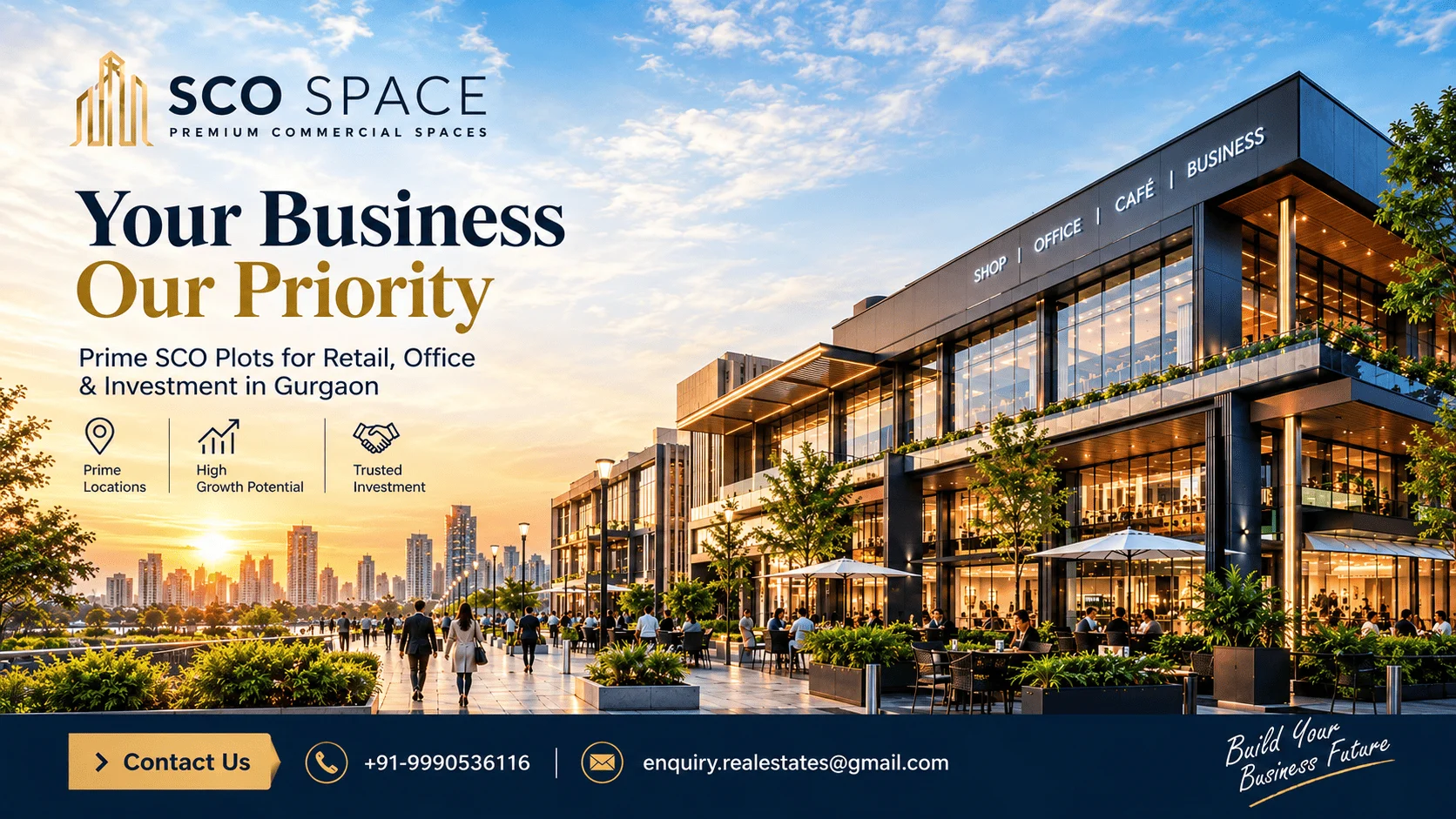
SCO Plots What Buyers Should Know About Location & Development
Understanding the Basics
Shop Cum Office SCO plots are small commercial plots, or plotted commercial units, where the ground floor is usually meant for retail and the upper floors for offices or other approved commercial use. In Gurgaon, they sit between large malls and standalone shops. This gives smaller businesses and individual investors a way into commercial property without buying a whole building.
Gurgaon matters here because it combines corporate offices, large residential catchments and several expanding road corridors. Two things decide how an SCO plot performs for a buyer: where it stands and how far its development has progressed. This guide explains how SCO plots work, how to read Gurgaon’s commercial corridors, which location and development factors to compare, and what to verify before you commit.
Key Details at a Glance What Should Buyers Know About SCO Plots in Gurgaon?
SCO plots in Gurgaon are commercial units meant for combined retail and office use. Their value depends mainly on location, such as road access, visibility and the surrounding catchment, and on development status, including approvals, infrastructure and surrounding build-out. Buyers should verify title, permitted use, RERA status where applicable and current pricing independently before purchasing.
Key points at a glance:
- SCOs are mixed-use commercial properties, not residential plots.
- Location drives footfall, visibility and tenant demand.
- Development status affects risk, timing and liquidity.
- Prices, approvals and timelines must be verified from current official sources.
- Returns are never guaranteed and depend on market conditions and holding period.
What Are SCO Plots and How Do They Work in Gurgaon?
An SCO plot is a commercial property format in which a single plot or unit is designed for both shop and office use. It is typically a narrow, multi-storey structure. The ground floor, and sometimes the first floor, is used for retail or showroom activity. Upper floors are used for offices, clinics, studios or other permitted commercial uses.
In Gurgaon, commercial plots are typically planned within sector layouts or licensed commercial colonies. Land use, permissible activities, floor-area limits, height, setbacks and parking requirements are set by planning rules and the terms of the relevant licence or allotment. Because those terms vary from one site to another, “SCO” is a category, not a guarantee of identical rights everywhere. Two SCOs in different sectors can differ in permitted use, built-up potential and parking provision.
Buyers usually meet dlf plots gurgaon in one of three forms:
- Plots allotted or auctioned by a public authority. Terms are set by the authority’s allotment conditions.
- Plotted commercial units within private licensed developments. Terms come from the licence, the layout plan and the builder-buyer agreement.
- Resale units, where a previous owner transfers an existing plot or built structure.
Each route carries different documentation, cost and risk, so first confirm which route applies to the property you are examining.
Why the SCO format appeals to different buyers
The format suits several kinds of buyer for different reasons:
- Business owners may want ground-floor visibility with upper-floor office space under one roof.
- Investors may be looking at rental income and long-term holding of a relatively smaller commercial asset.
- Professionals such as clinics and consultancies may value street-facing access combined with office area.
Whether the format actually delivers depends on the specific plot and its surroundings.
Understanding Gurgaon’s Commercial Growth Corridors
Gurgaon’s commercial real estate is not concentrated in one place. It has spread along major roads, and each corridor has developed its own character. Understanding these corridors is the first step in evaluating any SCO location.
The corridors that shape SCO demand
- Golf Course Road and Golf Course Extension Road: associated with established corporate and premium residential catchments. Golf Course Extension Road connects the Golf Course Road belt towards Sohna Road and its surrounding sectors.
- Southern Peripheral Road (SPR): an east-west arterial that links several sectors and major roads. It has attracted commercial and residential development along its length.
- Dwarka Expressway: a major connector between Delhi and Gurgaon, and a significant factor in the growth of New Gurgaon.
- Sohna Road: an older, established corridor with mixed commercial and residential use.
- NH-48 (Delhi–Jaipur corridor): the city’s long-standing commercial spine, with extensive office and hospitality presence.
Sector 67 is often discussed in this context because of its position within the Southern Peripheral Road and Golf Course Extension Road belt. Readers evaluating any sector should check its actual road access, planned connectivity and surroundings on a current map instead of relying on descriptions alone.
How corridors affect an SCO buyer
A corridor shapes who passes the property, who lives or works nearby, and how reachable the location is by private vehicle, taxi and public transport. It also influences how competitive the surrounding commercial supply is. A strong corridor can increase visibility and demand, but it can also mean more competing retail and office space nearby.
Travel times and distances change with traffic, construction and new road openings. Verify them yourself at the hours your business or tenants will actually use them.
Location Factors Buyers Should Compare Before Choosing an SCO Plot
Location is the most important variable in commercial property, and it has several layers. Think of it as a set of questions, not a single “good” or “bad” label.
1. Road access and visibility
Check the road the plot faces, how wide it is, whether it is a main road or an internal one, and how visible the frontage is from approaching traffic. A retail-focused buyer should walk or drive the approach in both directions. Signage visibility and the ease of pulling in and out matter as much as the address.
2. Customer catchment
Catchment means the people who can realistically reach the plot. Consider:
- Residential density within a practical distance
- Nearby offices, schools, hospitals and hospitality
- Footfall patterns across weekdays, weekends and evenings
- Whether surrounding residential projects are occupied or still under construction
An area with many planned but unoccupied homes has a different near-term catchment from one with established residents. That distinction is easy to miss.
3. Connectivity
Connectivity includes arterial roads, expressways, metro access where available, and the ease of reaching the property from other parts of Gurgaon and Delhi NCR. Distinguish between connectivity that exists today and connectivity that is planned. Planned projects can change in scope or timing, so treat them as possibilities, not certainties.
4. Competition
Look at what is already around the plot. A cluster of similar shops and offices can create a recognized commercial destination, or it can mean saturated supply. Count the vacancies. A row of shuttered units is a useful signal.
5. Parking and approach
Parking is a decisive factor for retail. Examine whether parking is provided, how it is shared, and what the realistic customer experience will be at peak times. Poor parking can hurt retail footfall even when the location looks strong on paper.
6. Neighbouring land use
The surrounding mix of uses affects both demand and risk. Adjacent residential, institutional or industrial uses, or vacant land with an unclear future, can change the character of the area over time. Check the current master plan or layout for what is planned nearby.
How Development Status Affects an SCO Plot
Development status is the second major variable, and it is often underestimated. It describes how far the plot and its surroundings have progressed, from land with approvals pending to a fully built, occupied commercial street.
Stages of development to distinguish
| Stage | What it typically means | What buyers should assess |
|---|---|---|
| Planned or launched | Layout or licence exists, construction may not have begun | Approvals, registration, delivery commitments, payment terms |
| Under development | Infrastructure or construction in progress | Actual progress, stated timelines, risk of delay |
| Ready with limited occupancy | Built, but few businesses operating | Footfall, tenant interest, vacancy |
| Established | Operating commercial area with active tenants | Existing rents, resale activity, competition |
Why it matters
- Risk profile: earlier-stage plots may carry timing and approval risk, while established ones carry fewer uncertainties but are generally priced to reflect that.
- Cash flow: a plot that cannot yet be used or let produces no income, while capital and financing costs continue.
- Liquidity: a plot in an operating, known commercial area is usually easier to evaluate and compare when you eventually sell.
- Surrounding infrastructure: roads, utilities and nearby housing may be incomplete, which affects when the location reaches its full potential.
Neither stage is automatically better. Early-stage purchases can be right for buyers with patience and appetite for risk. Established assets can suit buyers who prioritize income visibility. The mistake is to treat the two as identical.
Developer and project-level considerations
For plots within private developments, examine the developer’s delivery record, the registration details and any completed projects you can visit. Large, established developers, including those behind well-known dlf plots gurgaon offerings, are one category buyers may encounter, but track record should be verified project by project, not assumed from the brand.
Sector Comparison: A Framework for Evaluating Gurgaon SCO Locations
Rather than ranking sectors, which would require current verified data, use a consistent framework to compare any two locations. The table below structures that comparison.
| Comparison factor | Questions to ask | Why it matters |
|---|---|---|
| Road access | Which roads serve the plot? Is the frontage on a main road? | Visibility and ease of reaching customers |
| Catchment | Who lives and works nearby, and are they present today? | Demand for retail and office use |
| Connectivity | What is operational versus planned? | Accessibility now and later |
| Development stage | Is the surrounding area built and occupied? | Timing, risk and income potential |
| Competition | How much similar space exists, and how much is vacant? | Pricing power and tenant demand |
| Permitted use | What activities does the approval allow? | Business suitability and compliance |
| Parking | What is provided and how is it shared? | Customer convenience for retail |
| Entry cost | What is the verified price and total cost of acquisition? | Return thresholds and financing |
| Exit potential | Are there resale transactions and active buyers? | Liquidity |
Score each factor for each plot you consider, and make a note of what you could not verify. Missing information is itself a finding.
A practical example of comparison in action
Suppose you compare a plot on a busy arterial road in an area with many unoccupied new homes against a plot on a quieter road in a mature neighbourhood. The first may offer stronger visibility and a larger eventual catchment, but weaker immediate footfall. The second may offer steadier near-term demand but lower visibility and slower growth. Neither is the right answer. It depends on whether your priority is immediate trading, long-term holding or a lower-risk entry.
Business Suitability Retail, Office and Mixed Use
Are SCO plots suitable for retail businesses?
SCO plots can suit retail businesses that benefit from street-facing visibility, such as showrooms, cafes, clinics with walk-in traffic, service outlets and neighbourhood retail. Suitability depends on frontage, parking, nearby footfall and permitted use. Retail on upper floors generally performs less well than ground-floor retail, because customers are less likely to climb stairs for casual purchases.
Buyer takeaway: evaluate retail suitability by standing at the location during peak hours and counting actual foot and vehicle traffic.
Are SCO plots suitable for office use?
SCO plots can suit small and mid-sized offices, professional practices and boutique firms that want a self-contained building. Upper floors are commonly used for office space. Suitability depends on floor layout, lift and staircase provision, parking, power and connectivity infrastructure, and whether your staff and visitors can reach the location conveniently.
Buyer takeaway: check floor plates, access, parking per floor and the quality of surrounding commuting options before choosing an SCO for office use.
Mixed-use considerations
Combining retail below and offices above can work well when the uses do not conflict. Consider noise, customer flow, security, access separation and maintenance responsibilities. In multi-owner or shared arrangements, check how common areas and costs are managed.
Plot Sizes, Configurations and Unit Conversions
SCO configurations vary by site. Never assume a standard size: the area, frontage, depth and permitted floors differ from one development to another, and the figures in your agreement and approved plan are the ones that count.
Plot sizes are quoted in different units, so conversion errors are common. Use these standard conversions:
- 1 sq. m. ≈ 10.7639 sq. ft.
- 1 sq. m. ≈ 1.19599 sq. yd.
| If the area is given in | Multiply by | To get |
|---|---|---|
| Square metres | 10.7639 | Square feet |
| Square metres | 1.19599 | Square yards |
| Square yards | 0.83613 (approx.) | Square metres |
| Square feet | 0.092903 (approx.) | Square metres |
Questions to ask about configuration
- Is the stated area the plot area, the built-up area or the carpet area? These differ.
- How many floors are permitted, and what is the maximum built-up area?
- What are the frontage and depth?
- Are basements, mezzanines or terrace uses allowed?
- Is the price quoted per unit of plot area or per unit of built-up area?
Always confirm these from the sanctioned plan and the agreement, not from marketing material alone.
Pricing Considerations for SCO Plots in Gurgaon
This guide does not quote current prices. Commercial property prices change with market conditions, and any figure that is not verified on the day you read it can mislead. Get a current, dated price from an official or authorized source, and treat older figures as historical.
What typically influences SCO plot pricing
- Location and frontage: main-road and corner positions are often priced differently from interior plots.
- Plot size and configuration: area, depth and permitted floors.
- Development stage: under-development and ready properties are usually priced on different assumptions.
- Surrounding infrastructure: completed or planned connectivity can influence expectations.
- Market demand and supply: the amount of competing commercial space nearby.
- Developer or authority terms: payment plans, preferential location charges and similar items.
- Transaction environment: whether the sale is primary, resale or an auction.
Separate the price from the total cost
The quoted price is rarely the full cost. A realistic budget should include:
- Registration and stamp duty, which depend on current government rates
- Applicable taxes, including GST where relevant, subject to current rules
- Legal and documentation fees
- Maintenance and any one-time charges
- Construction or fit-out cost, if the plot is not built
- Financing cost, if you borrow
Because tax and duty rules change, confirm the current position with a qualified tax or legal professional before finalizing.
Verified, estimated and historical prices
When you compare prices, label each one:
- Verified current: confirmed from an official or authorized source, with a date.
- Estimated: an informed approximation, not a quoted price.
- Historical: a past figure that may no longer apply.
Mixing these categories is one of the commonest reasons buyers misjudge value.
Investment Analysis Factors to Evaluate Before Buying SCO Property
An SCO purchase is a business decision as well as a property decision. This section sets out the factors to weigh. It does not suggest that any SCO is automatically a good investment, and no return, rental level or appreciation is guaranteed.
Demand drivers
Commercial demand depends on the economic activity around the plot: office occupancy, residential population, institutional presence and consumer spending. Demand can change when new commercial supply opens elsewhere or when a corridor’s connectivity changes. Ask what is generating demand for this location today, and what could reduce it.
Rental potential
Rents depend on location, size, condition, floor, frontage and market demand. Look at actual achieved rents for comparable properties nearby, from brokers, current tenants and recent leases, and not at asking rents. Compare rents to your total acquisition cost to understand the income relative to what you are investing. Treat any projected figure as an assumption to test, not a promise.
Capital appreciation
Property values may rise, stay flat or fall, depending on the market and the location. Past performance of a corridor does not guarantee future performance. A sound approach is to examine what has driven past price changes in a given area, and whether those drivers still apply.
Holding period
Commercial property tends to suit buyers who can hold for a meaningful period. A short holding period increases exposure to transaction costs and market timing. Consider how long you can hold without needing to sell.
Liquidity and exit
Commercial plots are typically less liquid than listed assets. A sale can take time, and the number of active buyers for your specific property may be limited. Before buying, think through your exit: sell to another investor, sell to an owner-occupier or hold and let. Look at how many resale transactions occur in the area, since few transactions can indicate a thin market.
Financing
If you borrow, consider interest rates, loan eligibility for commercial property, repayment terms and your cash-flow resilience if the unit stays vacant for some months. Leverage can magnify both gains and losses.
A simple evaluation framework
- Define your purpose: own business use, rental income, long-term holding or a mix.
- Shortlist locations using the comparison framework above.
- Verify price, approvals and documents independently.
- Estimate total cost, including taxes, fit-out and financing.
- Stress-test income using conservative rent and a vacancy period.
- Plan your exit before you enter.
- Take professional advice on legal, financial and tax matters.
Commercial Risk Assessment
Every commercial purchase carries risk. Naming the risks clearly is part of making a sound decision.
| Risk type | What it means | How to reduce exposure |
|---|---|---|
| Regulatory | Approvals, permitted-use or compliance problems | Verify documents with a qualified lawyer |
| Title | Disputed or unclear ownership | Independent title search |
| Market | Prices or rents decline | Conservative assumptions, longer horizon |
| Vacancy | Unit stays empty | Stress-test cash flow; understand tenant demand |
| Competition | Nearby supply reduces your pricing power | Study existing and upcoming supply |
| Development delay | Project or infrastructure takes longer than stated | Treat timelines as estimates; check progress on site |
| Financing | Rate changes or loan constraints | Maintain a cash buffer |
| Liquidity | Difficulty selling when needed | Avoid investing money you may need soon |
| Business demand | Your own business underperforms at the location | Test footfall before committing |
No risk can be removed entirely. The aim is to understand them, price them into your decision and avoid taking on more than you can bear.
Common Mistakes SCO Buyers Make
- Treating “SCO” as a uniform product. Terms differ by site and by source.
- Relying on brochures instead of documents. Marketing is not a legal record.
- Ignoring total cost. Taxes, fit-out and financing are easy to underestimate.
- Confusing planned with existing infrastructure. Planned projects can slip or change.
- Not visiting at different times. A site that looks busy at noon may be quiet in the evening.
- Overlooking parking and access. These can decide retail performance.
- Assuming returns. Quoted yields are projections, not guarantees.
- Skipping legal review. Professional checks are cheap relative to a dispute.
- Neglecting exit planning. Liquidity is only visible when you try to sell.
- Comparing prices across different units of area. Plot area and built-up area are not interchangeable.
Buyer Due-Diligence Checklist
Use this checklist as a starting point and adapt it to the property. Recommend professional legal, financial and tax verification for each stage, since the right checks depend on the specific transaction.
Ownership and documents
- Title and ownership documents, including the chain of title for resale
- Allotment letter, licence or agreement terms, as applicable
- Encumbrance and litigation checks
- Official documentation obtained directly, not only through intermediaries
Approvals and regulation
- Approved layout and building plan
- Permitted use and floor-area limits
- Building regulations, setbacks and height limits
- RERA registration status where applicable, checked on the official regulator portal
- Completion or occupancy documentation for built properties
Property specifications
- Plot area, frontage and depth, in a consistent unit
- Whether the area quoted is plot, built-up or carpet
- Parking provision and access arrangements
- Utilities and infrastructure availability
Development status
- Actual status of construction and surrounding infrastructure, verified on site
- Stated timelines treated as estimates until delivered
- Status of neighbouring plots and common areas
Financial terms
- Current verified price with date
- Payment schedule and milestone linkage
- Applicable taxes, registration and stamp duty
- Maintenance charges and any one-time costs
- Financing terms and eligibility, if borrowing
Market and exit
- Comparable rents and recent resale transactions
- Competing supply nearby
- Availability of the specific unit
- Your exit options and likely holding period
An Example of Market-Level Context
Gurgaon includes several developments that package SCO-style units within planned commercial layouts. One example frequently discussed in the Sector 67 belt is DLF Central Sector 67. It is mentioned here only as a market example, not as a recommendation. Any buyer should apply the same location, development and due-diligence framework described above to each option, and verify current details with official sources.
Making the Right Choice
SCO plots occupy a distinct place in Gurgaon’s commercial property market. They offer a mixed-use format that can suit small businesses, professional practices and investors, but their performance depends heavily on the specific plot, not the category.
Location decides visibility, footfall and accessibility, and Gurgaon’s corridors, including Southern Peripheral Road, Golf Course Extension Road, Dwarka Expressway and Sohna Road, each create different conditions. Development status decides risk, timing and income potential. Business suitability depends on whether the plot truly fits your intended use. For investors, demand, rental potential, financing, holding period and liquidity should all be examined with conservative assumptions.
The buyers who tend to decide well are those who verify documents independently, compare locations with a consistent framework, budget for total cost and plan their exit before they enter. For readers exploring the wider market, resources on sco plots gurgaon and premium SCO plots in Gurgaon can help in comparing options, always alongside independent verification and professional advice.
Investment Disclaimer
This article is for general information and education only. It is not investment, legal, financial or tax advice. Property values, rents, prices, taxes and regulations change, and nothing here guarantees returns, appreciation, rental income or resale profit. Details such as prices, approvals, RERA status, plot sizes and timelines must be independently verified from current official sources. Consult qualified legal, financial and tax professionals before making any purchase decision.
Frequently Asked Questions
1. What are SCO plots in Gurgaon?
SCO stands for Shop Cum Office. These are commercial plots or units designed for ground-floor retail and upper-floor office use. In Gurgaon, they are found in planned commercial areas along major corridors. Permitted use, floor limits and parking differ by site, so buyers should confirm the specific terms in the approved plan and agreement.
2. How do SCO plots work?
An SCO is typically a narrow, multi-storey commercial structure on its own plot. The owner can use it for their own business, let floors to tenants, or hold it as an investment, within permitted use. Rights, charges and obligations come from the allotment or licence terms and the sale agreement, so reading these documents carefully is essential.
3. What affects SCO plot prices in Gurgaon?
Prices are influenced by location, frontage, plot size, permitted floors, development stage, nearby infrastructure, market demand and competing supply. Payment terms and additional charges also matter. Prices change over time and vary between sites, so always obtain a current, dated price from an official or authorized source and treat older figures as historical.
4. Which sectors in Gurgaon are known for SCO developments?
SCO developments exist across several parts of Gurgaon, including areas along Golf Course Road, Golf Course Extension Road, Southern Peripheral Road, Sohna Road and the Dwarka Expressway belt, including Sector 67 and New Gurgaon. Availability and quality vary, so check current supply, approvals and surroundings for any sector you consider.
5. What should buyers verify before purchasing an SCO plot?
Verify title and ownership, approved layout and building plan, permitted use, RERA registration where applicable, plot specifications, parking, payment terms, taxes and total cost. Also check development status on site and examine encumbrances. Use qualified legal, financial and tax professionals, and obtain official documents directly rather than relying only on marketing material.
6. Are SCO plots suitable for retail businesses?
They can be, particularly for street-facing showrooms, cafes, clinics and neighbourhood services. Suitability depends on frontage, visibility, parking, surrounding footfall and permitted use. Ground-floor retail typically performs better than upper-floor retail. Visit at different times of day to observe actual customer and vehicle traffic before deciding.
7. Are SCO plots suitable for office use?
SCO plots can suit small and mid-sized offices and professional practices that want a self-contained building. Consider floor layout, lift and stair provision, parking, power and connectivity, and how easily staff and visitors can reach the location. Confirm that the approved use explicitly permits office activity on the relevant floors.
8. What factors should investors compare before buying SCO property?
Compare location, catchment, connectivity, development stage, competition, permitted use, parking, total acquisition cost, achievable rent, financing and exit options. Use a consistent framework across properties and note what you could not verify. No return is guaranteed, so test conservative rent and vacancy assumptions before committing capital.
9. How do I convert SCO plot sizes between units?
Use standard conversions: 1 square metre is approximately 10.7639 square feet and approximately 1.19599 square yards. Confirm whether the stated area refers to plot area, built-up area or carpet area, because these are different measures. Always rely on figures in the sanctioned plan and agreement instead of rounded marketing numbers.
10. Are SCO plots a safe investment?
No commercial property is risk-free. SCO outcomes depend on location, development status, demand, vacancy, financing and market conditions, and returns are never guaranteed. Liquidity can also be limited. Buyers should verify documents, budget for total cost, stress-test income, plan an exit and seek professional legal, financial and tax advice.