Buying SCO Plots in Gurgaon? Start With This Checklist
Getting Started
SCO stands for Shop Cum Office. It is a commercial plot or unit built for ground-floor retail with offices or other permitted commercial uses above. Gurgaon is one of the most closely watched commercial markets in Delhi NCR. Its corridors, including Southern Peripheral Road, Golf Course Extension Road and Dwarka Expressway, have drawn retailers, professionals and investors. Interest in SCO plots Gurgaon has grown with them.
Plots in this segment vary widely in location, regulation and usability. This guide gives buyers a practical order of checks: how SCO plots work, which location factors matter, what costs to expect, how to judge business and investment fit, and which documents to verify before paying.
What Should You Check Before Buying an SCO Plot in Gurgaon?
Before buying an SCO plot in Gurgaon, verify five things: the legal title and approvals, the permitted commercial use, the plot’s size and specifications, the location’s customer catchment and accessibility, and the full cost including taxes and fees. Then compare your exit options. Professional legal, financial and tax review should come before any payment.
The five-gate checklist used in this guide:
- Legal gate: title, licence, approvals and RERA status where applicable
- Property gate: size, frontage, permitted use, building rules, parking
- Location gate: corridor, visibility, access and catchment
- Economics gate: total cost, financing, holding costs and realistic rental assumptions
- Exit gate: resale demand, liquidity and fallback options
A plot should clear each gate in order. A strong location does not make up for a weak title, and an attractive price does not make up for a plot that cannot support your business.
What Are SCO Plots in Gurgaon and How Do They Work?
An SCO plot is a commercial site where the building typically combines retail on the lower floors with offices or other permitted commercial activity on the upper floors. In Gurgaon, SCO plots are generally part of planned commercial developments or sectors, often along market strips and arterial roads. The exact rules depend on the licence, sector plan and zoning conditions that apply to the specific site.
Buyers often assume every SCO plot offers the same rights. In practice, details can differ:
- Permitted uses. Retail, showrooms, offices, banks, clinics, restaurants and similar uses may be allowed or restricted depending on approvals and zoning.
- Ownership structure. Some are sold as individual plots. Others are structured within a larger commercial development. The documents define what you actually own.
- Building norms. Ground coverage, height, floor-area limits and setbacks are set by applicable regulations and the approved plan. They shape how much usable commercial area the plot can support.
- Development responsibility. Roads, utilities, parking and common areas may be handled by a developer or a government authority, depending on the project.
Buyer takeaway: Treat “SCO” as a category, not a guarantee. Read the licence, plan and allotment or sale documents for the specific plot.
How SCO Plots Differ From Other Commercial Property
| Factor | SCO Plot | Shop in a Mall | Pre-leased Office Unit |
|---|---|---|---|
| Typical format | Plotted commercial site with retail and office floors | Single unit inside a managed retail complex | Single office unit in a building |
| Control over building | May be higher, within approved norms | Limited to the unit | Limited to the unit |
| Frontage and visibility | Depends on road and market position | Depends on mall layout | Usually low retail visibility |
| Common management | Varies by development | Usually centralized | Usually centralized |
| Business flexibility | Depends on permitted uses | Often governed by mall policy | Mainly office use |
| Typical buyer questions | Approvals, access, parking, building plan | Mall footfall, tenant mix, maintenance | Tenant quality, lease terms |
This comparison is general. Terms vary by project and should be confirmed in writing.
Why Gurgaon’s Commercial Growth Corridors Matter for SCO Buyers
Location affects an SCO plot’s usefulness more than almost any other factor. A shop-cum-office depends on people reaching it, seeing it and wanting to stop. Gurgaon’s commercial geography has several recognizable corridors, and each draws a different customer and business mix.
- Southern Peripheral Road (SPR). A major arterial road connecting several sectors in the southern part of the city. Commercial sites along or near it often depend on road visibility and connections to nearby residential sectors.
- Golf Course Extension Road. A well-known commercial and residential corridor linking established areas to newer sectors. Retail, offices and services have developed alongside residential growth.
- Dwarka Expressway. A corridor associated with newer residential and commercial development in the New Gurgaon belt. Its commercial maturity depends on population growth, completed infrastructure and occupancy.
- Sector-level markets and market strips. Individual sectors may have commercial belts serving residents within and around the sector.
What to evaluate: Whether a corridor is “growing” matters less than whether the specific plot sits where your customers actually travel, live or work. Nearby residential occupancy, office demand, competing commercial supply and the timing of infrastructure all affect commercial viability. Infrastructure timelines in particular change often, so check current official announcements rather than relying on older articles.
Sector 67 as a Reference Point
Sector 67 is a commonly referenced location in discussions of SCO supply along Southern Peripheral Road. Buyers researching premium SCO plots in Gurgaon often compare locations like this against alternatives along Golf Course Extension Road and in New Gurgaon. The comparison should rest on measurable factors: access roads, surrounding population, existing commercial activity and permitted use. Reputation alone is not enough.
How to Compare Locations: Sector and Corridor Evaluation Factors
Use the same criteria for every location you shortlist. A structured comparison keeps you from deciding on impression.
| Evaluation Factor | What to Check | Why It Matters |
|---|---|---|
| Road access | Width, entry and exit points, traffic flow | Affects whether customers can reach and stop easily |
| Visibility | Frontage, signage potential, obstructions | Important for retail and showrooms |
| Catchment | Nearby residential, office and institutional population | Determines the customer base |
| Occupancy | How much surrounding development is occupied | A completed building is not the same as a populated area |
| Competition | Existing and planned commercial supply nearby | Affects rent and resale demand |
| Parking | Dedicated or shared parking, street parking rules | Frequently decisive for retail and clinics |
| Public transport | Metro, bus or road links for staff and customers | Matters for office use and walk-in business |
| Utilities | Power backup, water, drainage, connectivity | Affects day-to-day operations |
| Regulatory status | Zoning, licence, approvals | Affects what you may legally do |
Practical tip: Visit the location at different times, such as a weekday morning, an evening and a weekend. Count who walks past, where they park and which nearby businesses are busy. This direct observation often tells you more than a brochure.
Understanding Plot Sizes, Configurations and Unit Conversions
Plot sizes may be quoted in square meters, square feet or square yards, so convert them before comparing. Never assume two quoted sizes are measured the same way.
Conversion reference:
- 1 sq. m. ≈ 10.7639 sq. ft.
- 1 sq. m. ≈ 1.19599 sq. yd.
Illustrative conversions (examples only, not actual plot sizes):
| Area in sq. m. | Approx. sq. ft. | Approx. sq. yd. |
|---|---|---|
| 50 | 538.20 | 59.80 |
| 100 | 1,076.39 | 119.60 |
| 200 | 2,152.78 | 239.20 |
Plot Area Is Not the Same as Usable Area
A larger plot does not automatically give more usable commercial space. Check these separately:
- Plot area: the land you own or hold rights to
- Permissible built-up area: what the building rules allow you to construct
- Frontage: the width facing the road, which is often important for retail
- Basement and parking provisions: whether they count toward usable area and whether they are allowed
- Height and floor limits: how many floors the approvals permit
If a specific plot’s dimensions or built-up entitlements are not clearly documented, treat them as unverified and ask for the sanctioned plan.
What Affects SCO Plot Prices in Gurgaon?
Prices vary by project, location, size, configuration and market conditions, so no single figure is reliable. This guide does not quote a price because any number would go stale quickly and might not apply to your plot. Verify current pricing directly with the seller or developer and confirm the date of the quote.
The main factors that may influence pricing:
- Location and corridor. Frontage on a main road generally differs from interior positions.
- Plot size and shape. Dimensions affect usable area and layout efficiency.
- Corner or facing position. Extra frontage can affect visibility and pricing.
- Development stage. Plots in under-construction developments may be priced differently from those in completed, operational markets.
- Surrounding development. Occupancy and the strength of the nearby commercial environment matter.
- Approvals and regulatory clarity. Clear approvals tend to reduce uncertainty.
- Market conditions and availability. Demand, supply and financing conditions change.
- Payment terms. Different plans can change the effective cost.
Current Price vs. Historical or Estimated Information
When you research pricing, separate three kinds of numbers:
| Type | Description | How to Treat It |
|---|---|---|
| Current verified | Provided directly by the seller or developer, with a date | Usable, but confirm validity and what it includes |
| Historical | Past transactions or older listings | Context only |
| Estimated or third-party | Portal averages or broker opinions | Treat as indicative and confirm independently |
Buyer takeaway: Ask what a quoted price includes and excludes. Compare plots on the total cost of ownership, not the headline rate alone.
Total Cost of Buying: Taxes, Fees and Ongoing Expenses
The purchase price is only part of what you pay. Budget for the full cost before committing.
Typical cost categories to check:
- Stamp duty and registration charges. These depend on current Haryana rates and rules. Confirm the applicable rates before budgeting.
- GST. Whether GST applies, and at what rate, can depend on the transaction type and stage. Confirm with a tax professional.
- Development and infrastructure charges. Some projects charge for external or internal development.
- Maintenance and common-area charges. Ask who maintains roads, security, lighting and shared services, and at what cost.
- Legal and advisory fees. Title verification and documentation carry professional fees.
- Financing costs. Interest, processing fees and any prepayment terms.
- Construction cost. If you are buying a plot and building on it, include design, approvals and construction.
- Property tax and other recurring charges. Confirm what applies after possession.
- Fit-out costs. A shop, showroom or office needs interiors before it can operate.
Expert context: Many buyers compare only the per-unit price and later find that fees, taxes and fit-out costs change the economics. Get a written cost sheet from the seller and have a professional review it.
Is an SCO Plot Suitable for Your Business?
Business fit decides whether an SCO plot works as an operating asset, not just a purchase.
Are SCO Plots Suitable for Retail Businesses?
SCO plots can suit retail when the location brings in customers and the building supports retail operations. Visibility, frontage, parking and nearby footfall matter most. Check that the permitted uses cover your category, such as food service, showrooms or clinics, and whether any restrictions apply.
Retail questions to answer:
- Who is the target customer, and do they pass or live near this location?
- Is there convenient parking for the customers you expect?
- Is the frontage wide enough for display and signage?
- Are similar businesses already nearby, and does that help (cluster effect) or hurt (competition)?
- Will the surrounding area’s occupancy support the business now, or only in the future?
Are SCO Plots Suitable for Office Use?
Offices in SCO buildings can work for small and mid-sized firms, professional practices and branch offices. Check lift access, power backup, parking, connectivity and the building’s identity and upkeep. Upper-floor office demand often depends on accessibility and nearby amenities, so compare the offering against nearby managed office buildings.
Questions to Ask Before Deciding
| Business Type | Key Considerations |
|---|---|
| Retail store | Visibility, footfall, parking, frontage |
| Restaurant or café | Permitted use, ventilation and fire norms, parking, evening activity |
| Clinic or diagnostics | Permitted use, accessibility, nearby residential catchment |
| Showroom | Frontage, floor height, vehicle access |
| Professional office | Access, upper-floor usability, staff commute, connectivity |
| Banking or services | Branch visibility, security and access norms |
Confirm each use against the licence and applicable regulations. Do not rely on verbal assurances.
Investment Analysis: Factors to Evaluate Before Buying an SCO Plot
This section covers factors to evaluate, not a recommendation. No SCO plot is automatically a good investment, and returns, rental income and resale value are never guaranteed.
Demand and Rental Potential
Rental demand for commercial property depends on tenant types, location, condition, lease terms and the strength of the local business environment. Any rental figure used in a calculation should come from a verifiable source, such as current lease comparables or a written lease offer, and should be tested conservatively. Treat advertised yields and projections as claims to verify.
Questions to ask:
- Who would realistically rent this space?
- What are similar properties in the same micro-market leasing for, and are those figures current and documented?
- How long might the unit remain vacant between tenants?
- What would you do if the first tenant leaves?
Capital Appreciation
Past price growth in an area does not predict future growth. Appreciation depends on demand, supply, infrastructure delivery, economic conditions and interest rates. Build your analysis so it holds up even if prices stay flat for an extended period.
Liquidity and Exit
Commercial property can be less liquid than many buyers assume. Selling may take time, and the pool of buyers is narrower than for residential property. Before buying, think through:
- Who would buy this property from you, and why?
- Does the property suit more than one type of use?
- Are the documents clean enough for a buyer’s lawyer and lender?
- How long can you hold if conditions are slow?
Holding Period and Financing
A longer holding period may smooth short-term swings, but it also ties up capital and adds carrying costs. If you finance the purchase, test whether you can service the loan if the property stays vacant for several months. Commercial loans often differ from home loans in terms and eligibility, so confirm with lenders.
Sample Investment Evaluation Framework
| Step | What to Do |
|---|---|
| 1. Total cost | Add purchase price, taxes, fees, fit-out and financing costs |
| 2. Income assumption | Use documented, conservative rent estimates |
| 3. Vacancy buffer | Assume periods without a tenant |
| 4. Ongoing costs | Include maintenance, property tax and management |
| 5. Stress test | Check outcomes if rent is lower or vacancy longer |
| 6. Exit view | Identify likely buyers and realistic timelines |
Run the numbers under cautious scenarios and see whether the investment still makes sense.
Common Risks in SCO Property and How to Assess Them
| Risk Type | What It Means | How to Assess |
|---|---|---|
| Regulatory risk | Approvals, licence or permitted-use issues | Verify documents with official sources and a lawyer |
| Title risk | Unclear ownership or encumbrances | Independent title search |
| Market risk | Prices or rents may fall or stagnate | Conservative assumptions, longer horizon |
| Vacancy risk | Property may stay unrented | Vacancy buffer, flexible use |
| Competition risk | Nearby supply may reduce demand | Study planned and existing commercial supply |
| Financing risk | Loan costs or rate changes strain cash flow | Stress-test repayments |
| Infrastructure risk | Planned roads or connectivity are delayed | Check official status, avoid depending on promises |
| Operational risk | Parking, access or services fall short | Site visit and written confirmations |
| Liquidity risk | Resale takes longer than expected | Plan holding capacity and alternative uses |
Expert context: Many problems in commercial real estate come from skipping basic verification in a hurry. A slower, documented process usually costs less than correcting an error afterward.
Buyer Due-Diligence Checklist for SCO Plots in Gurgaon
Use this as a working checklist. Confirm each item through official records or qualified professionals.
Legal and Regulatory
- Title and ownership documents. Confirm the seller’s right to sell and check for encumbrances, mortgages or disputes.
- Licence and approvals. Verify that the land is licensed and that layout and building approvals are in place for the commercial use you intend.
- RERA status where applicable. Check whether the development is registered with the Haryana Real Estate Regulatory Authority and review the registration details on the official portal.
- Permitted use. Confirm in writing that your intended business is allowed.
- Building regulations. Understand height, coverage, setbacks and floor-area rules.
Property and Physical
- Plot specifications. Verify dimensions, area and boundaries against the sanctioned plan.
- Development status. Check whether roads, drainage, power and water are in place or still pending.
- Parking and access. Confirm parking provisions and access rights.
- Possession status. Confirm whether possession is immediate or tied to a stage of development, and get that in writing.
Financial and Transaction
- Payment terms. Review the schedule, linked milestones and penalty clauses.
- Total cost sheet. Get an itemized statement of every charge.
- Financing. Confirm lender eligibility and terms before committing.
- Taxes and registration. Confirm current stamp duty, registration charges and GST treatment with a professional.
- Maintenance terms. Understand who maintains common areas and what it costs.
Documentation and Process
- Agreement review. Have a lawyer review the agreement before signing.
- Availability. Confirm the specific plot or unit is actually available and not already allotted.
- Official documents only. Rely on registered, signed and officially verifiable documents. Do not rely on brochures or verbal promises.
- Exit considerations. Check any transfer restrictions, resale conditions or lock-in terms.
Professional advice: Engage a qualified property lawyer, a chartered accountant or tax advisor, and, if you plan to borrow, a lender or financial advisor. Their fees are small next to the size of the transaction.
Common Mistakes Buyers Make When Buying SCO Plots
- Buying on location reputation alone. A well-known corridor does not guarantee the specific plot works.
- Skipping document verification. Relying on brochures or assurances instead of official records.
- Ignoring total cost. Focusing on the base price and overlooking taxes, fees and fit-out.
- Overestimating rental income. Using promotional yield claims instead of documented comparables.
- Underestimating vacancy. Assuming a tenant will be found immediately and stay indefinitely.
- Not confirming permitted use. Finding out after purchase that the business is restricted.
- Overlooking parking and access. Many retail plans fail on convenience.
- Over-leveraging. Borrowing more than the cash flow can support if rent is delayed.
- Relying on future infrastructure. Building a plan around projects that may be delayed or changed.
- Not planning an exit. Buying without thinking about who the next buyer might be.
Examples of How Buyers Evaluate Developer-Backed Commercial Options
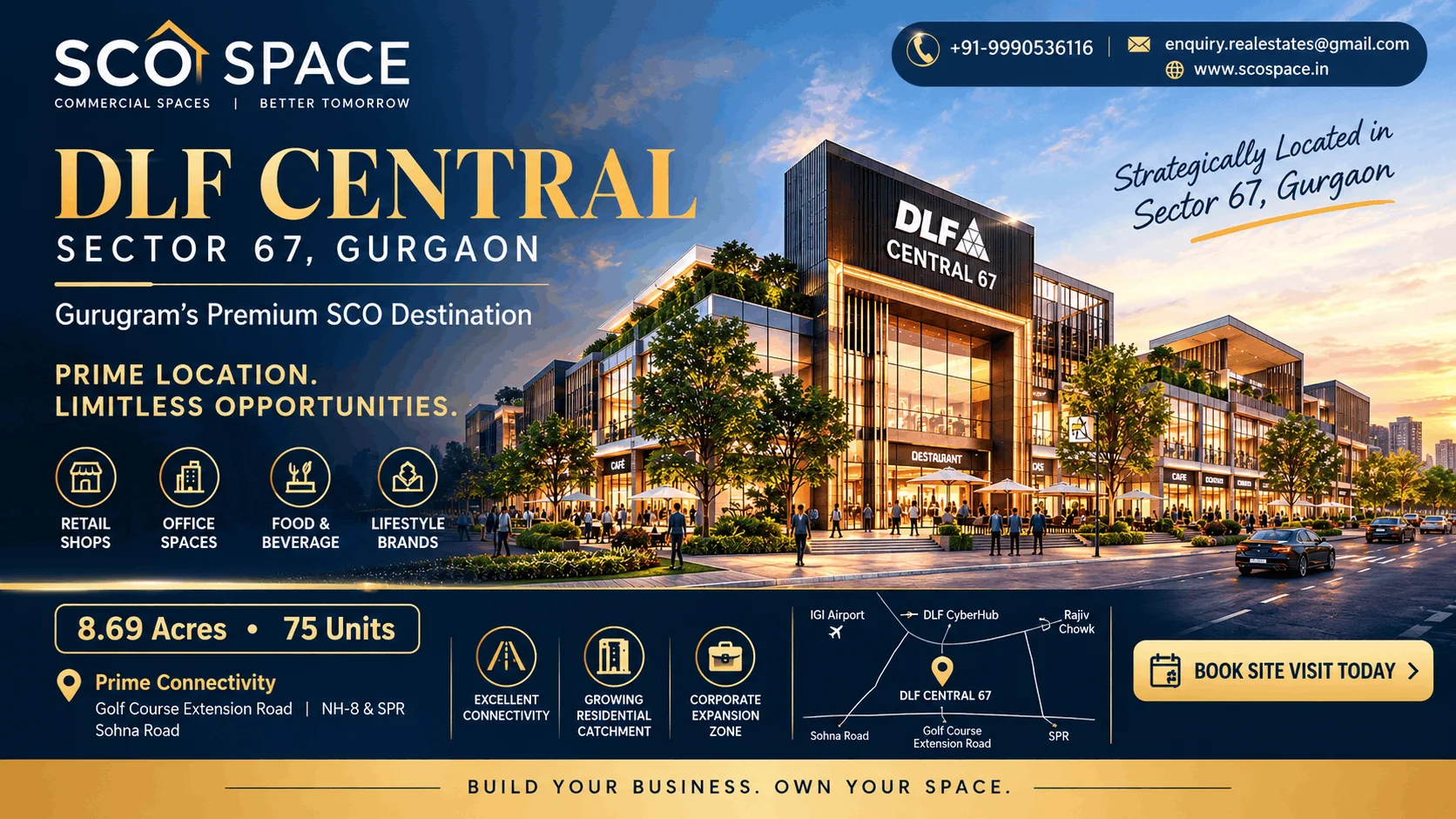
Some buyers prefer plots within developments by established developers, since documentation and delivery track records can be easier to review. One example is DLF Central Sector 67. An example is not an endorsement: the same checklist in this guide applies to any project, and you should confirm every detail directly with official sources. Buyers comparing DLF plots Gurgaon options, or any other developer’s offerings, should compare approvals, delivery history, payment terms and total cost on equal terms.
Step-by-Step Process for Evaluating an SCO Plot Purchase
- Define your goal. Decide whether you want an operating business location, an investment, or both.
- Set a total budget. Include taxes, fees and fit-out, not only the price.
- Shortlist corridors. Use the evaluation factors from the location table above.
- Visit sites. Observe footfall, parking and nearby businesses at different times.
- Request documents. Ask for the licence, approvals, plan and cost sheet.
- Verify independently. Check official portals and use a lawyer.
- Model the numbers. Use cautious assumptions and stress tests.
- Negotiate terms. Clarify payment schedule, possession and penalties.
- Review the agreement. Have it checked before signing.
- Plan the exit. Know your holding period and likely buyer pool.
What This Means for Buyers
Buying an SCO plot in Gurgaon is a decision about law, location, economics and business fit, not just price. The SCO format combines retail and office use, but each plot’s rights depend on its licence, approvals and permitted uses. Gurgaon’s growth corridors, including Southern Peripheral Road, Golf Course Extension Road and Dwarka Expressway, offer different catchments and different levels of maturity. Judge each plot on access, visibility, surrounding occupancy and competition.
For investors, the key factors are documented rental demand, realistic vacancy assumptions, financing capacity, total cost and a credible exit. Risks include regulatory, title, market, vacancy and liquidity problems, and none of them can be ignored. Due diligence reduces those risks but does not remove them. Verify title, approvals, RERA status where applicable, permitted use, specifications and costs through official records and qualified professionals. Whether you are buying for your own business or for investment, a patient, documented process is the best protection. Readers who want to explore the market further can look at SCO plots listings and compare them using this checklist.
Investment Disclaimer
This article is for general information and education only. It is not legal, financial, tax or investment advice. Real estate involves risk, including the possible loss of capital. Prices, regulations, taxes, approvals and infrastructure plans change, and the information here may not reflect current conditions. No returns, rental income or appreciation are guaranteed. Verify all details independently through official sources, and consult qualified legal, financial and tax professionals before making any purchase decision.
Frequently Asked Questions
1. What are SCO plots in Gurgaon?
SCO stands for Shop Cum Office. These are commercial plots or units designed for retail on the lower floors and offices or other permitted commercial uses above. In Gurgaon, they are usually found in planned commercial areas and along market strips. The rights attached to each plot depend on its licence, approvals and zoning, so verify them for the specific property.
2. How do SCO plots work?
An SCO plot gives the owner a commercial site where a building can be developed or used within approved norms. The owner may run a business there, lease it, or hold it for resale. What can be built or operated depends on building rules, permitted uses and the sale documents, so confirm these before buying.
3. What affects SCO plot prices in Gurgaon?
Several factors influence pricing: location and corridor, road frontage, plot size and shape, corner position, development stage, nearby occupancy, approvals, market conditions and payment terms. Prices vary by project and change over time, so always get a dated written quote and ask exactly what it includes, such as taxes and development charges.
4. Which sectors in Gurgaon are known for SCO developments?
SCO developments appear in several parts of Gurgaon, including sectors along Southern Peripheral Road, Golf Course Extension Road and the Dwarka Expressway corridor in New Gurgaon. Sector 67 is one commonly referenced location. Availability changes, so check current supply, approvals and surrounding development for any sector you are considering rather than relying on general reputation.
5. What should buyers verify before purchasing an SCO plot?
Verify the title and ownership, licence and approvals, RERA status where applicable, permitted use, plot specifications, building rules, parking and access, payment terms, taxes and registration costs, and the availability of the specific plot. Use official records and a qualified property lawyer, and rely on signed documents rather than brochures or verbal assurances.
6. Are SCO plots suitable for retail businesses?
They can be, depending on the location and permitted uses. Retail works best where there is good visibility, adequate parking and steady footfall from nearby residents, workers or passing traffic. Check that your business category is allowed, how the frontage supports display and signage, and what competition exists nearby before deciding.
7. Are SCO plots suitable for office use?
They can suit small and mid-sized firms, professional practices and branch offices, particularly on upper floors. Consider lift access, power backup, parking, connectivity and building upkeep. Compare the space with nearby managed office buildings, and confirm that office use is permitted under the property’s approvals.
8. What factors should investors compare before buying SCO property?
Investors should compare location and catchment, documented rental comparables, vacancy risk, total acquisition cost, financing terms, holding costs, competition, regulatory clarity and exit options. Stress-test the numbers with conservative assumptions. Returns, rental income and appreciation are not guaranteed, and past performance does not predict future results.
9. How do I convert SCO plot sizes between square meters, square feet and square yards?
Use these approximate conversions: 1 square meter is about 10.7639 square feet and about 1.19599 square yards. For example, 100 square meters is roughly 1,076.39 square feet or 119.60 square yards. Always confirm which area measure a quote uses, such as plot area or built-up area, and check it against the sanctioned plan.
10. Do I need a lawyer and tax advisor to buy an SCO plot?
It is strongly advisable. A property lawyer can verify title, approvals and agreement terms, while a tax or financial advisor can explain stamp duty, registration, GST treatment, financing and holding costs. The fees are small compared with the transaction size and can help you avoid costly legal or financial mistakes.