Choosing a commercial plot is fundamentally different from buying a property only for personal use. A residential buyer may focus on construction quality, neighbourhood, amenities and daily convenience, but a commercial property buyer must think about customers, visibility, access, frontage, business compatibility, surrounding development and long-term demand. These factors become particularly important when evaluating a shop-cum-office plot, where the value of the property can be influenced significantly by its exact position within a larger commercial development.
Capital One Global Sector 73 Gurgaon is positioned along the Southern Peripheral Road in Sector 73 and is presented as a commercial development based around an integrated “Sociozone” concept. The project page describes approximately 7.4 acres of development, 84 SCO plots in its detailed project overview, ground-plus-four-upper-floor development potential, and approximately 1.145 acres of water bodies and sit-out areas. The same source describes the development as a RERA-approved commercial project with registration number GGM/686/418/2023/30.
For someone considering Capital One Global SCO Plots, however, the bigger question is not simply whether the project is located in Sector 73. The real question is whether a particular plot has the characteristics that can support the intended business or investment strategy.
A good commercial location is created by a combination of factors. Road connectivity alone is not enough. A plot may be on a major road but have poor internal visibility. Another may be slightly away from the main frontage but benefit from a stronger corner position, better pedestrian movement or proximity to a central activity zone. The right choice therefore requires a more detailed evaluation.
Location Should Be Judged From a Business Perspective
The first principle for evaluating Capital One Global Sector 73 is to stop looking at the location only on a map.
A commercial location should be assessed according to the customer journey.
Where will customers come from?
How will they reach the property?
Where will they park?
Can they easily identify the development?
Can they see the individual plot?
Is the entrance convenient?
Will the surrounding businesses create complementary footfall?
Will the area continue to develop after the property is purchased?
These questions are more useful than simply saying that a project has a “prime location.”
Capital One Global is described as being strategically positioned on the Southern Peripheral Road, or SPR. The source identifies access through 90-metre, 60-metre and 24-metre roads and states that the development has multiple entry and exit points. These characteristics can be particularly relevant to businesses that depend on convenient vehicle access and visibility.
However, the buyer should examine the actual plot rather than applying these advantages uniformly to every available unit.
Why Southern Peripheral Road Matters
Road connectivity is one of the fundamental elements of commercial real estate.
A business requires customers, employees, suppliers and service providers to reach its premises without unnecessary friction. A strategically positioned road corridor can therefore improve the practical usability of commercial property.
The project reference positions Capital One Global Gurgaon on SPR and describes the corridor as an emerging commercial destination. It also highlights connectivity toward Golf Course Extension Road, Dwarka Expressway, Cyber City, NH-8 and other major parts of the wider Gurugram region.
For a retailer, connectivity can increase the potential customer catchment.
For an office user, it can improve employee and client accessibility.
For a restaurant, it can support both local and destination-driven visits.
For an investor, connectivity can influence the attractiveness of the property to future tenants.
Nevertheless, good connectivity does not automatically mean high returns. The surrounding commercial ecosystem, actual traffic patterns, competition and customer demographics must also be considered.
The Importance of Frontage
Frontage is one of the most overlooked characteristics when buyers compare commercial plots.
A plot's frontage determines how much of the property is exposed to passing customers and how effectively the business can present its brand.
Imagine two commercial plots with similar areas. One has a broad frontage facing a prominent road, while the other has a deeper configuration with limited visual exposure. Their physical areas may be comparable, but their commercial utility may be very different.
The project page highlights three-side accessibility through 90-metre, 60-metre and 24-metre roads and describes open-facade planning intended to support visibility. It also describes all plots in certain sections as two-side-open and highlights large frontages. These details should be confirmed for the exact plot being offered.
A buyer should therefore ask for the exact plot dimensions rather than looking only at square-yard area.
Corner Plots Can Have Different Commercial Characteristics
Corner positioning is another factor worth investigating.
A corner plot may have exposure to more than one direction, potentially improving signage opportunities, customer recognition and access. This can be particularly valuable for retail, food and beverage, healthcare, lifestyle and other customer-facing businesses.
But corner status alone should not determine the purchase.
A corner plot may cost more. The additional price should therefore be compared with the incremental commercial value it could create.
For an investor, the question should be:
Does the premium paid for the location have a reasonable relationship with future leasing or resale potential?
For an end-user, the question is slightly different:
Will the additional visibility materially improve business performance?
These are more practical ways to evaluate Capital One Global SCO Plots Sector 73.
Size Is Important, But Bigger Is Not Always Better
The project reference identifies five detailed plot configurations:
- 101 square yards
- 126 square yards
- 208 square yards
- 225 square yards
- 255 square yards
The detailed source lists 20 plots of 101 square yards, 38 of 126 square yards, 13 of 208 square yards, 7 of 225 square yards and 6 of 255 square yards.
These different sizes create different commercial possibilities.
A smaller plot may be appropriate for a boutique retailer, professional office or compact service business.
A mid-sized plot may provide more room for a café, showroom or multi-level office.
A larger plot could support a flagship retail concept, larger corporate operation or business requiring substantial floor space.
But purchasing the largest available plot simply because it appears more premium can be a mistake.
A larger property means a larger capital requirement and potentially higher construction and maintenance expenses. The business must be capable of using the additional space productively.
The right plot is therefore not necessarily the biggest one. It is the one whose size matches the intended use.
The Shop-Cum-Office Advantage
The Capital One Global SCO Plots Gurgaon format is designed around the combination of commercial retail and office functions.
The project reference describes development up to ground plus four upper floors. This creates opportunities for businesses to separate customer-facing and operational functions within one property, subject to approved plans and applicable regulations.
For example, a retailer could potentially use the lower level for customer interaction and upper floors for inventory, administration or additional display.
A professional practice could create reception and consultation areas alongside private offices.
A service company could combine a public-facing facility with back-office operations.
The actual permissible usage must be verified through the sanctioned plans and relevant authorities. Buyers should not assume that every commercial activity is automatically permitted simply because a property is described as an SCO plot.
Customer Catchment Is More Important Than Distance Alone
One of the strongest indicators of commercial viability is the quality of the surrounding customer catchment.
The project page states that more than 55,000 families are located within a five-kilometre radius and identifies premium residential sectors including Sectors 71, 72, 74, 75 and 76. It also refers to nearby residential developments and commercial occupiers.
This information is relevant because many commercial businesses depend heavily on local customers.
A salon needs nearby residents.
A café needs regular consumers.
A convenience retailer depends on repeat visits.
A clinic benefits from local accessibility.
A restaurant may draw both residents and office workers.
An investor should therefore evaluate the demographic profile of the catchment rather than relying only on the number of households.
Affluence, household composition, employment profile, lifestyle preferences and existing spending patterns can all influence commercial demand.
Residential Development Can Support Commercial Activity
Commercial and residential real estate often develop together.
As residential communities become occupied, demand for everyday services increases. Retailers, restaurants, salons, healthcare providers, educational businesses and professional services can benefit from this expanding customer base.
The project reference specifically identifies nearby premium residential communities and describes the surrounding market as an expanding ecosystem.
For Capital One Global Gurgaon Property, this surrounding ecosystem can therefore be an important consideration.
But buyers should distinguish between completed occupancy and announced development.
A planned residential project does not necessarily create immediate customer demand.
During due diligence, buyers should determine:
- Which nearby developments are occupied?
- Which are under construction?
- What is the actual resident population?
- What commercial services already exist?
- What categories remain underserved?
- What competing commercial projects are planned?
This research can reveal whether the intended business has a genuine market gap.
Commercial Competition Should Be Studied Carefully
Competition is not automatically negative.
In fact, a cluster of similar businesses can sometimes strengthen a commercial destination.
A restaurant cluster may attract customers specifically because they have multiple dining options.
A furniture cluster can become a destination for home buyers.
A healthcare cluster can increase awareness of the location.
However, excessive competition can reduce the customer share available to individual operators.
Before purchasing a plot, examine the existing and planned commercial inventory around the development.
If you are planning a café, identify nearby cafés.
If you are planning a clinic, study healthcare competitors.
If you are opening a fashion outlet, analyse competing brands.
The objective is not necessarily to avoid competition. It is to understand whether sufficient demand exists.
Waterfront Positioning and Customer Experience
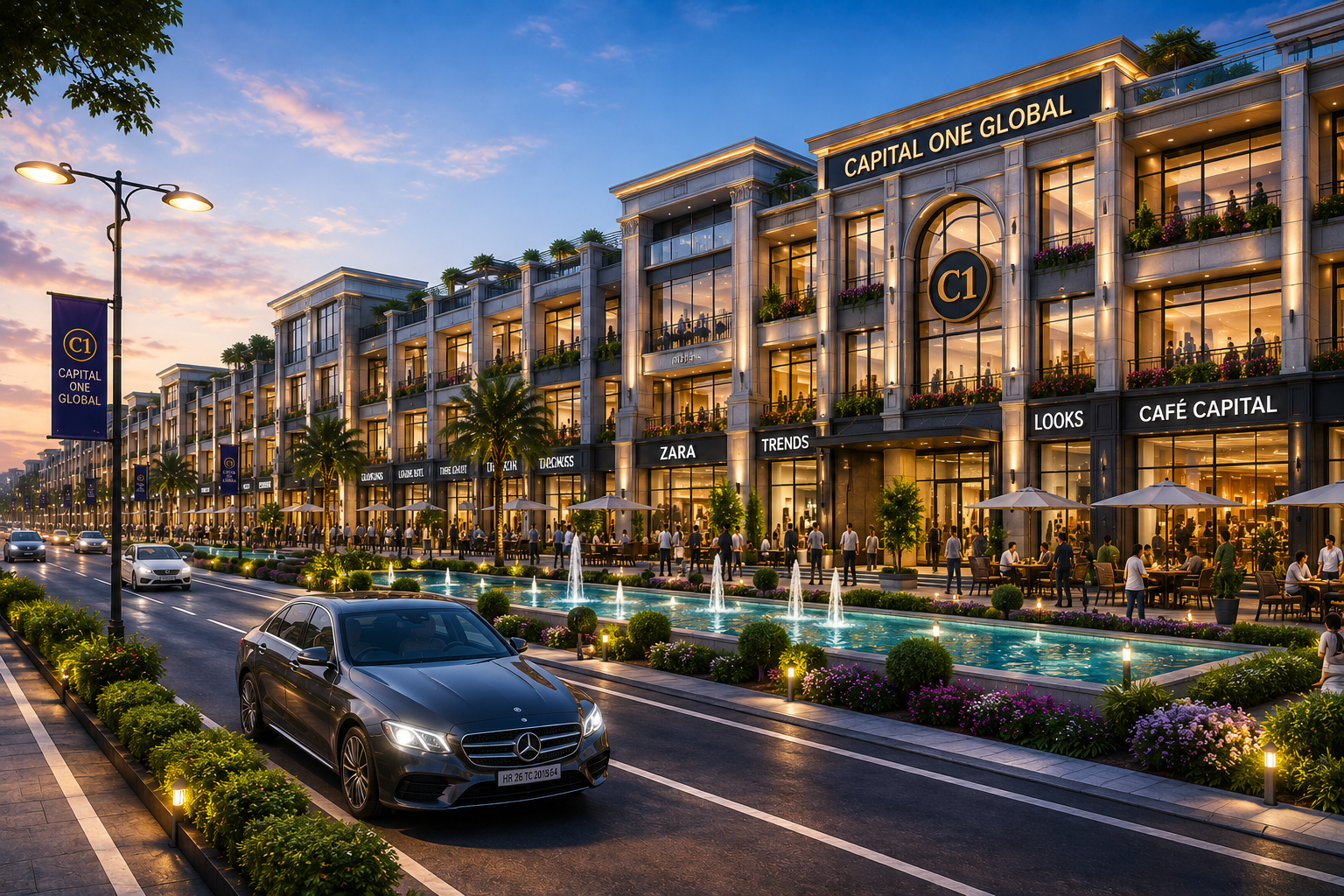
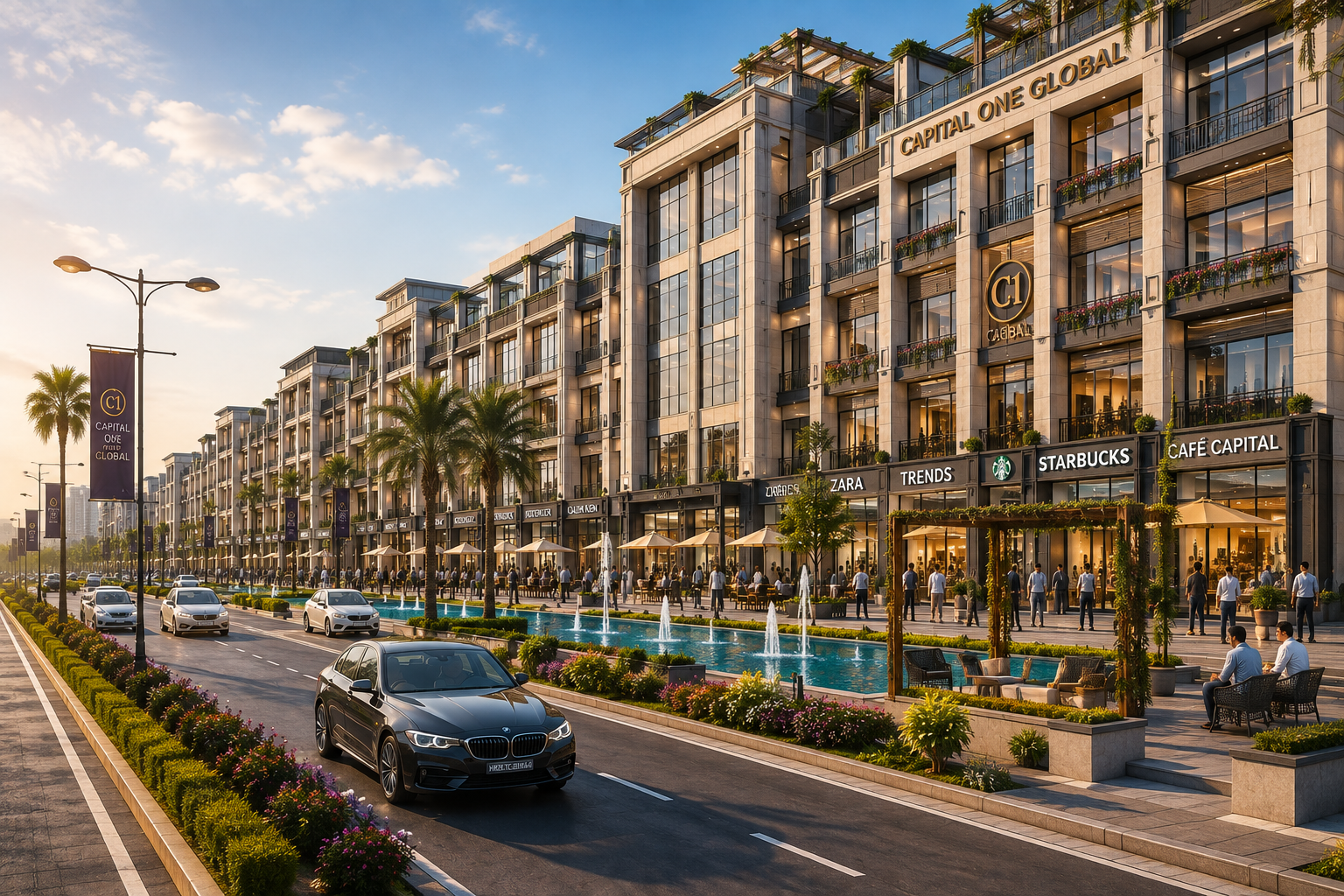
One of the distinctive elements highlighted by the project reference is the presence of approximately 1.145 acres of water bodies and sit-out areas. The source describes the development as a waterfront retail experience and identifies landscaped areas, premium sit-outs and recreational spaces.
For lifestyle-oriented businesses, this can have practical significance.
Restaurants and cafés can benefit from attractive surroundings.
Premium retail brands can use the environment to strengthen customer experience.
Event-oriented businesses may value destination appeal.
An aesthetically strong commercial environment can also support the overall positioning of a business.
However, buyers should not assign a monetary premium to waterfront positioning without assessing the exact plot's relationship to the water feature.
A plot that is adjacent to a visible waterbody may have a different commercial profile from one located farther away.
Access Points and Customer Convenience
The project source describes six entry and exit points across three road sides.
From a commercial planning perspective, multiple access points can help distribute traffic and reduce dependence on a single entrance.
This can be beneficial for:
- Customer arrivals
- Employee movement
- Deliveries
- Emergency access
- Parking circulation
- Service operations
But again, the buyer should inspect the actual internal road layout.
A development can have multiple entrances while a particular plot remains less convenient because of its position.
During the site visit, physically walk from the entrance to the proposed plot.
That simple exercise can reveal details that a master plan may not communicate clearly.
Parking Is a Commercial Requirement
Parking is not merely an amenity.
For many commercial businesses, it directly affects customer conversion.
A customer who cannot find convenient parking may choose another restaurant, clinic, showroom or service provider.
The source identifies ample parking and visitor parking as project features.
Prospective buyers should nevertheless verify:
- Total parking capacity
- Visitor parking
- Parking allocation
- Parking charges
- Peak-hour availability
- Loading and unloading areas
- Access for delivery vehicles
If the intended business expects high customer volumes, parking should be analysed as part of the business model.
Infrastructure Can Affect Long-Term Business Operations
Modern commercial businesses depend heavily on infrastructure.
Reliable electricity is essential.
Internet connectivity is essential for digital payments, cloud systems and communication.
Water supply matters for restaurants, healthcare businesses and other service categories.
Fire safety is critical.
The project page describes 24×7 power backup, water supply, fibre connectivity, fire safety systems, CCTV surveillance and professional security staff among its stated infrastructure features.
The buyer should ask whether these facilities apply to the individual plot, common areas or the development as a whole and what costs are associated with their operation.
Construction Flexibility
A commercial plot's potential depends partly on what can legally and technically be built on it.
The project source states a ground-plus-four-upper-floor configuration and also references a B+G+4+terrace development allowance in its highlights. Because the page contains multiple descriptions, buyers should verify the sanctioned building plan applicable to the exact property before relying on any floor-count statement.
This is particularly important for investors.
More permissible floor area can potentially increase usable commercial space, but it also increases construction costs.
The correct approach is to calculate:
Land Cost + Construction Cost + Statutory Charges + Financing Cost + Fit-Out Cost = Total Project Cost
Only then should expected rental or business income be considered.
How a Business Owner Should Select a Plot
An end-user should begin with the business rather than the property.
Define:
- Target customer
- Required floor area
- Required frontage
- Parking needs
- Storage requirements
- Employee count
- Delivery requirements
- Expected operating hours
- Brand positioning
- Expansion requirements
Then compare available plots against these requirements.
For example, a compact consulting practice may not need a 255-square-yard plot.
A flagship retail brand may find a 101-square-yard plot restrictive.
A restaurant may prioritise visibility and parking over total plot area.
A clinic may require better privacy and access.
A business-focused approach produces a more rational purchase.
How an Investor Should Select a Plot
An investor should approach the property differently.
The key variables include:
- Acquisition price
- Plot size
- Construction potential
- Location premium
- Expected rent
- Tenant profile
- Vacancy risk
- Maintenance cost
- Financing cost
- Exit liquidity
The project source promotes rental and appreciation potential, but it also provides projected return claims that should not be treated as guaranteed outcomes. Actual investment performance depends on market conditions, tenant demand, costs and timing.
A conservative financial model is therefore preferable.
The Importance of Exact Plot-Level Due Diligence
A common mistake is evaluating the project but not the plot.
Commercial property is highly location-sensitive.
Two units within the same development can have different values because of:
- Frontage
- Corner position
- Road width
- Visibility
- Waterbody proximity
- Entry/exit location
- Parking access
- Neighbouring uses
- Signage potential
That is why Capital One Global Commercial Plots should always be evaluated individually.
Request the exact plot plan.
Mark the plot on the master layout.
Check its dimensions.
Walk its surrounding roads.
Understand what will be built next to it.
Then make the investment decision.
What Makes a Good Commercial Plot Location?
A strong commercial plot generally combines several characteristics rather than relying on one.
A useful evaluation framework is:
Accessibility + Visibility + Catchment + Frontage + Parking + Business Compatibility + Infrastructure + Future Development
If most of these factors are strong, the plot may have a solid commercial foundation.
If only one or two are strong, the buyer should investigate further.
For Capital One Global 73, the project's SPR positioning, multiple road access, surrounding residential catchment, commercial ecosystem, waterbody features and planned SCO configuration provide several factors worth examining.
The final decision, however, should depend on the exact plot and the buyer's objective.
A Practical Site-Visit Checklist
During the site visit, inspect the property from the perspective of an actual customer.
Drive to the development.
Observe the road.
Enter through different access points.
Walk toward the plot.
Stand at the proposed storefront.
Look at the surrounding properties.
Check parking.
Observe pedestrian movement.
Return during another time of day if possible.
Then ask yourself:
Would my customer find this location convenient?
That question is often more useful than a long list of brochure features.
Capital One Global 73 Gurgaon is positioned as a commercial SCO development on Southern Peripheral Road in Sector 73, with a Sociozone concept combining retail, office and lifestyle elements. The project reference highlights approximately 7.4 acres of development, a range of plot sizes, multiple road access points, water bodies and sit-out areas, parking and infrastructure facilities.
But the quality of a commercial investment ultimately depends on more than the project's headline features.
A good commercial plot is one that matches its location with a viable business model.
For an entrepreneur, this means choosing a plot that customers can reach, identify and use comfortably.
For an investor, it means choosing a property whose acquisition cost, development potential and future tenant demand create a sensible risk-return proposition.
The best decision is therefore not simply to choose the largest plot, the corner plot or the plot with the highest advertised premium. It is to identify the property whose location, size, frontage, accessibility and financial structure align with the intended commercial objective.
Before purchasing, obtain the latest availability, plot-specific cost sheet, sanctioned plans and applicable approvals. The source page also contains inconsistent inventory references, including 84 plots in the detailed overview and different figures in the highlights, so this information should be verified from current authorised documentation before publication or booking.
When those checks are complete, a site visit can turn a general commercial-property enquiry into an informed plot-selection decision.