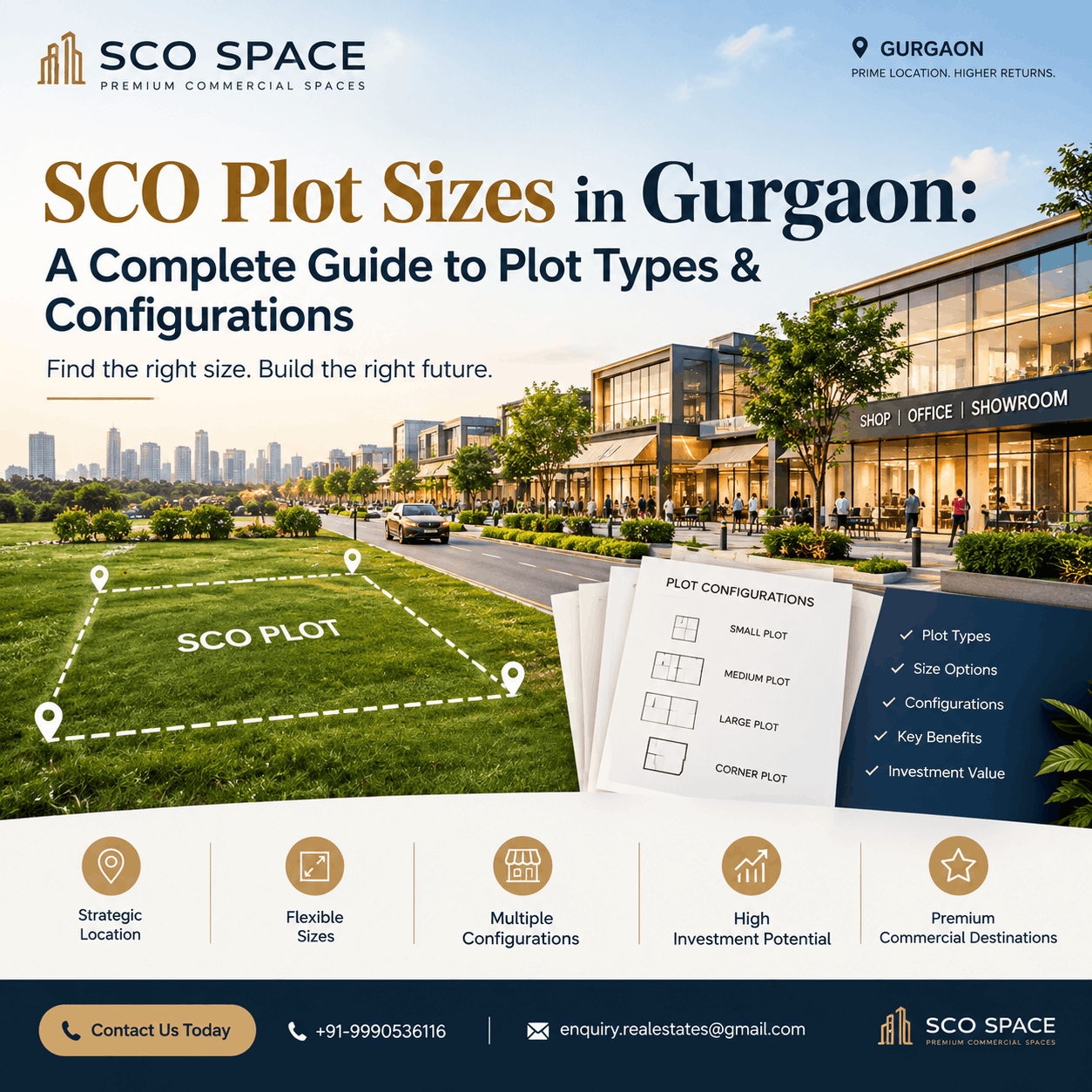
Gurgaon's commercial real estate market has grown around one distinctive product: the SCO plot, or Shop-Cum-Office plot. Unlike a shop in a mall or a floor in an office tower, an SCO plot gives a buyer a freehold piece of commercial land on which retail and office space can be built and used together. For business owners looking for visibility and control, and for investors looking for a leasable commercial asset outside the traditional mall model, SCO plots have become one of the most discussed categories in Gurugram's property market.
This guide looks at the SCO market across Gurgaon as a whole — not any single project — and covers how these plots work, where the main commercial corridors are, what affects pricing, how retail and office buyers should evaluate suitability, and what to verify before signing anything. Where information depends on a specific project, developer, or point in time, that is flagged so it can be checked independently rather than assumed.
What Is an SCO Plot in Gurgaon?
An SCO (Shop-Cum-Office) plot is a freehold commercial plot in Gurgaon, allotted under Haryana's Commercial Plotted Colony Policy, that permits low-rise construction combining retail use on the lower floor(s) with office or business use above. Owners typically build and either occupy or lease the structure floor by floor. Exact permitted heights, floor plans and uses vary by licence and local zoning, so specifics should always be confirmed against the individual plot's approved building plan.
What Are SCO Plots and How Do They Work in Gurgaon?
SCO plots exist because of a specific Haryana government planning category: the Commercial Plotted Colony Policy administered by the Directorate of Town and Country Planning (DTCP). Under this policy, developers are granted a licence to lay out a colony of individual commercial plots rather than build a single large mall or office tower. Each plot is then sold to an individual buyer, who is responsible for constructing their own building within the permitted parameters.
In practice, this creates a street of independently owned buildings, each typically designed with a retail-facing ground floor (and sometimes a lower ground or basement) and one or more upper floors intended for office, showroom, clinic, salon, coaching centre, restaurant, or similar commercial use, subject to what the local building bye-laws and licence conditions allow. Because the buyer owns the land and the structure, they can choose to occupy the space themselves, lease individual floors to different tenants, or sell the developed asset later — subject to the terms of their allotment and any restrictions in the builder-buyer agreement.
This is a meaningfully different ownership model from buying a unit inside a mall or an integrated office park, where a buyer typically owns strata title to one unit within a larger, centrally managed building. With SCO plots, the buyer has more control over design and use, but also carries more direct responsibility for construction, compliance, and building management.
The Regulatory Framework Behind SCO Plots
SCO plots exist as a distinct asset class because of a specific regulatory structure in Haryana, and understanding that structure helps explain both the opportunities and the risks involved. The Commercial Plotted Colony Policy is issued and administered by the Directorate of Town and Country Planning (DTCP), Haryana. A developer applies for and is granted a licence to develop a defined parcel of land as a commercial plotted colony, after which individual plots within that colony are sold to buyers, who then build their own structures within the approved parameters.
Two documents matter most when evaluating any specific SCO project: the DTCP licence, which establishes that the land is legally approved for commercial plotted development, and the project's registration with the Haryana Real Estate Regulatory Authority (HRERA), which governs disclosure requirements, payment schedules, and delivery timelines for real estate projects sold to buyers. A project's RERA registration number and filed details are generally available on the Haryana RERA portal and should be cross-checked against what a developer or broker represents verbally, since brochure claims and RERA filings do not always align exactly.
It is also worth understanding that DTCP approval governs the land and colony layout, while a separate building plan approval governs what can actually be constructed on an individual plot — including permitted height, floor count, setbacks, and parking norms. A plot can be part of a validly licensed colony while an individual buyer's construction still requires its own building plan sanction before work begins. Buyers should ask specifically which approvals are already in place for the plot they are considering, rather than assuming colony-level licensing automatically covers plot-level construction approval.
Understanding Gurgaon's Commercial Growth Corridors
SCO development in Gurgaon is not spread evenly across the city. It clusters along a handful of corridors where residential density, planned infrastructure, and commercial licensing have converged. The main corridors commonly referenced in the market include:
- Dwarka Expressway — an arterial road connecting Delhi's Dwarka sub-city to NH-8/NH-48 near Gurgaon, running through a belt of newer sectors that have seen significant residential and commercial licensing activity in recent years.
- Southern Peripheral Road (SPR) — connects Golf Course Extension Road to Sohna Road, passing through sectors that combine established and newer residential catchments.
- Golf Course Extension Road — an established high-density residential and commercial belt on the southern side of the city.
- New Gurgaon (Sectors in the 80s–100s range, including Sector 67 and neighbouring sectors) — a broad label used in the market for the newer sectors developed along NH-48 and the Dwarka Expressway, distinct from the older "Old Gurgaon" and DLF Phase areas.
Within these broad corridors, the market tends to distinguish between sectors that already have a substantial resident population and established retail activity, and sectors that are still filling up, where residential towers may be delivered but occupancy is still climbing. Sector 67 and its neighbouring sectors along the New Gurgaon belt are frequently referenced in SCO marketing precisely because they sit at this intersection — close enough to established residential clusters and arterial roads to have credible footfall potential, while still offering plots at an earlier stage of colony development than fully built-out corridors like Golf Course Road. Whether that translates into strong near-term retail performance for a specific plot depends on how much of the surrounding residential supply is actually occupied today, which is a detail worth checking directly rather than inferring from a sector number alone.
Each corridor has a different mix of completed residential population versus population still moving in, different road and utility completion status, and different competitive density of commercial plots. Because infrastructure projects in the NCR region are frequently subject to revision and delay, any claim about a specific completion date, travel time, or distance for a road, metro line, or expressway extension should be checked against current official sources rather than taken from marketing material, including this one.
How to Compare Sectors for SCO Investment
Because SCO plots are sold and used individually rather than as part of one managed development, sector- and micro-location-level comparison matters more than it would for a single large commercial building. Buyers evaluating SCO commercial plots in different sectors typically weigh the following factors against each other rather than looking at any one in isolation.
| Comparison Factor | What It Affects | What to Check |
|---|---|---|
| Residential catchment density | Footfall for retail-facing businesses | Number of occupied residential towers/plots within a realistic walking or short-drive radius, not just planned population |
| Road and utility completion | Accessibility, construction timelines, day-one usability | Status of the approach road, water and sewer connections, and power availability at the specific plot |
| Number of competing SCO plots nearby | Tenant/buyer competition, achievable rent | How many other licensed SCO colonies exist within the same catchment |
| Visibility and frontage | Retail performance | Road width facing the plot, corner vs mid-row position, signage rules |
| Mixed-use vs standalone commercial pocket | Whether the corridor sustains footfall outside peak hours | Presence of offices, schools, or institutional catchments nearby, not just housing |
| Regulatory/licence status | Legal usability of the plot | Confirm the licence number, DTCP approval, and any RERA registration for the specific colony |
No single factor determines whether a location will perform well commercially. A plot with strong current footfall in an established corridor and a plot in an emerging corridor with lower current footfall but a larger incoming residential base represent genuinely different risk-return profiles, and the right choice depends on the buyer's own timeline and risk tolerance rather than a generic ranking.
SCO Plot Configuration, Sizes and Unit Conversions
SCO plots are typically marketed in square yards, though building plans and RERA filings may reference square metres or square feet. Plot sizes vary considerably between projects and are set by the individual licence and layout plan, so no single "standard" SCO plot size applies across Gurgaon. Buyers should treat any specific plot size, floor plate, or number of permitted floors as project-specific information to be confirmed from the approved layout plan rather than assumed from another project.
For reference, the standard area conversions used across Gurgaon real estate documentation are:
| Unit | Conversion |
|---|---|
| 1 square metre | ≈ 10.7639 square feet |
| 1 square metre | ≈ 1.19599 square yards |
| 1 square yard | = 9 square feet |
Configuration types commonly referenced in SCO project marketing include smaller units suited to cafes, kiosks, or boutique retail, mid-sized units suited to standard retail outlets or service businesses, and larger corner or showroom-format plots suited to bigger retail formats or businesses that need higher visibility. The specific type labels (often "Type A," "Type B," "Type C," and so on) differ by developer and are not standardised across the market, so they should not be compared across projects without checking the actual carpet and built-up areas involved.
What Affects SCO Plot Pricing in Gurgaon?
SCO plot prices in Gurgaon are not fixed by any central authority and vary by project, location, plot size, floor allocation, and prevailing market conditions at the time of sale. Because pricing changes frequently and differs plot-to-plot even within the same colony, no specific per-square-yard or total price figure is stated here — any price quoted for a project should be treated as current only as of the date it was verified, and reconfirmed directly with the seller or developer before making a decision.
Factors that commonly influence how one SCO plot is priced relative to another in the same broad area include:
- Corner vs mid-plot position — corner plots generally command a premium due to dual-frontage visibility.
- Road-facing width — plots facing wider arterial roads are typically priced above interior plots.
- Floor being sold — ground floor retail space usually carries a different valuation than upper-floor office space within the same building.
- Construction and possession status — a ready or near-ready plot with an existing structure is priced differently from an undeveloped plot at an early launch stage.
- Distance from the primary access road or planned metro/transit point — proximity premiums exist but should be verified against actual, current infrastructure status rather than projected timelines.
- Overall market demand cycle — like all real estate, SCO pricing responds to broader NCR commercial demand, interest rates, and investor sentiment, which shift over time.
Buyers comparing prices across projects should also separate the base plot price from additional costs — including External Development Charges (EDC), Infrastructure Development Charges (IDC), preferential location charges (PLC), club or maintenance deposits, and applicable GST — since these can materially change the effective cost per square yard and are sometimes quoted separately in marketing material.
Is an SCO Plot Right for Your Business? Retail vs Office Suitability
Because SCO plots combine retail and office floors in one building, suitability depends heavily on which floor and format a business actually needs.
Retail Suitability
Ground-floor SCO units generally suit businesses that depend on walk-in footfall and street visibility — for example, F&B outlets, salons, retail showrooms, pharmacies, and convenience formats. For these businesses, the residential catchment size, road frontage, parking availability, and signage visibility of the specific plot matter more than the SCO format itself. A retail business evaluating an SCO plot for sale in Gurgaon should assess the corridor's actual current footfall, not just its projected future population.
Office Suitability
Upper-floor SCO space tends to suit smaller professional offices, clinics, coaching centres, consultancy firms, and back-office functions that need dedicated, self-contained space but do not depend on ground-level walk-in traffic. For these uses, lift availability, parking allocation, floor plate efficiency, and power backup provisions are typically more relevant than street frontage.
Because SCO buildings are individually constructed rather than centrally managed like a Grade-A office park, the quality of common-area maintenance, lift service, security, and building upkeep can vary significantly from one SCO building to the next, even within the same colony. This is worth physically inspecting rather than assuming from renders or brochures.
Customer Catchment and Commercial Demand Drivers
For a retail or service business, the value of a location comes largely from who is realistically likely to walk in or drive by — its customer catchment — rather than the headline population figure for the sector. When evaluating catchment, useful questions include:
- How many residential units in the immediate vicinity are actually occupied today, as opposed to sold but vacant or still under construction?
- Is the corridor primarily residential, or does it also draw daytime footfall from offices, schools, hospitals, or institutional campuses nearby?
- How much existing retail and service competition already operates in the same stretch, and is it currently under- or over-supplied relative to demand?
- Is there adequate parking and safe pedestrian access, particularly for evening and weekend footfall?
Demand for SCO space in a given corridor is generally driven by a combination of nearby residential absorption, connectivity to employment hubs, and the pace at which competing commercial supply is being added. All three factors move over time, and a corridor that looks under-supplied today can see a wave of new SCO launches within a short period, changing the competitive picture for existing owners.
Investment Analysis: Liquidity, Risk and Exit Considerations
SCO plots are frequently marketed as an investment vehicle, not only as owner-occupied business space. For investors, several dimensions are worth evaluating together rather than in isolation, and none of them should be assumed to guarantee a particular outcome.
| Dimension | What to Evaluate |
|---|---|
| Rental potential | Depends on actual tenant demand in that corridor at the time of leasing, not on projected figures in sales material. Achievable rent should be benchmarked against comparable operating SCO units nearby, not asking rents alone. |
| Capital appreciation | Historical price movement in a corridor does not guarantee future movement. Appreciation depends on infrastructure delivery, absorption of surrounding residential supply, and broader market cycles. |
| Liquidity | Individual commercial plots are generally less liquid than residential apartments; resale timelines can be longer, particularly for upper-floor or interior-plot units with less visibility. |
| Holding period | Buyers should have a realistic view of how long they may need to hold the asset before an exit at an acceptable price becomes likely, factoring in construction time if the plot is undeveloped at purchase. |
| Vacancy risk | A leased unit generates income only while occupied; gaps between tenants, especially in newly developing corridors, should be budgeted for. |
| Competitive supply risk | A wave of new SCO launches in the same corridor can increase vacancy and put downward pressure on achievable rents for existing owners. |
None of these factors, individually or together, guarantee returns, appreciation, or rental income. They are the variables an investor should weigh, ideally with independent market data and professional advice, before committing capital.
Financing and the True Cost of Ownership
Most banks and NBFCs offer commercial property loans against SCO plots, though loan-to-value ratios, interest rates, and eligibility criteria for commercial purchases typically differ from residential home loans and vary by lender. Beyond the loan itself, buyers should budget for costs that are sometimes left out of headline pricing discussions:
- Stamp duty and registration charges, which vary by state and are periodically revised by the Haryana government.
- GST on under-construction commercial property, where applicable.
- Construction cost for building out the structure, if the plot is sold undeveloped.
- Ongoing maintenance charges, property tax, and any club or association fees specific to the colony.
- Brokerage or legal fees associated with the transaction.
Because these figures change with policy updates and vary by project, current rates should always be confirmed with the relevant government department, lender, or a qualified professional rather than assumed from general market commentary.
Common Buyer Mistakes to Avoid
- Treating projected population as current footfall. A sector's planned residential capacity is not the same as how many people currently live and shop there.
- Comparing "Type" labels across developers as if standardised. Plot and floor typologies differ by project; always check actual carpet area.
- Ignoring floor-specific differences within the same SCO building. Ground floor and upper floor units can have very different use cases, pricing, and demand.
- Skipping verification of DTCP licence and RERA registration. Not all commercial plotted colonies are registered identically; this should be confirmed plot by plot.
- Underestimating additional charges. EDC, IDC, PLC, GST, and maintenance deposits can add materially to the base plot price.
- Assuming construction and possession timelines will hold exactly as marketed. Construction-linked plans and possession dates in the commercial plotted-colony segment are subject to delay, as with most real estate development.
- Not physically visiting the site and the surrounding corridor. Brochure renders and Google Maps views do not substitute for seeing current road access, construction status, and existing footfall in person.
Buyer Due-Diligence Checklist
Before committing to any SCO plot — whether for self-use or investment — buyers are generally advised to verify the following, ideally with the help of a property lawyer and, where relevant, a chartered accountant:
- Title documents — confirm clear, marketable title and chain of ownership for the underlying land.
- DTCP licence details — confirm the licence number and that the plot falls within the licensed area for commercial plotted development.
- RERA registration — check the project's registration status on the Haryana RERA portal, where applicable, and cross-check promised timelines against the RERA-filed project details.
- Approved building plan — confirm permitted floors, height, and use match what is being marketed.
- Development status — physically verify current construction progress against what the seller represents.
- Permitted use — confirm the specific business use intended (retail, F&B, clinic, office, etc.) is actually allowed under the plot's zoning and licence conditions.
- Parking and access provisions — check allocated parking, loading access for retail, and fire/emergency access compliance.
- Payment plan and builder-buyer agreement terms — review payment milestones, penalty clauses, and any resale or leasing restrictions in the agreement.
- Taxes and registration costs — confirm current stamp duty, registration charges, and applicable GST with a professional.
- Maintenance and common-area management structure — understand who is responsible for upkeep of shared spaces, roads, and utilities within the colony.
- Liquidity and exit expectations — realistically assess how easily comparable units in the same colony have historically resold or been leased.
Professional legal, financial, and tax verification is strongly recommended before signing any agreement or making any payment, since documentation and regulatory requirements can vary by project and change over time.
Overall Assessment
SCO plots have become a distinct and actively marketed category within Gurgaon's commercial real estate landscape, offering buyers freehold ownership and design flexibility that differs meaningfully from mall or Grade-A office ownership models. Their performance — whether measured by business suitability, rental income, or resale value — depends heavily on corridor-specific factors: actual current footfall versus projected population, road and utility completion, competitive supply of nearby SCO colonies, and the specific floor and configuration being purchased. Growth corridors such as the Dwarka Expressway, Southern Peripheral Road, Golf Course Extension Road, and the broader New Gurgaon sectors each present a different mix of current maturity and future potential, and none should be assumed to outperform the others without corridor-level and plot-level verification.
Buyers and investors evaluating this market are best served by treating every price, timeline, and yield claim as project-specific information to be independently verified, and by working through a structured due-diligence process — covering title, licensing, RERA status, and total transaction cost — before committing capital to any individual plot.
Investment Disclaimer
This article is for general informational purposes only and does not constitute investment, legal, financial, or tax advice. Real estate prices, approvals, infrastructure timelines, and regulatory requirements change over time and vary by project. No guarantee of returns, rental income, appreciation, or resale value is made or implied. Readers should conduct independent due diligence and consult qualified legal, financial, and tax professionals before making any property purchase or investment decision.
Frequently Asked Questions
1. What are SCO plots in Gurgaon?
SCO (Shop-Cum-Office) plots are freehold commercial plots allotted under Haryana's Commercial Plotted Colony Policy, allowing owners to construct low-rise buildings combining retail use on lower floors with office or business use above, subject to the specific licence and approved building plan.
2. How do SCO plots work compared to a mall unit or office floor?
Unlike a strata-titled mall unit or office floor within one large managed building, an SCO plot gives the buyer ownership of the underlying land and full responsibility for constructing, managing, and maintaining their own building, offering more design and usage flexibility but less centralised facility management.
3. What affects SCO plot prices in Gurgaon?
Pricing is influenced by factors such as corner versus mid-plot position, road frontage width, which floor is being sold, construction and possession status, proximity to major access roads, and overall market demand at the time of sale. Prices vary by project and should always be confirmed as of a specific date.
4. Which corridors in Gurgaon are known for SCO developments?
SCO colonies are commonly found along the Dwarka Expressway, Southern Peripheral Road, Golf Course Extension Road, and across the newer sectors broadly referred to as New Gurgaon, including areas around Sector 67. Each corridor differs in current maturity, connectivity, and competitive supply.
5. Are SCO plots suitable for retail businesses?
Ground-floor SCO units can suit retail businesses that depend on footfall and street visibility, but suitability depends on the specific plot's frontage, parking, and the actual current customer catchment of the surrounding corridor, not just the sector's projected population.
6. Are SCO plots suitable for office use?
Upper-floor SCO space can work well for professional offices, clinics, or service businesses that need dedicated space without depending on ground-level walk-in traffic, though buyers should check lift access, parking allocation, and building maintenance standards, which vary between individual SCO buildings.
7. What should buyers verify before purchasing an SCO plot?
Key items include title documents, DTCP licence details, RERA registration status, the approved building plan and permitted use, current construction status, payment plan terms, and all applicable charges such as EDC, IDC, PLC, GST, and stamp duty. Professional legal and financial verification is recommended.
8. Are SCO plots in Gurgaon freehold?
Most SCO plots marketed in Gurgaon are described as freehold commercial property, but ownership structure and any restrictions should be confirmed from the specific title documents and builder-buyer agreement for each project rather than assumed.
9. What size do SCO plots typically come in?
Plot and floor plate sizes vary by project and licence, and there is no single standardised SCO plot size across Gurgaon. Buyers should confirm exact dimensions from the approved layout plan and use standard conversions (1 sq. m. ≈ 10.7639 sq. ft. ≈ 1.19599 sq. yd.) when comparing figures across documents.
10. What factors should investors compare before buying SCO property in Gurgaon?
Investors typically compare residential catchment density, road and utility completion, competitive SCO supply nearby, achievable rent versus asking rent, liquidity of comparable resale units, and total transaction cost — evaluating these together rather than relying on any single metric, and without assuming guaranteed appreciation or rental income.