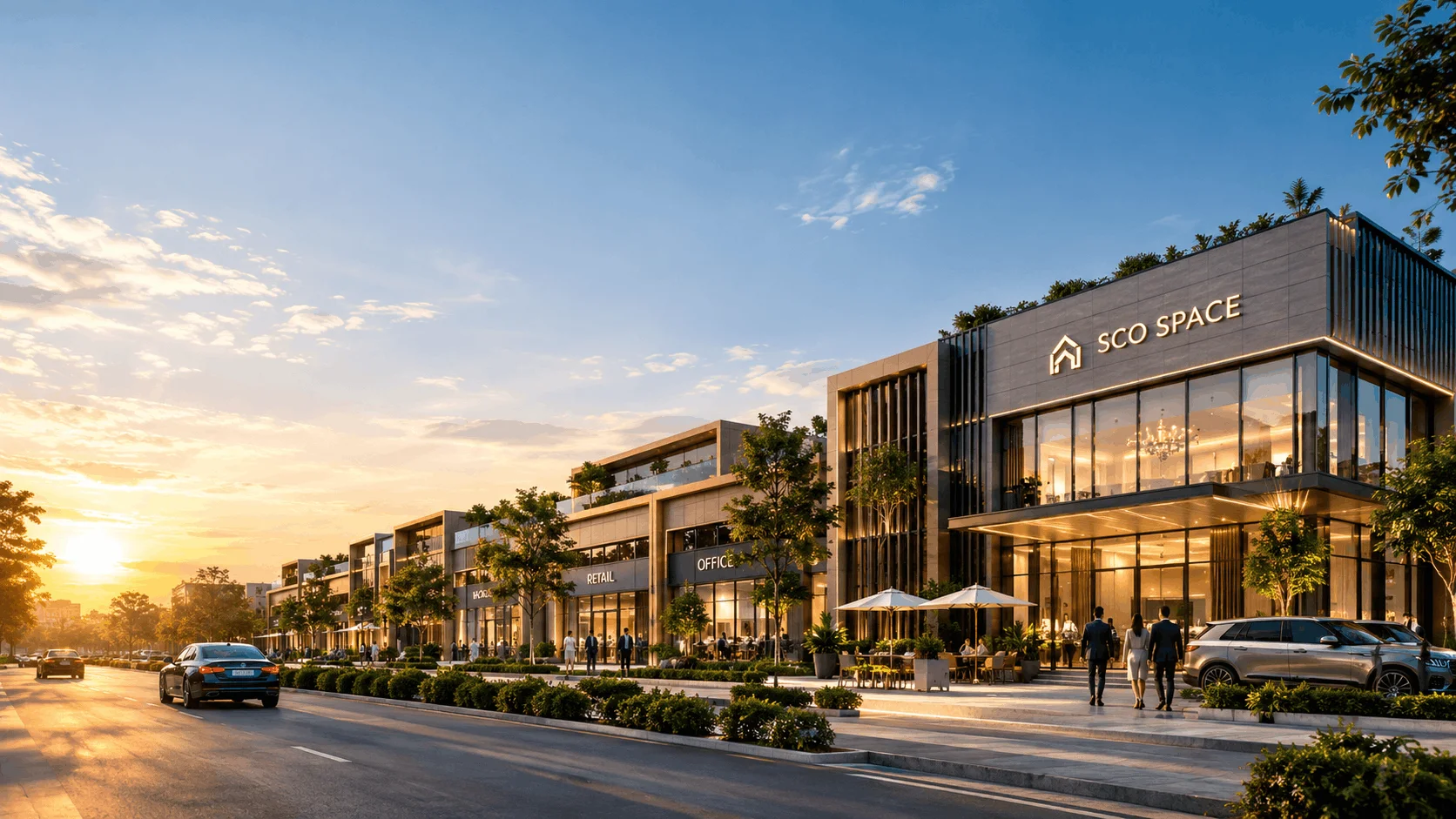
SCO Plot Due Diligence Checklist 15 Things Gurgaon Buyers Should Verify
Understanding the Topic
Shop Cum Office (SCO) plots are small commercial plots, usually meant for ground-floor retail with offices or other commercial use above. In Gurgaon they sit along growth corridors such as Southern Peripheral Road, Golf Course Extension Road and Dwarka Expressway. The category attracts business owners and investors. But a commercial plot is only as good as its paperwork, approvals and permitted use. This guide walks through SCO plots from a verification point of view. It lists 15 checks, explains why each matters, shows what documents to ask for, and flags the risks that often get overlooked.
What Should You Verify Before Buying an SCO Plot in Gurgaon?
Before buying an SCO plot in Gurgaon, verify the seller's title and ownership chain, the land licence and zoning, RERA registration where applicable, the approved plot size and permitted use, building rules, parking and access, encumbrances, payment terms, all charges and taxes, financing eligibility, and the exit and resale position. Confirm everything against official documents.
Why Due Diligence Matters More for Commercial Plots
Residential buyers often focus on location and price. Commercial buyers carry additional exposure. The plot's permitted activities, floor-area limits, parking norms and access arrangements directly decide what business can run there and how the property can be financed, rented or resold.
A few features make SCO purchases different from a standard apartment purchase:
- Use is regulated. Commercial plots are usually governed by the licence, layout plan and applicable building rules, and not every activity may be allowed.
- Ticket sizes are usually larger. A documentation gap can mean a bigger financial consequence.
- Value depends on the surrounding commercial ecosystem, including footfall, neighbouring plots, access roads and parking, which a buyer cannot control.
- Exit depends on a smaller buyer pool than residential property typically has.
The checklist below follows the order in which most buyers actually proceed: ownership first, then approvals, then physical and financial details, then exit planning.
The 15-Point SCO Plot Due Diligence Checklist
1. Title and Ownership Chain
The first question is whether the seller can legally sell what they are offering. Ask for the complete chain of title documents, from the original allottee or landowner to the current seller.
- Sale deeds, allotment letters or conveyance documents, as applicable
- Mutation records and revenue records, where relevant
- Any power of attorney or authorisation documents, and proof they remain valid
- Identity and authority documents of the signing party
Gaps in the chain, unexplained transfers or documents that do not match one another are reasons to pause. A property lawyer should review the chain, not just the latest document.
2. Land Licence and Zoning Status
Commercial colonies and plotted commercial developments in Haryana are generally regulated through licences issued by the state's town and country planning authorities. Ask for the licence number, its validity, the licensed land area and the name of the licence holder.
Also confirm that the specific plot falls inside the licensed area and that the licence is current. A licence that has lapsed or covers a different parcel is a serious flag. Verify these details directly with the relevant authority or its official records, not just from the seller's copy.
3. Approved Layout and Zoning Plan
Ask for the approved layout or zoning plan and locate the plot on it. Compare the plot number, dimensions, abutting road widths and neighbouring land uses against what you were told.
This step catches practical mismatches. A plot sold as "main road facing" may in the approved plan face an internal road. A plot shown near open space may sit next to a utility zone. The plan is the reference document, and marketing material is not.
4. RERA Registration Status
Where a project falls under the Real Estate (Regulation and Development) Act, check whether it is registered with the Haryana Real Estate Regulatory Authority and whether the registration is current. The registration normally carries project details, timelines and promoter information that you can compare against what the seller says.
Not every transaction falls under RERA. Resale of a completed plot, for example, may sit differently from a new project sale. Ask directly whether RERA applies to your transaction, and check the official portal rather than relying on a number quoted verbally. Registration is a useful transparency tool. It is not a guarantee of commercial performance.
5. Plot Specifications and Area Conversions
Confirm the plot's area in the unit used in official documents, then check conversions carefully. Indian property documents may use square metres, square yards or square feet, and mismatched units cause real confusion.
Use these standard conversions:
- 1 sq. m. ≈ 10.7639 sq. ft.
- 1 sq. m. ≈ 1.19599 sq. yd.
The table below shows how conversions work using purely illustrative sizes. These are not actual plot sizes from any development.
| Illustrative area (sq. m.) | Approx. sq. ft. | Approx. sq. yd. |
|---|---|---|
| 100 | 1,076.39 | 119.60 |
| 200 | 2,152.78 | 239.20 |
| 300 | 3,229.17 | 358.80 |
| 500 | 5,381.95 | 598.00 |
Ask for the plot's frontage, depth and shape too, not just the total area. Two plots of equal area can behave very differently commercially if one is wide and shallow and the other is narrow and deep.
6. Development and Infrastructure Status
Check the actual state of the site, not only the brochure. Is the land developed or still being developed? Are internal roads, drainage, water supply, power connections and sewerage in place, or only planned?
A site visit is essential. Photograph the plot, the approach roads and the neighbouring structures. If infrastructure is promised, ask for the written commitment, the responsible party and the timeline. Treat verbal timelines as unverified.
7. Permitted Use and Allowed Activities
"Commercial" is a broad word. Confirm exactly which activities are permitted on the plot: retail, showroom, offices, food and beverage, banking, clinics, co-working or others. Some uses may need additional permissions or may be restricted under the applicable rules.
This matters most for owner-operators. A café, a clinic and a software office each have different requirements for ventilation, fire safety, parking and licensing. Verify your intended use in writing against the licence conditions and building rules. Do not assume it.
8. Building Regulations: Floor Area, Height and Setbacks
Ask for the applicable rules on floor area ratio, ground coverage, permissible height, setbacks, basement provisions and any restrictions on mezzanine or terrace use. Rules can differ by plot size, location and the conditions attached to the licence, and they can change over time.
Ask the seller or developer for the sanction process and any pre-approved building plan, if one exists. Then have an architect or planning consultant estimate what can actually be built. The buildable area decides the usable area, and the usable area decides income potential.
9. Parking and Access Provisions
Parking is one of the most underestimated commercial factors. A shop with no practical parking may struggle to draw customers, however busy the road is. Confirm how parking is handled: on-plot parking requirements, shared or common parking, basement options and any restrictions on roadside parking.
Check access separately. Look at the width of the approach road, whether entry and exit points are direct, how service vehicles can reach the plot, and whether road widening or median cuts are planned. These details shape both footfall and the day-to-day operation of a business.
10. Encumbrances, Litigation and Mortgages
Check whether the plot is free from claims. An encumbrance search across the relevant period shows registered mortgages, charges and certain other transactions. Separately, search court records for litigation involving the land, the seller or the developer.
Ask the seller to confirm in writing whether the plot is mortgaged to a bank or financial institution. If it is, understand how and when the charge will be released and who will provide the no-objection documents. Verbal assurances are not enough for any of these points.
11. Payment Plan and Agreement Terms
Read the agreement before paying anything beyond a token amount. Look closely at the payment schedule, what each instalment is linked to, cancellation and refund conditions, delay clauses, penalties and dispute resolution terms.
Pay attention to whether payments are linked to verifiable milestones, what happens if the seller delays, and whether the agreement matches the draft discussed earlier. Have a lawyer review the agreement and compare the final text against any earlier term sheet.
12. Maintenance, Development and Other Charges
The price quoted may not be the total outlay. Ask for a written list of every charge that may apply: external and internal development charges, maintenance deposits, ongoing maintenance, club or common-area fees where relevant, electricity and water connection costs, and any transfer charges on resale.
Ask which charges are already paid, which are due and which may be revised later. Clarity here prevents unpleasant surprises after possession, and it feeds directly into an accurate cost-of-ownership calculation.
13. Taxes, GST, Stamp Duty and Registration
Taxes and registration costs can change the real cost of a commercial purchase, and the position can differ based on whether the property is under construction, ready or a resale. Ask a qualified tax professional which indirect taxes apply to your transaction, what stamp duty and registration charges apply at the time of purchase, and how income from the property would be taxed.
Rates and rules change. Do not rely on a figure from an old article, including this one. Confirm the current position with a chartered accountant or tax adviser and with official sources before you commit.
14. Financing and Loan Eligibility
Not every commercial plot is equally easy to finance. Lenders usually run their own legal and technical checks, and they may have conditions on approvals, plot type and borrower profile. Commercial property loans can also differ from home loans in tenure, rates and margin requirements.
Speak to lenders early and ask what they need from the property. If a bank declines to finance a plot, ask why. It may point to a documentation or approval issue that you should understand before you invest your own money.
15. Possession, Completion Status and Exit Considerations
Finally, understand what you are receiving and how you might leave. Confirm the possession status, the handover process and the documents you will receive on registration. If construction is part of the deal, check completion and occupation requirements as they apply.
Then consider the exit. A smaller pool of commercial buyers, vacancy cycles and local competition can all affect how quickly a property sells or rents. Ask yourself how you would exit if your business plan changed or the surrounding market softened, and whether the documentation will make a resale straightforward for the next buyer.
Summary Table: What to Check and What to Ask For
| # | Check | Key documents or sources | Common red flag |
|---|---|---|---|
| 1 | Title and ownership chain | Sale deeds, allotment papers, mutation records | Gaps or mismatches in the chain |
| 2 | Land licence and zoning | Licence copy, authority records | Expired licence or different land parcel |
| 3 | Approved layout plan | Zoning or layout plan | Plot position differs from the pitch |
| 4 | RERA status | Official RERA portal | Registration lapsed or details inconsistent |
| 5 | Plot specifications | Documents, survey details | Unit confusion, undisclosed shape issues |
| 6 | Development status | Site visit, written commitments | Infrastructure promised but not delivered |
| 7 | Permitted use | Licence conditions, rules | Intended business not clearly allowed |
| 8 | Building rules | Applicable norms, architect's view | Buildable area lower than expected |
| 9 | Parking and access | Plan, site inspection | Poor access or insufficient parking |
| 10 | Encumbrances and litigation | Encumbrance search, court record search | Undisclosed mortgage or dispute |
| 11 | Payment and agreement terms | Draft and final agreement | One-sided penalty or refund clauses |
| 12 | Maintenance and other charges | Written charge schedule | Charges not disclosed upfront |
| 13 | Taxes and registration | Tax adviser, official sources | Relying on outdated rates |
| 14 | Financing | Lender feedback | Lenders declining without a clear reason |
| 15 | Possession and exit | Handover documents, market view | No realistic exit plan |
How to Evaluate SCO Location Factors Alongside the Paperwork
Documents confirm that a purchase is legal. Location helps decide whether it makes commercial sense. Gurgaon's commercial growth has spread across several corridors, and each has its own character, so compare them on observable factors rather than on assumptions.
Begin with the corridor itself. Buyers researching SCO plots on Dwarka Expressway, for example, will want to look at how residential occupancy and commercial supply in the surrounding sectors are developing. The same applies to Southern Peripheral Road and Golf Course Extension Road, each of which serves a different catchment.
Then look at the micro-location:
- Catchment: Who lives, works or passes nearby, and how many of them are already there rather than projected?
- Visibility and frontage: Can customers see the unit from the main road?
- Accessibility: How do customers arrive, by car, metro-linked transport, auto or on foot?
- Competition: How many similar commercial units are planned or already vacant nearby?
- Anchor activity: Are there offices, schools, hospitals or large residential clusters that create steady demand?
Do not rely on quoted travel times or distances from marketing material. Measure them yourself at the hours your business would actually operate.
Retail, Office or Mixed Use: Matching the Plot to the Business
The right plot depends on the business. A quick comparison helps frame the decision.
| Factor | Retail or showroom | Office use | Food and beverage |
|---|---|---|---|
| Frontage importance | Very high | Moderate | High |
| Parking sensitivity | High | Moderate | High |
| Footfall dependence | High | Low to moderate | High |
| Approval complexity | Moderate | Lower | Often higher |
| Upper-floor value | Depends on access | Often well suited | Depends on rules |
Ground-floor retail normally depends on footfall and visibility. Upper-floor offices depend more on access, lifts, parking and the surrounding professional ecosystem. Food and beverage operators should check licensing, ventilation and fire norms in advance. In every case, test your assumptions against permitted use before you pay.
Investment Analysis What Investors Should Compare
An SCO plot may appeal to investors who want commercial exposure at a smaller ticket size than a larger commercial building. Whether it works for a particular investor depends on the numbers and the risks, not on the category alone.
Entry cost. Add the plot price, all charges, taxes, registration costs and any construction cost if the plot is undeveloped. Compare the total, not the headline price.
Income potential. Rental income depends on demand for the specific unit type in that micro-market, on vacancy periods and on tenant quality. Any rental figure quoted to you is an estimate until it is backed by signed leases or comparable local data. Verify it independently.
Holding costs. A vacant unit still carries maintenance, taxes, interest and opportunity cost. Model a realistic vacancy period rather than assuming immediate occupancy.
Capital appreciation. Past price movement does not guarantee future movement. Appreciation depends on infrastructure delivery, supply, demand and wider market conditions, none of which anyone can promise.
Liquidity and exit. Commercial property can take longer to sell than residential property, and the buyer pool is narrower. Think about holding period and exit route before you buy.
Financing structure. Interest costs, loan eligibility and repayment terms affect net returns. Stress-test your plan against changes in interest rates and vacancy.
A sensible approach is to build three scenarios, conservative, base and optimistic, using inputs you have verified. If the investment only works in the optimistic case, that is itself useful information.
Common Mistakes Gurgaon SCO Buyers Make
- Relying on verbal assurances. Anything that matters should appear in a document.
- Skipping the site visit. Photographs and renders do not show access, neighbouring activity or traffic.
- Ignoring permitted use. A buyer discovers too late that the intended business needs extra permissions.
- Underestimating total cost. Charges, taxes and fit-out costs add up beyond the quoted price.
- Overlooking parking. Footfall means little if customers cannot stop.
- Comparing only price per square yard. Frontage, buildable area and access change real value.
- Skipping independent legal review. Documents from the seller's side are not an independent check.
- Assuming returns. Projected yields and appreciation are not facts.
- Planning no exit. Buyers who think only about entry can be surprised by a slow resale.
How to Run the Due-Diligence Process Step by Step
- Shortlist plots by business fit and location, not only by price.
- Request documents for each of the 15 checks and keep a written log of what you received and when.
- Visit the site at different times of day and speak to nearby occupiers.
- Verify independently with official records and portals rather than only the seller's copies.
- Engage professionals: a property lawyer for title and agreement, a tax adviser for costs, and an architect for buildable area.
- Test financing with at least one lender before signing.
- Model the numbers across conservative, base and optimistic cases.
- Review the final agreement line by line against everything you were told.
- Complete registration and collect all original documents, receipts and certificates.
Buyers comparing SCO commercial plots across sectors can apply the same process to each shortlisted plot, which makes the comparison fairer and the paperwork easier to track.
Where Individual Developments Fit In
Market-level research should come before any decision about a specific development. Once you have a shortlist, apply the same 15 checks to each. For example, someone evaluating a development such as DLF Central 67 should still confirm licence, RERA status, permitted use, plot details and charges against official documents and the developer's current written disclosures. Project pages and brochures are starting points, not substitutes for verification.
Buyers who want to browse available options can review listings of SCO plots for sale in Gurgaon, and those following newer supply can look at SCO plots in New Gurgaon. In both cases, current availability, size and pricing should be confirmed directly and dated at the time of enquiry, because they change.
Putting It All Together
SCO plots in Gurgaon can suit business owners who want their own commercial premises and investors who want commercial exposure, but the category rewards careful verification. The 15 checks above cover the core of the process: ownership, licence and layout, RERA, specifications, permitted use, building rules, parking and access, encumbrances, agreement terms, charges, taxes, financing and exit. Location analysis then tests whether the plot suits the business or investment plan, and the investment analysis tests whether the numbers hold up under realistic assumptions.
No checklist removes risk. Market demand, vacancy, competition, regulation and interest rates can all change outcomes. What diligence does is replace assumptions with documents and make the remaining risks visible. Buyers who verify before paying, take independent legal, tax and technical advice, and plan an exit as carefully as an entry put themselves in a stronger position to decide.
Investment Disclaimer
This article is for general information only and is not legal, financial, tax or investment advice. Commercial property carries risk, and returns, rental income and appreciation are not guaranteed. Rules, charges, tax rates and approvals change and may differ by plot and transaction. Confirm all details with official sources and qualified professionals before making any decision.
Frequently Asked Questions
1. What documents should I check first when buying an SCO plot in Gurgaon?
Start with the title and ownership chain: sale deeds, allotment or conveyance papers, and revenue records. Then check the land licence, approved layout plan and RERA registration where applicable. These establish whether the seller can legally sell the plot and whether the land is approved for commercial use. Have a property lawyer review them independently.
2. Is RERA registration mandatory for SCO plots?
It depends on the project and the transaction. Many commercial projects fall within RERA's scope and must be registered, while some transactions, such as certain resales of completed property, may be treated differently. Ask the seller directly whether RERA applies, and check the official Haryana RERA portal for registration status and project details.
3. How do I confirm that a plot is approved for commercial use?
Check the land licence, the approved zoning or layout plan and the licence conditions, then compare the plot number and dimensions against the plan. Verify these with the relevant authority's official records rather than relying only on the seller's copies. Confirm that your specific intended activity is permitted, because commercial use covers many categories.
4. What costs should I budget for beyond the plot price?
Budget for registration and stamp duty, applicable taxes, development and maintenance charges, utility connections, legal and professional fees, and construction or fit-out costs if relevant. If you borrow, add loan processing and interest costs. Ask for a written schedule of every charge, and confirm current tax and duty rates with a qualified adviser.
5. How do I convert SCO plot sizes between square metres, feet and yards?
Use 1 sq. m. ≈ 10.7639 sq. ft. and 1 sq. m. ≈ 1.19599 sq. yd. For example, 200 sq. m. is about 2,152.78 sq. ft. or 239.20 sq. yd. Always confirm the area stated in the official documents, and check frontage and depth too, since shape affects usability.
6. Why does parking matter so much for an SCO plot?
Parking affects whether customers and tenants can reach the property conveniently, which influences footfall, rental appeal and business operations. Check on-plot requirements, shared or basement options and nearby roadside rules. A plot with strong visibility but poor parking can underperform for retail and food-related businesses.
7. Can I get a loan to buy an SCO plot?
Often, but eligibility varies by lender, borrower profile and the property's approvals and documentation. Commercial loans can differ from home loans in tenure, interest rates and margin requirements. Approach lenders before signing, ask what they require, and treat a refusal as a prompt to find out what documentation issue may be behind it.
8. What are the main risks of investing in an SCO plot?
The main risks include documentation or approval gaps, restricted permitted use, vacancy, competition from nearby commercial supply, financing costs, slower resale in a narrower buyer pool, and regulatory changes. Returns and appreciation are not guaranteed. Testing conservative scenarios and verifying every claim helps you understand these risks before committing.
9. Should I visit the site before buying?
Yes. A visit shows actual access, road width, neighbouring activity, infrastructure status and parking conditions that documents and renders cannot. Go at different times of day, photograph the plot and surroundings, and speak with nearby businesses. Compare what you see with the approved layout plan and the seller's claims.
10. Do I need a lawyer for an SCO plot purchase?
It is strongly advisable. A property lawyer can review the title chain, licence, encumbrance searches and the sale agreement, and flag unfavourable clauses. A tax adviser and an architect can add input on costs and buildable area. Independent professional review reduces the risk of relying only on the seller's documents and claims.