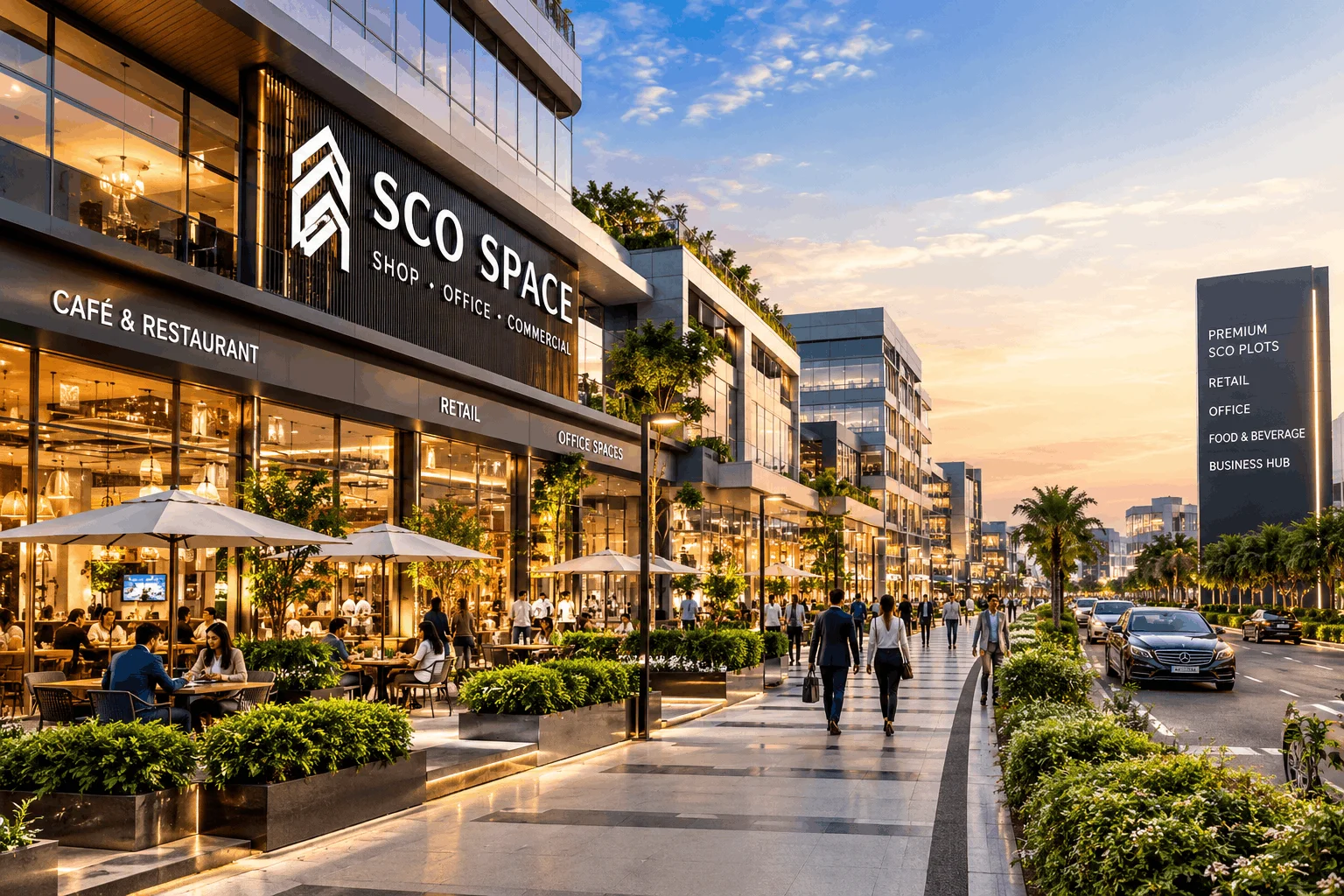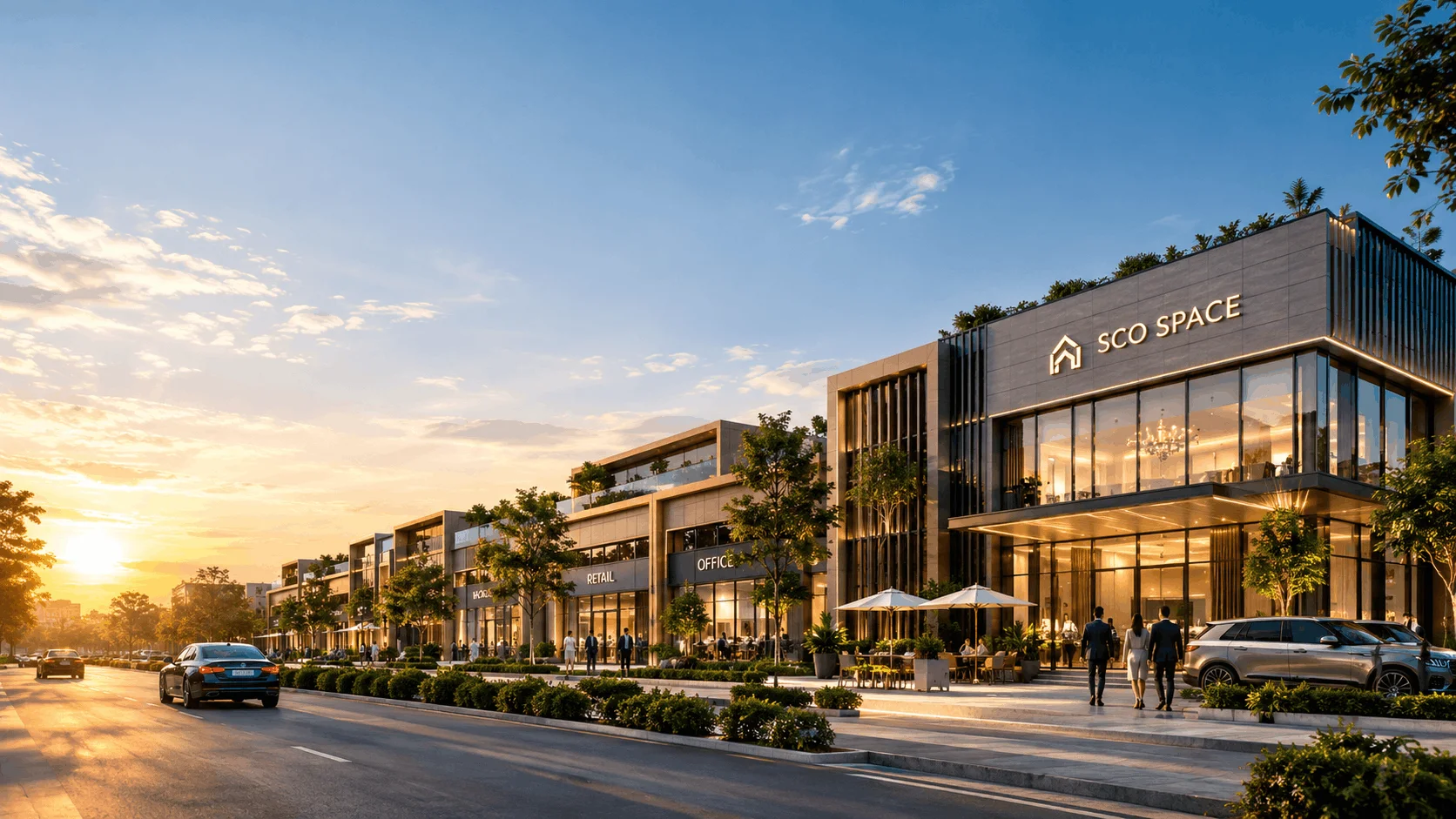
SCO Plots in Gurgaon A Buyer's Guide to Price Drivers, Plot Sizes and Locations
The Big Picture
SCO plots, short for Shop Cum Office plots, are commercial plots in Haryana's planned sectors. They are designed so that a business can combine retail or showroom space with offices in one building. Gurgaon is one of the most active commercial property markets in Delhi NCR, with corridors such as Golf Course Extension Road, Southern Peripheral Road, Dwarka Expressway and New Gurgaon drawing sustained interest from business owners and investors. This guide explains how SCO plots work, what influences their price, how plot sizes are measured and converted, how corridors compare, and what to verify before buying. It deliberately avoids quoting unverified prices or returns.
What Are SCO Plots in Gurgaon?
SCO plots in Gurgaon are commercial plots in planned sectors where a buyer can build, or buy, a Shop Cum Office unit: typically retail or showroom space on lower floors and offices above. Price depends on location, plot size, frontage, approvals and market conditions. Buyers should verify all details independently.
How SCO Plots Work in Gurgaon
What is an SCO plot?
Direct answer: An SCO plot is a commercial plot where the permitted use generally combines shop (retail) and office space within one building. Unlike a residential plot, it sits in a commercial zone of a licensed sector, and its use, floor area and building rules are governed by the approvals attached to that plot or project.
In practice, an SCO building usually places retail or showroom units at street level, where footfall and visibility matter most. Upper floors are usually used for offices, clinics, coaching centres, studios or service businesses. The exact permitted mix is not universal. It depends on the sector's zoning, the licence terms and the building regulations that apply, so buyers need to confirm it for each plot.
SCO vs other commercial formats
SCO is one of several commercial property types in Gurgaon. Understanding the differences helps buyers choose the right format for their business.
| Factor | SCO plot / unit | Retail shop in a mall | Office space in a business park | Showroom |
|---|---|---|---|---|
| Typical use | Retail plus offices | Retail only | Offices only | Display and sale of products |
| Street visibility | Often direct road frontage | Internal, mall-dependent | Usually limited | Usually high |
| Control over building | Higher for a plot; limited for a unit | Low | Low | Varies |
| Footfall source | Passing traffic and neighbourhood | Mall-generated | Employee-based | Destination or passing traffic |
| Maintenance model | Varies by development | Mall management | Park management | Varies |
This table is a general comparison. Individual developments differ, so check each one's terms.
Why the plot-versus-unit distinction matters
The phrase "SCO plot" is used loosely. Sometimes it means an actual plot on which the owner may construct. Other times it refers to a built or developer-managed SCO unit within a larger commercial development. These carry different rights, costs and risks. Buyers should confirm in writing what is being sold, including whether construction is permitted, who builds, what floors are included and how common areas are managed.
Why Gurgaon Is Important for Commercial Property
Gurgaon developed as a corporate and service hub in Delhi NCR, with large office clusters, residential townships and retail destinations. That mix creates continuous demand for local commercial space: professionals who need nearby offices, residents who need daily services, and brands that want a visible presence close to their customers.
SCO property tends to suit businesses that rely on neighbourhood demand and visible frontage: pharmacies, cafés, salons, banks, clinics, boutique retail and professional services. The Gurgaon SCO market therefore depends on how well a particular corridor's residential and working population matches the business planned. A strong corridor on paper does not guarantee that a specific plot will perform well.
Gurgaon Commercial Growth Corridors and Where SCO Developments Are Found
Several corridors are commonly associated with commercial development. Descriptions here are general; verify current development status, master-plan provisions and infrastructure timelines through official sources.
| Corridor / area | General commercial context | What buyers should verify |
|---|---|---|
| Golf Course Extension Road | Mixed residential and commercial belt connecting established and newer sectors | Frontage, nearby occupancy, competing supply |
| Southern Peripheral Road (SPR) | Major arterial road linking several sectors, including areas around Sector 67 | Access points, service roads, parking |
| Sector 67 | Planned sector in the Golf Course Extension / SPR area; includes commercial and residential developments | Specific plot location within the sector, approvals |
| Dwarka Expressway | Newer corridor connecting Gurgaon with Delhi's Dwarka side | Status of surrounding construction, completed vs planned |
| New Gurgaon | Broad term for newer sectors on the western and southern side | Population build-up, retail saturation, connectivity |
| Sohna Road | Established corridor with commercial and residential activity | Traffic conditions, competing retail |
For readers comparing locations for SCO plots on Dwarka Expressway, a useful approach is to check how much of the surrounding residential and office population actually exists today versus what is planned. Commercial space in areas still under development may take longer to reach stable occupancy.
Similarly, SCO commercial plots in New Gurgaon sectors should be evaluated against the pace of local residential occupancy. Retail space needs customers living or working nearby, not only planned future housing.
Sector 67 as an example of a planned commercial location
Sector 67 is often discussed in connection with Golf Course Extension Road and Southern Peripheral Road. Its relevance for buyers is that commercial plots in such sectors can benefit from road access and nearby residential developments. As a market example, DLF Central 67 is a commercial development in this sector; buyers interested in any specific project should obtain current details directly from the developer and verify them independently.
SCO Plot Sizes and Unit Conversions
Plot sizes in Haryana are often discussed in square yards or square metres, while commercial floor areas are quoted in square feet. This mix causes avoidable confusion, so conversions matter.
Standard conversions
- 1 sq. m. ≈ 10.7639 sq. ft.
- 1 sq. m. ≈ 1.19599 sq. yd.
- 1 sq. yd. ≈ 9 sq. ft. (approximately 0.8361 sq. m.)
Illustrative conversion table
The figures below are illustrative arithmetic only, not actual plot sizes offered in any development.
| Area in sq. m. | Approx. sq. ft. | Approx. sq. yd. |
|---|---|---|
| 50 | 538 | 59.8 |
| 100 | 1,076 | 119.6 |
| 150 | 1,615 | 179.4 |
| 200 | 2,153 | 239.2 |
Plot area vs built-up area vs carpet area
Buyers frequently compare numbers that are not equivalent:
- Plot area: the land parcel itself.
- Built-up area: the constructed floor area, which may be spread across several floors.
- Carpet area: the usable internal area, excluding walls and some common spaces.
- Super area / saleable area: the area on which a developer's price is often quoted, including a share of common areas.
When comparing offers, always convert to a consistent measure and ask exactly which area the quoted price is based on. Never assume the plot sizes of one development apply to another.
What Affects SCO Plot Prices in Gurgaon?
Direct answer: SCO plot prices in Gurgaon are influenced by location and corridor, road frontage and visibility, plot size and shape, permitted floor area, approvals and development status, surrounding population, competing commercial supply, and prevailing market conditions. Prices vary by configuration and availability, so buyers should obtain current written quotes.
Key price drivers
- Location and corridor: Proximity to major roads, residential catchments and employment clusters.
- Frontage and visibility: Corner plots or plots facing wide roads may be valued differently from inner positions.
- Plot dimensions: Very narrow or irregular plots may limit usable layouts.
- Permitted floor area and height: Determines how much space can legally be built.
- Approvals and legal clarity: Clean title and valid permissions generally support better liquidity.
- Surrounding development: Established neighbourhoods may support faster occupancy than areas still under construction.
- Competition: Nearby commercial supply influences both rent and resale options.
- Market cycle and financing conditions: Interest rates and demand can shift valuations.
A note on current prices
This guide does not quote specific prices. Commercial property prices change, and any figure quoted here could quickly become outdated or misleading. When you collect quotes:
- Ask for a dated written price sheet specifying which area the rate applies to.
- Distinguish current asking prices from historical or estimated prices you may see online.
- Check whether the price includes preferential location charges, development charges, power backup, parking, taxes and registration costs.
- Compare any quote with recent registered transactions in the same sector, where such data is accessible.
Business Suitability: Retail, Office and Mixed Use
Are SCO plots suitable for retail businesses?
Direct answer: SCO plots can suit retail businesses that depend on street visibility and neighbourhood footfall, such as convenience stores, food outlets, pharmacies and service retail. Suitability depends on the specific location, road access, parking, surrounding population and competition, so each site needs independent evaluation.
Retail performance depends heavily on the customer catchment: how many people live or work within a convenient distance, how they travel, and whether they can easily stop. A visible plot with poor parking or difficult access can underperform, while a less prominent location with strong residential demand may do well.
Are SCO plots suitable for office use?
Direct answer: SCO upper floors can suit small and mid-sized offices, clinics, consultancies and studios that value an independent address and local accessibility. They may be less suitable for businesses needing large floor plates, campus-style facilities or extensive shared amenities, which business parks typically provide.
Considerations include lift availability, parking per floor, fire-safety compliance, power backup and whether the building's mix of tenants supports the business image you want.
Business suitability checklist
| Business type | Factors to examine |
|---|---|
| Restaurants and cafés | Permitted use, ventilation, parking, evening footfall |
| Clinics and diagnostics | Accessibility, approvals for medical use, parking |
| Showrooms | Frontage width, ceiling height, loading access |
| Professional offices | Staff commute, lift and parking, building image |
| Coaching and training centres | Floor layout, safety compliance, peak-hour congestion |
Investment Analysis: What Investors Should Evaluate
SCO property is sometimes treated as an investment, but it should not be assumed to be automatically profitable. Returns depend on factors that cannot be guaranteed, and no figure for rental yield, appreciation or resale profit is promised or implied in this guide.
An investor's evaluation framework
| Factor | Questions to ask |
|---|---|
| Entry cost | What is the all-in cost, including taxes, registration and fit-out? |
| Rental potential | Are there comparable rentals nearby, and what vacancy has been typical? |
| Tenant demand | Which business types are likely tenants, and are they present in the area? |
| Holding period | How long can you hold without distress if the unit stays vacant? |
| Liquidity | How easily have comparable units resold in the same sector? |
| Exit strategy | Who is the likely next buyer: an owner-user, investor or tenant-occupier? |
| Financing | What are loan terms for commercial property, and how do they affect cash flow? |
| Competition | How much similar commercial space is planned or under construction nearby? |
Liquidity and exit considerations
Commercial property is generally less liquid than many financial assets. Selling can take time, and buyer pools may be smaller than for residential property. Units that are well located, legally clear and already leased may find buyers more easily, but this is not guaranteed. Investors should plan for the possibility of longer holding periods than expected.
Costs people often overlook
- Stamp duty and registration charges (verify current rates with official sources)
- GST or other applicable taxes on certain transactions or services
- Fit-out and interior costs
- Maintenance and common-area charges
- Property tax and utility deposits
- Brokerage, legal and documentation fees
- Costs of vacancy during tenant search
Commercial Risk Assessment
Every commercial property carries risk. For SCO plots in Gurgaon, the main categories include:
- Regulatory risk: Changes in zoning, building rules or permitted use; incomplete approvals.
- Market risk: Oversupply in a corridor, slower absorption or changes in demand.
- Vacancy risk: Prolonged periods without tenants, especially in areas still developing.
- Competition risk: New commercial supply nearby can dilute footfall and rents.
- Financing risk: Rising interest rates or limited loan availability.
- Execution risk: Delays in construction, infrastructure or surrounding development.
- Business-demand risk: Tenant or owner-business performance may change with the local economy.
Common buyer mistakes
- Relying on brochure claims instead of independent verification.
- Assuming a growth corridor automatically means high demand for a specific plot.
- Comparing prices without standardising area definitions.
- Ignoring parking and access, which strongly affect retail performance.
- Underestimating transaction and fit-out costs.
- Buying for resale without a realistic holding-period plan.
- Skipping professional legal and financial review.
Buyer Due-Diligence Checklist
Direct answer: Before buying an SCO plot, verify title and ownership documents, licence and approvals, RERA registration where applicable, plot specifications, permitted use, building regulations, payment terms, taxes and registration costs, and exit options. Independent legal, financial and tax professionals should review the documents.
Step-by-step process
- Confirm what is being sold: a plot, a built unit or a share in a developer-managed building.
- Verify title and ownership: review the chain of title and check for encumbrances or disputes.
- Check approvals: confirm licences, layout and building-plan approvals with the relevant authorities.
- Check RERA status where applicable: look up registration on the Haryana RERA portal and review declared details.
- Review plot specifications: exact dimensions, area basis, frontage and corner status.
- Confirm permitted use: ensure your intended business activity is allowed.
- Study building regulations: permitted floors, height, setbacks and parking norms.
- Assess access and parking: road width, entry points, parking provision and service access.
- Understand maintenance arrangements: who maintains common areas, and at what cost.
- Review payment terms and financing: payment schedule, penalties and loan eligibility.
- Calculate taxes and registration costs: confirm current rates through official sources.
- Obtain official documentation: allotment letters, agreements and receipts.
- Evaluate liquidity and exit options: research comparable resales and rentals.
- Seek professional verification: engage a property lawyer, chartered accountant and, where relevant, a registered valuer.
Document checklist
| Document | Purpose |
|---|---|
| Title deed / allotment letter | Establishes ownership or allotment |
| Licence and approval documents | Confirms legal development status |
| Sanctioned building plan | Confirms permitted construction |
| RERA registration details | Where the project is covered |
| Payment receipts and statements | Records of amounts paid |
| Tax and utility records | Confirms no outstanding dues |
| Agreement to sell / sale deed | Legal transfer documents |
How to Compare Gurgaon SCO Options
When comparing two or more SCO opportunities, use a consistent scorecard rather than relying on impressions.
| Comparison factor | What to check |
|---|---|
| Location and catchment | Residential and working population nearby |
| Connectivity | Road access and public transport, verified on the ground |
| Frontage and visibility | Road width, corner position, signage potential |
| Legal and approval status | Documents and registrations |
| Size and layout | Usable area, floor plates and parking |
| Total cost | Price plus taxes, fees and fit-out |
| Occupancy and rental evidence | Nearby leased units and typical tenants |
| Competing supply | Planned and under-construction commercial space |
| Exit potential | Likely future buyers |
For readers following new commercial launches, SCO plots New Gurgaon listings can be a starting point for comparison, but any launch should be evaluated using the same documentation and market checks described above.
Financing, Taxes and Transaction Costs
Commercial property loans generally differ from home loans in eligibility criteria, interest rates, loan-to-value limits and tenure. Lenders may also assess the property's legal status and the borrower's business or income profile more closely. Because terms change, obtain current offers directly from lenders.
Tax treatment of rental income, depreciation, capital gains and GST can be complex. The correct treatment depends on your circumstances, so consult a qualified tax professional rather than relying on general summaries.
Closing Remarks
The Gurgaon SCO market offers businesses and investors a flexible commercial format that combines retail and office use, supported by several established and emerging corridors. The right choice depends less on the label "SCO" and more on specific factors: location and catchment, frontage and access, approvals, total cost, competition and your own holding period.
Location analysis should look beyond planned infrastructure to actual population, occupancy and footfall. Business suitability should be tested against permitted use, parking and operations. Investment decisions should account for liquidity, vacancy and financing risk, and no return should be assumed. Finally, thorough due diligence, with professional legal, financial and tax review, is essential before committing. Readers who want to explore available options can start with SCO plots in Gurgaon and apply the checklists above to each shortlisted property.
Investment Disclaimer
This article is for general information only and is not legal, financial, tax or investment advice. Property values, rents, approvals and regulations can change, and past performance does not indicate future results. Returns, appreciation and resale value are not guaranteed. Verify all information independently with official sources and consult qualified professionals before making any purchase decision.
Frequently Asked Questions
1. What are SCO plots in Gurgaon?
SCO plots, or Shop Cum Office plots, are commercial plots in Gurgaon's planned sectors where retail space and offices can be combined in one building. Typically, shops occupy lower floors and offices sit above. The exact permitted use, floor area and building rules depend on the sector's approvals, so buyers should confirm them for each plot.
2. How do SCO plots work?
A buyer acquires either a plot on which construction is permitted or a unit within a developed SCO building. Ground-level space is usually used for retail, while upper floors are used for offices or services. The buyer's rights, maintenance duties and construction options depend on the allotment or sale terms, which should be reviewed before buying.
3. What affects SCO plot prices in Gurgaon?
Prices are shaped by corridor and location, road frontage, plot size and shape, permitted floor area, approvals, surrounding population, competing supply and market conditions. Because these vary by plot and over time, buyers should request dated written quotes and compare them against recent registered transactions in the same sector.
4. Which sectors in Gurgaon are known for SCO developments?
SCO developments are found across several Gurgaon areas, including sectors along Golf Course Extension Road, Southern Peripheral Road, Dwarka Expressway, New Gurgaon and Sohna Road. Sector 67 is one commonly discussed example. Availability changes over time, so check current listings and official approvals for any sector you are considering.
5. What should buyers verify before purchasing an SCO plot?
Buyers should verify title and ownership, licences and building approvals, RERA registration where applicable, exact plot specifications, permitted use, payment terms, taxes and registration costs, maintenance arrangements and exit options. Engaging a property lawyer and a financial or tax professional helps reduce the risk of missing legal or financial issues.
6. Are SCO plots suitable for retail businesses?
They can be, particularly for businesses that benefit from road visibility and neighbourhood footfall, such as pharmacies, cafés and service retail. Suitability depends on the specific location, parking, access, surrounding population and competition. Visiting the site at different times of day helps gauge real footfall before deciding.
7. Are SCO plots suitable for office use?
Upper SCO floors can suit small to mid-sized offices, clinics and consultancies that want an independent address. They may be less suitable for large organisations needing big floor plates or shared amenities. Check lift access, parking, power backup, fire-safety compliance and permitted use before choosing a unit for office purposes.
8. What factors should investors compare before buying SCO property?
Investors should compare total entry cost, rental evidence, likely tenant types, vacancy risk, liquidity, financing terms, competing supply, holding period and exit strategy. Legal clarity and location catchment also matter. No return is guaranteed, so scenarios should include delayed leasing and longer holding periods.
9. How do I convert SCO plot sizes between square metres, square feet and square yards?
Use these approximate conversions: 1 sq. m. ≈ 10.7639 sq. ft., and 1 sq. m. ≈ 1.19599 sq. yd. For example, 100 sq. m. is roughly 1,076 sq. ft. or about 119.6 sq. yd. Always confirm whether a quoted area is plot, built-up, carpet or saleable area.
10. Are SCO plots a good investment?
There is no universal answer. Outcomes depend on the specific location, price paid, legal status, tenant demand, financing costs, vacancy and market conditions at the time of sale. SCO property can carry liquidity and vacancy risk, so investors should evaluate each opportunity individually and seek professional advice rather than assume returns.