SCO Plots Gurgaon Price Drivers, Location Factors and Buyer Due Diligence
An Overview of the Topic
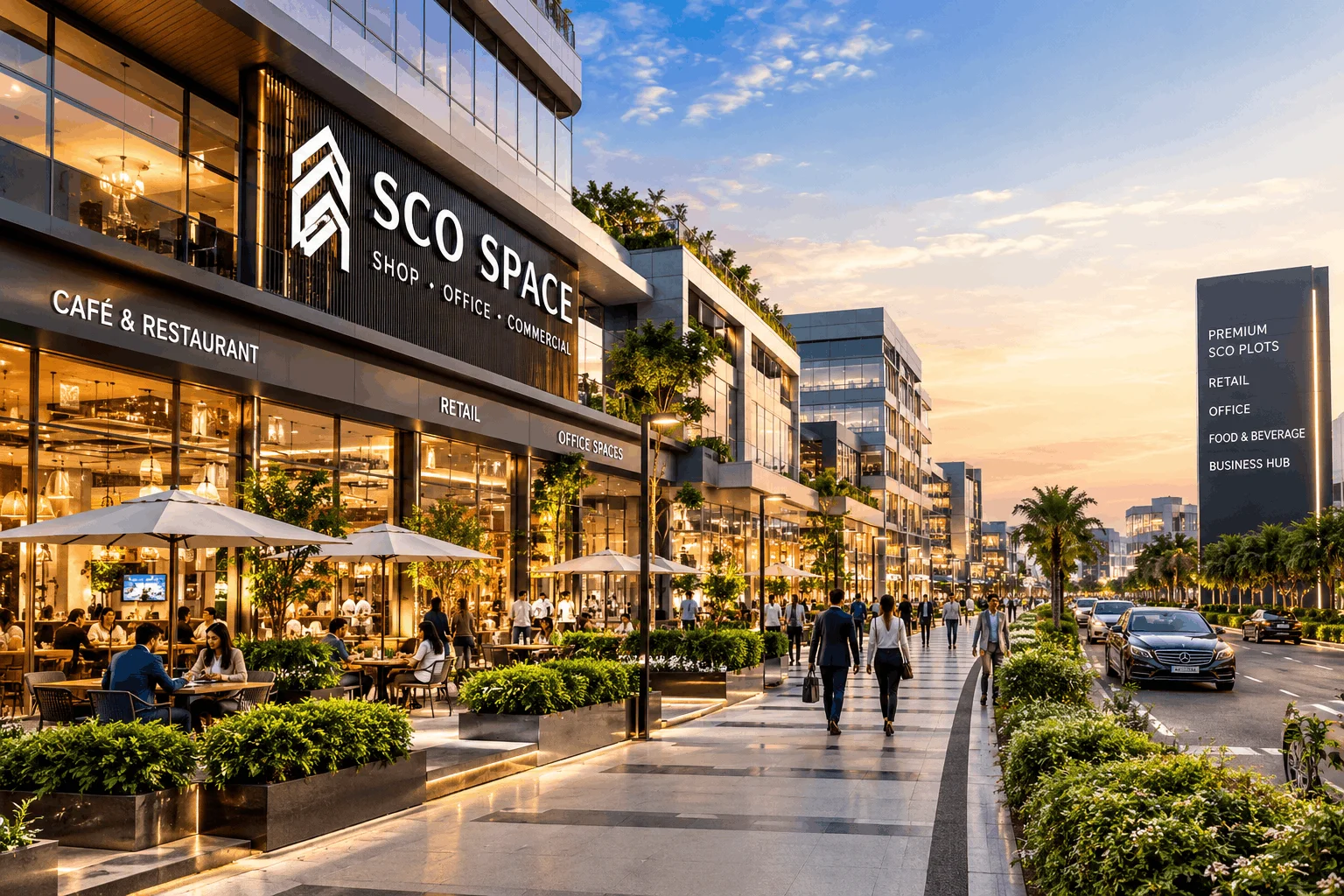
SCO stands for Shop Cum Office. An SCO plot is a small commercial plot where the ground and lower floors typically serve retail and the upper floors serve offices or services. Gurgaon is one of Delhi NCR’s most active commercial markets. Corporate offices, residential sectors, expressways and retail demand sit close together. That mix keeps buyers interested in SCO property.
Interest alone does not make a sound purchase. Prices, approvals, permitted use and location quality differ widely from one sector to the next. This guide explains how SCO plots work, which factors shape their pricing, how Gurgaon’s commercial corridors compare and what to verify before committing money. It does not recommend any specific project.
What Are SCO Plots in Gurgaon?
SCO plots in Gurgaon are commercial plots meant for mixed retail-and-office buildings. Buyers typically develop or occupy them as shops, showrooms, clinics, offices or service outlets. Price depends on location, plot size, frontage, approvals and market conditions. Buyers should verify title, permitted use, licence and RERA status where applicable before purchasing.
Three points help in a first evaluation:
- An SCO is a commercial asset, so the business logic matters more than the label.
- Corridor, frontage and catchment usually matter more than the headline price.
- Prices, rentals and timelines change. Any figure you see should carry a date and an official source.
How Do SCO Plots Work in Gurgaon?
SCO plots are commercial plots in planned sectors where the permitted building form usually combines shops on lower floors with offices above. The exact rules, such as coverage, height and permitted activities, depend on the sector plan, licence terms and applicable building regulations.
The Shop Cum Office concept
The idea is simple. Street-facing floors suit businesses that depend on walk-in customers. Upper floors suit businesses that need a professional address but not heavy footfall, such as consultancies, clinics, studios and back offices. This split lets one building serve more than one kind of demand.
Plot versus built unit
Buyers meet the term in two forms:
- A plot, where the owner constructs or completes the building within the approved parameters.
- A built or partly built unit, where a developer delivers the structure and the buyer takes a floor or unit.
The two carry different risks. Plot ownership brings construction cost, approval and timeline responsibility. Built units shift some of that to the developer but add developer and delivery risk.
Why configuration matters
Frontage, corner positioning, road width, parking and access shape how usable a commercial plot is. Two plots of identical size can perform very differently if one has better visibility and easier entry.
Why Gurgaon Is a Significant Commercial Property Market
Gurgaon built its commercial identity around corporate employment, a large residential population and strong road links to Delhi and the rest of NCR. That combination creates several layers of demand for commercial space:
- Daily-needs retail serving nearby residents
- Food, beverage and services serving office workers
- Professional offices and clinics
- Showrooms and brand outlets along major roads
These demand drivers are structural, but they are not uniform. A sector with mostly built-up housing and established roads behaves differently from one still filling in. Competition, vacancy and the pace of residential occupancy decide whether a given commercial location performs.
Gurgaon’s Commercial Growth Corridors
Buyers often group Gurgaon’s commercial areas into corridors. Each tends to attract a different business mix.
| Corridor | General character | Factors to evaluate |
|---|---|---|
| Golf Course Road and Golf Course Extension Road | Established premium residential and office belt | Competition, rental levels, availability of plots |
| Southern Peripheral Road (SPR) | Link between several Gurgaon sectors and major roads | Frontage, traffic flow, surrounding occupancy |
| Dwarka Expressway belt | Newer corridor connecting Gurgaon with Delhi’s side of NCR | Infrastructure status, residential occupancy, project delivery |
| New Gurgaon | Developing residential and commercial sectors | Pace of population growth, retail saturation |
| Older city areas | Mature markets with established customer bases | Plot availability, congestion, parking |
This table is a general framework, not a ranking. Corridor characteristics shift as roads open, housing fills up and new supply arrives. Check current conditions on the ground, and confirm infrastructure timelines with the relevant authorities.
Where Sector 67 fits
Sector 67 is often discussed in connection with the Southern Peripheral Road and Golf Course Extension Road areas. Buyers researching it should confirm exact connectivity, distances and travel times themselves, using maps and site visits. Commercial activity there is also still developing. A SCO Plots In Gurgaon search will surface many options, but each location has its own surroundings and its own maturity.
What Affects SCO Plot Prices in Gurgaon?
SCO plot prices in Gurgaon depend on location and corridor, plot size, frontage and road width, approvals and licence status, surrounding development, available supply and overall market conditions. Prices may vary significantly even within the same sector, so buyers should compare dated, verified figures.
Main price drivers
- Location and corridor: Main-road exposure and proximity to residential or office catchments usually command higher prices.
- Plot size and shape: Larger plots allow more built-up area, but the cost per unit area may differ.
- Frontage and road width: More frontage generally improves visibility and access.
- Corner or facing position: Corner plots can offer two-sided exposure.
- Development status: Established sectors price differently from those still being built.
- Approvals and legal clarity: A clean title and valid approvals reduce risk and can support value.
- Market cycle: Demand, interest rates and supply influence pricing at any given time.
Treat every price as dated information
Prices change. A figure from an old listing, a broker or a blog may not reflect today’s market. When you compare prices, ask for the date, the source and what the figure includes. Does it cover development charges, maintenance deposits, taxes or parking? This guide does not quote prices, because any number printed here could be outdated by the time you read it. Confirm current rates directly with the seller or developer, and cross-check them against recent registered transactions.
Plot Sizes and Unit Conversions
Plot sizes appear in square metres, square feet and square yards, and mixing them causes errors. These conversions are standard:
| Unit | Equivalent |
|---|---|
| 1 sq. m. | ≈ 10.7639 sq. ft. |
| 1 sq. m. | ≈ 1.19599 sq. yd. |
A simple worked example
A 100 sq. m. plot equals roughly 1,076 sq. ft. and about 120 sq. yd. This is only an illustration of the arithmetic. It is not a typical or available plot size. Always get the actual size, and the area basis used for pricing, from official documents.
Common size-related pitfalls
- Comparing a price per square yard with a price per square foot as if they were the same
- Confusing plot area with permissible built-up area
- Ignoring whether the quoted area is carpet, built-up or super area for built units
Are SCO Plots Suitable for Retail and Office Use?
Retail suitability
SCO plots can suit retail businesses that depend on visibility and walk-in customers, such as showrooms, restaurants, pharmacies or service outlets. Suitability depends on frontage, parking, customer catchment and competition, so buyers should assess the specific location before deciding.
Questions worth asking for retail use:
- Who lives or works within a realistic walking or driving distance?
- Is the frontage visible from the main road?
- Can customers park easily and enter safely?
- How many similar businesses already operate nearby?
Office suitability
SCO plots can suit small and mid-sized offices, clinics and professional services, particularly on upper floors. Suitability depends on access, parking, building quality, nearby amenities and the permitted use under the applicable regulations.
Offices matter less on footfall and more on accessibility, staff convenience, parking and the surrounding environment. Upper floors of an SCO building often serve this purpose well, but lift access, parking provision and the ability to use the space for the intended business all need checking.
Matching business to location
A food outlet, a clinic and a consultancy have different needs. A location that suits one may be poor for another. Define the business first, then test the location against it.
How to Analyse Customer Catchment
Catchment analysis separates a good commercial location from one that only looks good on paper. A simple approach:
- Map the surroundings. Identify residential clusters, offices, schools, hospitals and transport nodes nearby.
- Check occupancy. Empty or partly occupied housing generates less footfall than a full neighbourhood.
- Review competition. Note similar businesses nearby and their visible activity.
- Visit at different times. Weekday mornings, evenings and weekends can look very different.
- Test access. Check road width, turning points, parking and pedestrian movement.
Do not rely on projected population or promised infrastructure alone. Footfall depends on how many people actually use an area, and that is easiest to judge by being there.
SCO Investment Analysis: Factors to Evaluate
Investors comparing SCO property should evaluate location and catchment, entry cost, financing, rental potential, vacancy risk, liquidity, holding period and exit strategy. No outcome is guaranteed, so assumptions should be tested and independently verified.
Economics
- Entry cost: Compare the purchase price with comparable, dated data.
- Financing: Commercial property loans can differ from residential loans in rates, eligibility and terms. Confirm with lenders.
- Transaction costs: Stamp duty, registration and other charges add to the purchase cost. Confirm the current rates and any applicable GST with a qualified adviser.
- Ongoing costs: Maintenance, property tax, insurance and any construction costs.
Income and demand
- Rental potential: Rents depend on location, space quality and tenant demand. They can change over time and are not guaranteed.
- Vacancy risk: Commercial spaces can remain empty between tenants. Plan for periods without income.
- Tenant quality: A stable, creditworthy tenant lowers risk, but is not always available.
Liquidity and exit
Commercial property is generally less liquid than many other assets. Selling may take time, and the buyer pool for a specific plot may be small. Think about your holding period and what happens if you need to exit sooner than planned.
What this analysis does not say
Nothing here implies that SCO property is automatically a good investment. Outcomes depend on the specific asset, the price paid, the location and market conditions. Anyone researching SCO Plots for Sale In Gurgaon should treat listings as a starting point and build their own comparison.
Commercial Risk Assessment
| Risk type | What it means | How to reduce exposure |
|---|---|---|
| Regulatory | Approvals, licences or permitted use may be unclear or change | Verify with official records and a lawyer |
| Market | Demand or prices may fall | Avoid over-reliance on projections |
| Vacancy | Space may stay unoccupied | Budget for gaps; assess tenant demand |
| Competition | Similar supply nearby may weaken demand | Study the surroundings before buying |
| Financing | Interest rates or loan terms may shift | Stress-test your repayments |
| Business-demand | Your business may not attract the expected customers | Test the catchment first |
| Delivery | A project may be delayed | Check development status and timelines |
Treat this table as a prompt for questions, not a verdict on any location.
Understanding Price Differences Across Gurgaon
Price comparison across sectors needs care. A lower price per unit area does not make a plot a bargain. It may reflect weaker frontage, lower footfall or less developed surroundings. A higher price may reflect a stronger location, or it may simply reflect aggressive pricing.
When comparing, hold as many variables constant as you can:
- Compare plots of similar size and configuration.
- Compare on the same unit basis.
- Compare dated figures from the same period.
- Note what each price includes and excludes.
Emerging versus established sectors
Established sectors usually offer visible activity and occupied surroundings, which makes demand easier to assess. Developing sectors may offer lower entry points and room for growth, but the growth is uncertain and depends on infrastructure, housing and business arrival actually happening. Neither category is automatically better. They carry different kinds of risk.
Growth Corridors Buyers Often Compare
Several corridors regularly come up in commercial property research:
- Golf Course Extension Road and SPR: Often discussed together because they link several residential and commercial sectors.
- Dwarka Expressway: A newer corridor. Buyers researching SCO Plots On Dwarka should check current infrastructure status and how much of the surrounding housing is occupied.
- New Gurgaon: A wider term covering developing sectors. Those researching SCO Commercial Plots here should compare sector-level conditions rather than treat the whole area as uniform.
Infrastructure announcements can influence expectations, but timelines change. Verify the current status with official sources instead of relying on promotional material.
Buyer Due-Diligence Checklist for SCO Plots
Before buying an SCO plot, verify the title and ownership documents, licence and approvals, RERA status where applicable, plot specifications, permitted use, building regulations, parking and access, maintenance terms, payment terms, taxes and charges, and your exit options. Use professional legal, financial and tax advice.
Legal and documentary checks
- Title and ownership: Confirm the chain of title with a qualified property lawyer.
- Licence and approvals: Confirm that the land and project hold valid licences and approvals from the competent authority.
- RERA status: Where the project falls under RERA, check registration on the Haryana RERA portal and compare it with what the seller tells you.
- Official documentation: Request copies and verify them independently. Do not rely on summaries.
Property checks
- Plot specifications: Confirm exact size, dimensions and boundaries.
- Permitted usage: Confirm which activities the plot may be used for.
- Building regulations: Understand permitted height, coverage and floor-area limits.
- Parking and access: Confirm provisions for parking and road access.
- Development status: Check whether roads, utilities and surrounding infrastructure are actually in place.
Financial checks
- Payment terms: Understand the schedule and what happens on delay or cancellation.
- Financing: Confirm loan eligibility and terms before committing.
- Taxes and registration: Confirm stamp duty, registration charges and any applicable GST.
- Maintenance: Understand maintenance charges and who pays them.
- Availability: Confirm the plot or unit is actually available, in writing.
Exit planning
- Liquidity: Consider how easily you could resell.
- Transfer terms: Check for restrictions or charges on transfer.
Common Mistakes SCO Buyers Make
- Treating a label as proof. “SCO” describes a type of plot, not its quality or legal standing.
- Relying on projected returns. Rental and appreciation figures from sellers are assumptions, not guarantees.
- Ignoring the catchment. A visible location with little real footfall can disappoint.
- Skipping legal verification. Unverified documents are among the most costly errors.
- Comparing prices without context. Different units, dates or inclusions make comparisons misleading.
- Overlooking total cost. Taxes, financing and construction can change the economics significantly.
- Underestimating vacancy. Commercial space can stay empty longer than planned.
- Buying on urgency. Pressure to decide quickly is a reason to slow down.
Reading Project Information Critically
Individual developments show how SCO plots are offered in practice. For example, DLF Central 67 is one project buyers encounter when researching this part of Gurgaon. Treat any such project page as one source among several. Compare its claims about price, approvals, size and timelines with official records, and weigh them against other options.
Making an Informed Decision
SCO plots in Gurgaon combine retail and office use in one commercial format, and they sit within a market shaped by corporate employment, residential growth and road connectivity. That does not make every plot a sound purchase. Location, frontage, catchment, approvals and pricing differ widely, and the right choice depends on your business or investment goals.
Corridors such as Golf Course Extension Road, Southern Peripheral Road, Dwarka Expressway and New Gurgaon offer different mixes of maturity, competition and uncertainty. Business suitability depends on whether the surrounding population and traffic match what you plan to do. Investment outcomes depend on entry cost, financing, vacancy, liquidity and your holding period, and none of these can be guaranteed.
The most reliable protection is verification. Confirm title, licences, RERA status where applicable, permitted use, taxes and payment terms through official records and qualified professionals. Compare dated, comparable information, visit the location at different times, and make the decision on evidence.
Investment Disclaimer
This article is for general information only. It is not legal, financial, tax or investment advice. Property prices, rentals and returns are not guaranteed and may change. Regulations, infrastructure timelines and market conditions also change. Verify all information independently with official sources and consult qualified legal, financial and tax professionals before making any property decision.
Frequently Asked Questions
1. What are SCO plots in Gurgaon?
SCO stands for Shop Cum Office. These are commercial plots meant for buildings that combine shops on the lower floors with offices above. Buyers use them for retail, showrooms, clinics and professional offices. Permitted use and building rules depend on the sector plan and licence terms, so buyers should verify them before purchase.
2. How do SCO plots work?
An SCO plot is developed or used within approved commercial parameters. Ground floors typically serve customer-facing businesses, and upper floors serve offices or services. Buyers may construct the building themselves or purchase built units from a developer. Each route carries different cost, approval and delivery responsibilities that should be understood in advance.
3. What affects SCO plot prices in Gurgaon?
Prices depend on location and corridor, plot size, frontage, road width, corner positioning, approvals, surrounding development and market conditions. Prices can vary within the same sector. Because they change over time, buyers should compare dated, verified figures and confirm what each price includes before drawing conclusions.
4. Which sectors in Gurgaon are known for SCO developments?
SCO developments appear across several parts of Gurgaon, including areas along Golf Course Extension Road, Southern Peripheral Road, Dwarka Expressway and New Gurgaon. Availability and character differ by sector and change over time. Buyers should check current sector plans and on-ground conditions rather than rely on general reputation.
5. What should buyers verify before purchasing an SCO plot?
Buyers should verify title and ownership, licences and approvals, RERA status where applicable, plot specifications, permitted use, building regulations, parking and access, payment terms, taxes and maintenance charges. Independent legal, financial and tax advice is recommended. Buyers should also confirm availability and documentation in writing before paying.
6. Are SCO plots suitable for retail businesses?
They can be, particularly for businesses relying on visibility and walk-in customers, such as showrooms, restaurants and service outlets. Suitability depends on frontage, parking, customer catchment and competition nearby. A retail owner should test footfall at different times and check that the permitted use covers the intended business.
7. Are SCO plots suitable for office use?
They can suit small and mid-sized offices, clinics and professional services, especially on upper floors. Buyers should check access, lift provision, parking, nearby amenities and permitted use. Offices depend less on footfall and more on convenience for staff and clients, so practical accessibility deserves close attention.
8. What factors should investors compare before buying SCO property?
Investors may compare location and catchment, entry cost, financing terms, taxes and transaction costs, rental potential, vacancy risk, liquidity, holding period and exit options. Returns are not guaranteed. A sound comparison uses dated, verified data and stress-tests assumptions such as vacancy and interest rates.
9. How do I convert plot sizes between square metres, feet and yards?
One square metre is approximately 10.7639 square feet and approximately 1.19599 square yards. Multiply the area in square metres by these factors to convert. Always confirm the plot area and the unit basis used for pricing from official documents, since mixing units is a common source of confusion.
10. Are SCO plots a good investment?
It depends on the specific plot, the price paid, the location, financing and market conditions. SCO property carries risks including vacancy, competition, regulatory and liquidity risk, and returns are not guaranteed. Investors should evaluate each factor independently and take professional advice rather than assume any plot is automatically a good investment.